The Thread That Refuses to Hide
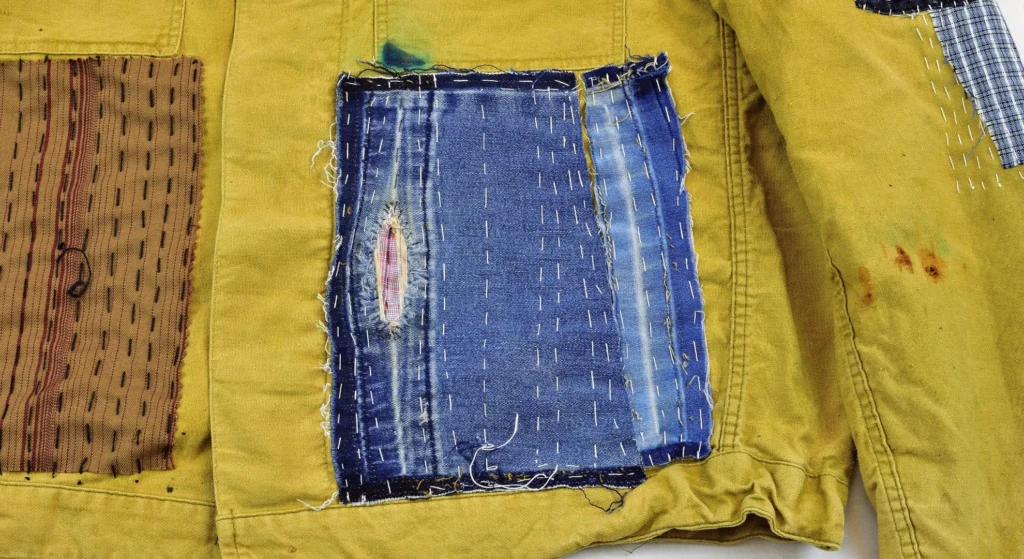
In most cultures, when clothing tears, the goal of repair is invisibility—mend it so no one can tell it was ever broken. In Japan, there is a textile tradition that takes the opposite approach. It makes the mending not only visible but beautiful.
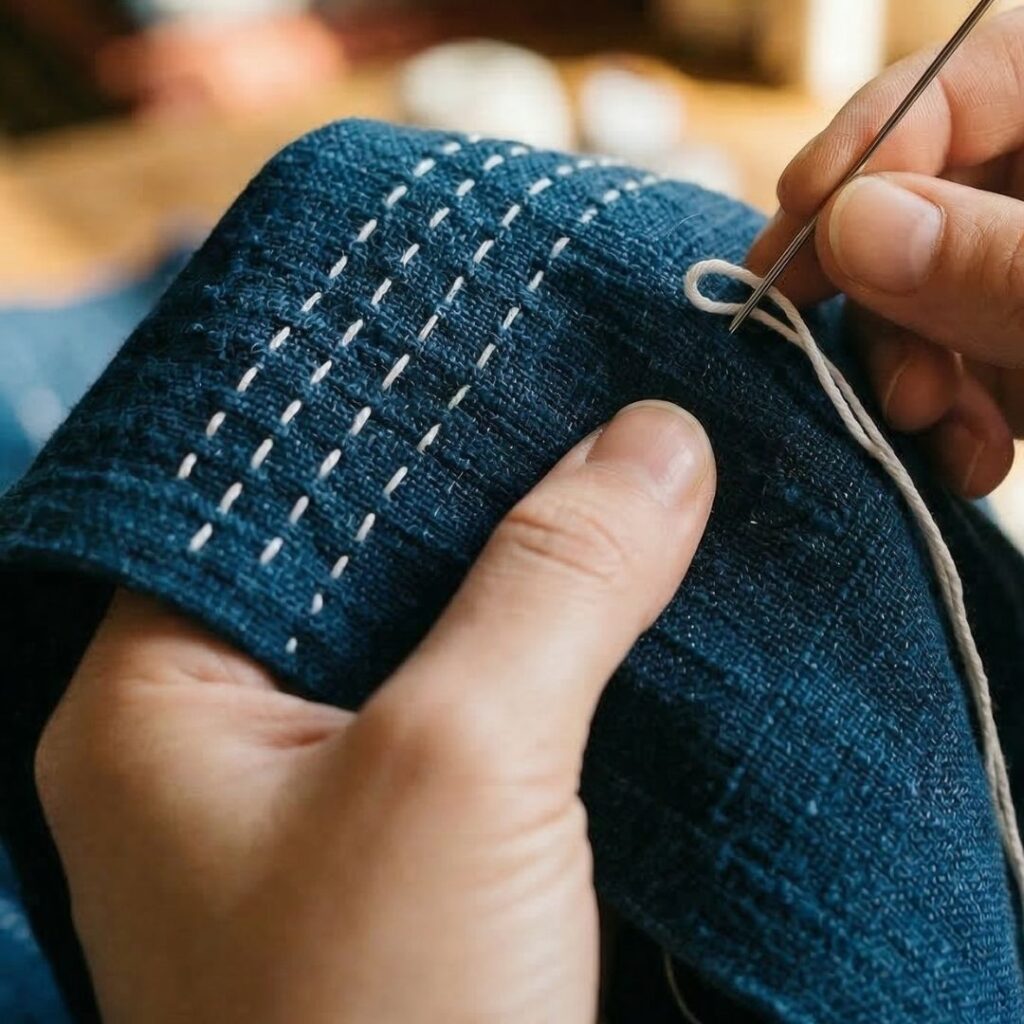
Sashiko (刺し子) is the Japanese art of decorative reinforcement stitching. The name means “little stabs” or “little piercings”—a humble description for a practice that has evolved from rural necessity into one of the most expressive and meditative textile arts in the world. Using simple running stitches in white thread on indigo fabric, sashiko transforms wear and damage into geometric patterns of striking beauty.
The philosophy behind sashiko is inseparable from wabi-sabi (侘び寂び)—the Japanese aesthetic of finding beauty in imperfection, impermanence, and the evidence of time passing. A sashiko-mended garment does not pretend to be new. It announces its history. The patches, the stitching, the visible signs of repair become part of the fabric’s character—proof that something was valued enough to be restored rather than discarded.
Comprehensive guide: Wabi Sabi : The Japanese Philosophy of Finding Beauty in Imperfection
In an era of disposable fashion and planned obsolescence, sashiko offers something radical: the idea that repair is not a concession but an art form, and that the things we fix become more interesting—more ours—than the things we replace.
From Farmer’s Necessity to Living Art
Origins: Warmth and Survival
Sashiko originated in rural northern Japan during the Edo period (1603–1868), born not from aesthetics but from poverty. In the farming communities of Tōhoku and Hokkaidō, cotton was scarce and expensive. Families could not afford to discard worn clothing. Instead, women layered scraps of fabric together and stitched them with dense running stitches to create stronger, warmer textiles from materials that would otherwise be waste.
These early sashiko garments were purely functional—the stitching reinforced weak areas at elbows and knees, joined multiple layers for insulation, and extended the life of fabrics that might pass through three or four generations. The characteristic white-on-indigo color scheme arose from circumstance: indigo (ai, 藍) was the only dye affordable to the working class, and undyed cotton thread was the cheapest available.
The Emergence of Pattern
Necessity produced function, but human nature produced beauty. Over generations, the reinforcement stitching evolved from random rows into deliberate geometric patterns. Women developed and shared designs—handed down within families and communities—that turned labor into art without ever abandoning its practical purpose.
This dual nature is what makes sashiko distinctive among textile traditions. A sashiko pattern is never purely decorative. Every stitched line strengthens the fabric beneath it. The beauty and the function are inseparable—you cannot have one without the other.
Three Traditions
Sashiko developed into three regional styles, each with a distinct character:
Moyōzashi (模様刺し) — Pattern Stitching. The most widely known style, using running stitches to create all-over geometric patterns on a single layer of fabric. This is the style most people picture when they think of sashiko—repeating grids of stars, waves, or interlocking shapes covering an entire surface.
Hitomezashi (一目刺し) — Single-Stitch Patterns. A technique where each stitch is exactly one fabric thread in length, creating intricate patterns from the accumulated effect of thousands of tiny, uniform stitches. Hitomezashi patterns emerge almost magically from simple rules—stitch one, skip one—repeated across rows with specific offsets.
Kogin-zashi (こぎん刺し) — Tsugaru Embroidery. Originating in the Tsugaru region of Aomori Prefecture, kogin-zashi uses counted-thread stitching on coarsely woven fabric to create dense, diamond-shaped motifs. Originally used to strengthen hemp garments, kogin-zashi produces a distinctively textured surface that is both warm and visually complex.
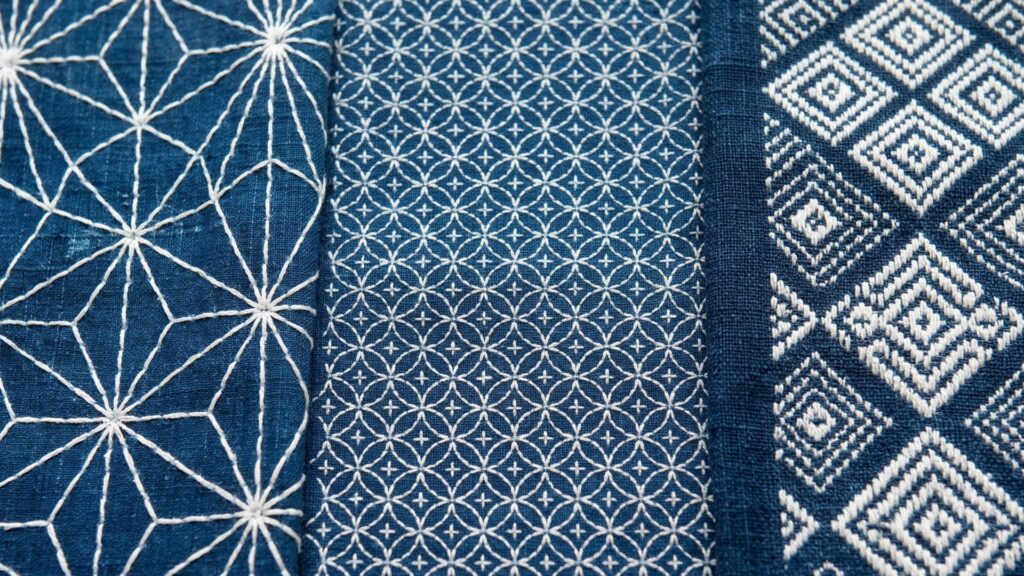
Moyōzashi (left): The iconic pattern stitching seen here in the star-like Asanoha (hemp leaf) design. It uses rhythmic running stitches to create sweeping, all-over geometric patterns.
Hitomezashi (center): Represented by the dense, interlocking circles in the center. Here, the “one-stitch” technique creates intricate patterns that emerge magically from thousands of tiny, uniform stitches.
Kogin-zashi (right): The textured diamond motifs on the right. Originating in Aomori, this counted-thread technique was traditionally used to strengthen and warm coarse hemp garments, creating a uniquely complex surface.
Which style speaks to you most?
Sashiko Patterns and Their Meanings
The geometric patterns of sashiko are not arbitrary decorations. Each traditional design carries cultural meaning—wishes for protection, prosperity, growth, or resilience stitched into the fabric as both art and intention. Understanding these meanings transforms sashiko from needlework into a form of visual language.
Asanoha (麻の葉) — Hemp Leaf
A six-pointed star pattern based on the leaf of the hemp plant, which grows quickly and straight. Asanoha is traditionally stitched onto babies’ clothing and children’s garments as a wish for healthy, vigorous growth. It is one of the most recognizable sashiko patterns and one of the most satisfying to stitch—its interlocking geometry creates a sense of expansion that seems to radiate outward from every point.
Seigaiha (青海波) — Blue Ocean Waves
Overlapping concentric arcs representing ocean waves, symbolizing calm seas, good fortune, and the endless continuity of the ocean. Seigaiha originated not in textile arts but in ancient Chinese court music and was adopted into Japanese decorative tradition during the Heian period. In sashiko, its flowing curves offer a welcome contrast to the angular geometry of most patterns.
Jūjitsunagi (十字つなぎ) — Linked Crosses
A grid of interlocking crosses representing connection, continuity, and community. The pattern’s strength lies in its structure—each cross supports and is supported by its neighbors, creating a fabric of mutual dependence. It is both one of the simplest sashiko patterns to stitch and one of the most symbolically powerful.
Yabane (矢羽) — Arrow Feathers
Chevron patterns representing the fletching of arrows. Because an arrow shot from a bow does not return, yabane became a traditional motif for brides’ kimonos—a wish that the daughter sent to her husband’s household would not be “returned.” In sashiko, the strong directional energy of the pattern creates a sense of forward movement and determination.
Nowaki (野分) — Autumn Grasses in Wind
Curved, windblown lines representing grasses bending in an autumn storm. Nowaki is one of the more poetic sashiko patterns—less geometric, more organic—expressing the beauty of yielding to natural force rather than resisting it. There is a Zen quality to its philosophy: strength through flexibility, beauty through surrender.
Comprehensive guide: a Zen quality to its philosophy
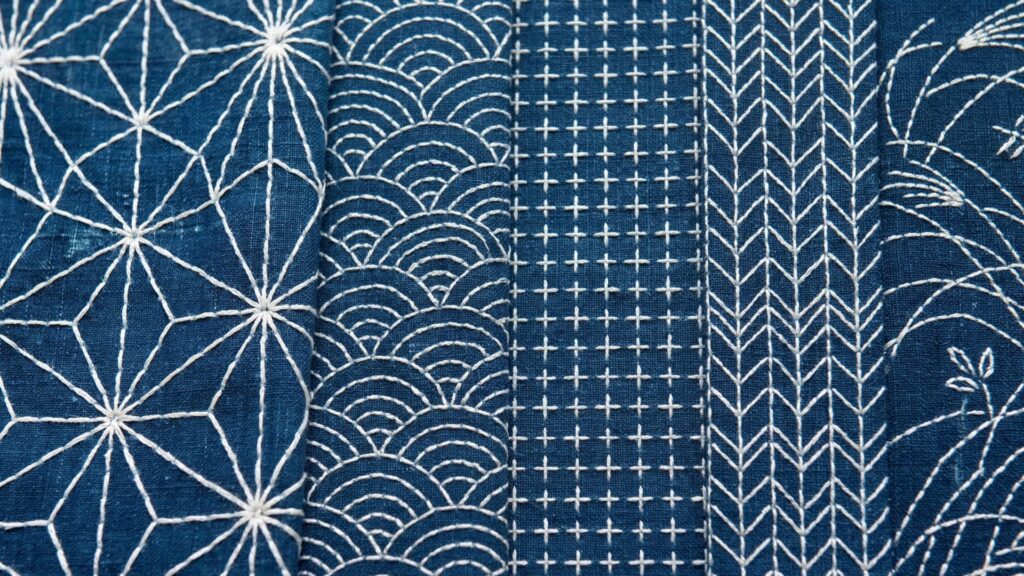
Asanoha (麻の葉) — Hemp Leaf | Seigaiha (青海波) — Blue Ocean Waves | Jūjitsunagi (十字つなぎ) — Linked Crosses | Yabane (矢羽) — Arrow Feathers
| Nowaki (野分) — Autumn Grasses in Wind
Sashiko and Kintsugi: Sister Arts of Beautiful Repair
Sashiko shares a philosophical bloodline with kintsugi (金継ぎ)—the art of repairing broken pottery with gold. Both practices reject the assumption that damage diminishes value. Both make repair visible rather than hidden. Both transform what was broken into something more interesting than what was whole.
Related guide: Kintsugi: The Art of Golden Repair and Finding Beauty in Broken Things
But there is an important difference. Kintsugi uses gold—a precious material that elevates the repair into something luxurious. Sashiko uses cotton thread—the cheapest, most ordinary material available. Where kintsugi says “this break is valuable,” sashiko says “this labor is valuable.” The beauty of sashiko comes not from expensive materials but from the accumulated evidence of time, patience, and care. Every stitch represents a moment of attention. A garment covered in sashiko stitching is a record of hours spent in quiet, repetitive, meditative work.
This is why the modern visible mending movement has embraced sashiko with such enthusiasm. In a culture increasingly uncomfortable with waste and disposability, sashiko offers a philosophy of repair that is both environmentally responsible and aesthetically compelling. It proves that the most sustainable choice—fixing what you have rather than buying something new—can also be the most beautiful.
Getting Started: Your First Sashiko Project
What You Need
Sashiko requires remarkably few materials, and none of them are expensive.
Thread. Sashiko thread is thicker than standard embroidery floss, with a matte texture and slight twist that gives the characteristic stitch appearance. White on indigo is traditional, but any color combination works.
Needles. Sashiko needles (sashiko-bari) are longer than standard sewing needles—typically 5–7 cm—allowing you to load multiple stitches before pulling the thread through. This “scooping” technique is essential to the rhythm of sashiko.
Fabric. Traditional sashiko uses tightly woven cotton in indigo. For mending projects, use whatever garment needs repair. For practice, any medium-weight cotton in a dark color will work.
Thimble. A Japanese thimble (yubinuki) worn on the middle finger helps push the needle through layered fabric. A standard metal thimble works as well.
A Beginner Project: Mending Jeans with Sashiko
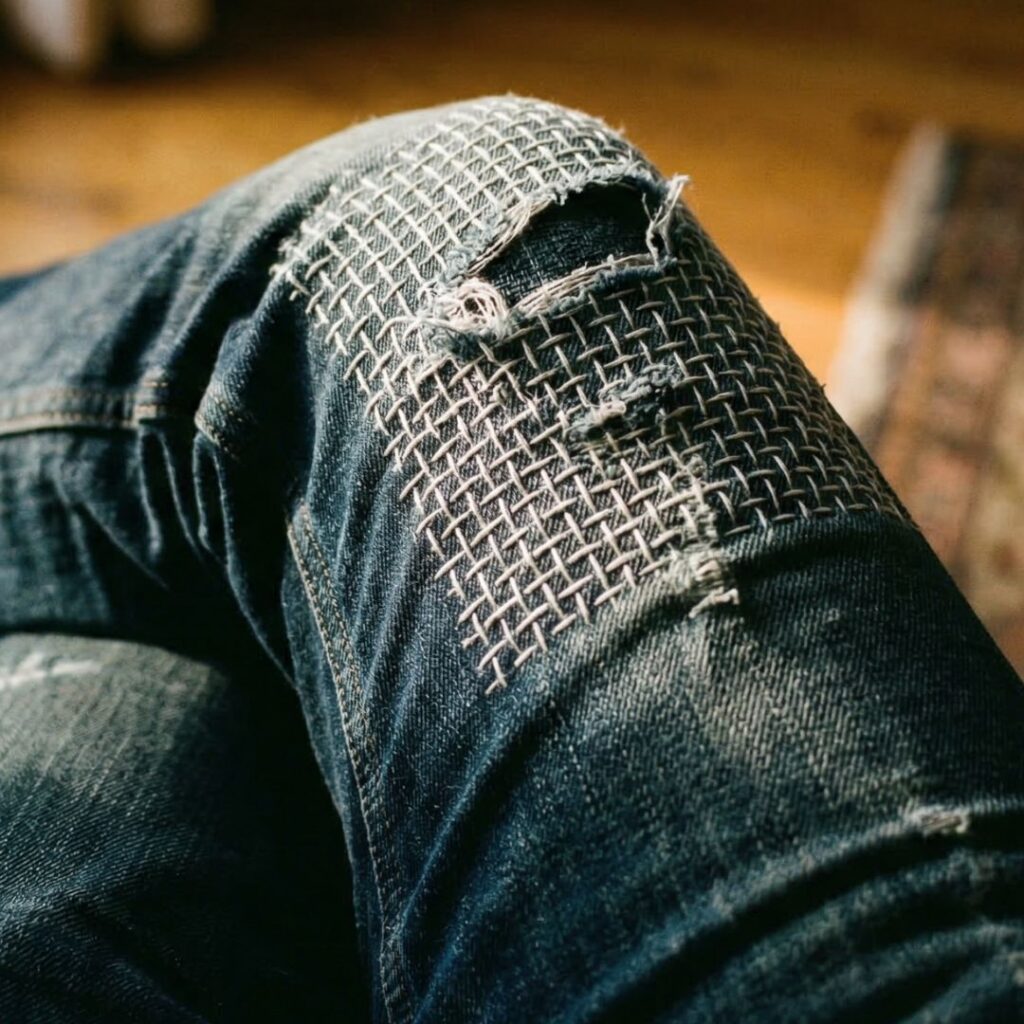
Jeans are the ideal first sashiko project. The denim is sturdy enough to hold stitches well, the indigo color is traditional, and nearly everyone has a pair with a worn knee or thinning seat that deserves a second life.
Step 1: Prepare the area. Turn the jeans inside out. Cut a patch of fabric slightly larger than the damaged area and pin or baste it behind the hole. This backing fabric becomes the foundation for your stitching.
Step 2: Choose a simple pattern. For your first project, a basic grid (jūjitsunagi—linked crosses) or parallel lines (tatejima) keeps the focus on your stitch quality rather than complex geometry. Draw or trace the pattern lightly on the right side of the fabric with a water-soluble pen.
Step 3: Stitch. Thread your sashiko needle with a length approximately the span of your outstretched arms (about 60 cm). Do not knot the end—leave a 3 cm tail that you will secure later. Begin stitching along your marked lines, loading 3–4 stitches onto the needle before pulling through. Aim for stitches approximately 3–4 mm long with 2 mm gaps between them. Consistency matters more than perfection.
Step 4: Maintain rhythm. This is where sashiko becomes meditative. The repetitive motion—needle in, scoop, scoop, scoop, pull through—creates a rhythm that quiets the mind in the same way that counting breaths does in seated meditation. Do not rush. The point is not to finish but to be present with each stitch.
Comprehensive guide: How to Practice Zazen at Home
Step 5: Finish. When you reach the end of a thread or a pattern line, weave the thread back through 3–4 stitches on the wrong side to secure it. No knots. Cut the excess. Move to the next line.
Step 6: Wear it. A sashiko-mended garment is not a museum piece. Wear your jeans. Wash them. The stitching will soften and the thread will settle into the denim. Over time, the mending becomes part of the fabric’s character—indistinguishable from the garment’s original texture, yet clearly, beautifully visible.
FAQ
Q: What is sashiko?
A: Sashiko (刺し子, meaning “little stabs”) is a traditional Japanese form of decorative reinforcement stitching. It originated in rural northern Japan during the Edo period as a way to strengthen and repair worn textiles. Using simple running stitches—traditionally white thread on indigo fabric—sashiko creates geometric patterns that are both structurally functional and visually beautiful. Today it is practiced worldwide as a textile art and as a form of visible mending.
Q: What is the difference between sashiko and embroidery?
A: Standard embroidery is primarily decorative—it adds images or designs to the surface of fabric. Sashiko is simultaneously decorative and structural—the stitching reinforces the fabric, joins layers, and repairs damage while creating geometric patterns. The technique is also simpler: sashiko uses only the running stitch, while embroidery employs dozens of specialized stitches. This simplicity is part of sashiko’s appeal—and part of its meditative quality.
Q: Is sashiko difficult to learn?
A: Sashiko is one of the most accessible needle arts. The only stitch required is the basic running stitch—in and out, in and out. What makes sashiko distinctive is not complexity but consistency and patience. If you can push a needle through fabric, you can do sashiko. The challenge is not skill but attention: keeping your stitches even, your spacing consistent, and your mind present. Most people produce satisfying work on their very first project.
Q: What materials do I need to start sashiko?
A: At minimum: a sashiko needle (longer than standard sewing needles, 5–7 cm), sashiko thread (thicker than embroidery floss, with a matte finish), fabric (traditional indigo cotton, or any sturdy garment you want to mend), and a water-soluble marking pen for tracing patterns. A starter kit containing all essentials typically costs $15–25. No sewing machine or special equipment is required—sashiko is done entirely by hand.
Q: What do sashiko patterns mean?
A: Traditional sashiko patterns carry cultural symbolism. Asanoha (hemp leaf) represents healthy growth and is stitched onto children’s clothing. Seigaiha (blue ocean waves) symbolizes calm seas and good fortune. Yabane (arrow feathers) represents determination and forward movement. Jūjitsunagi (linked crosses) symbolizes connection and community. Understanding these meanings adds a layer of intention to the practice—you are not just stitching a pattern but expressing a wish.
Every Stitch a Presence
There is no mystical secret to sashiko. It is thread, fabric, and a needle moving in and out in a straight line. A child can learn it in minutes. A master practices it for decades.
What changes over time is not technique but attention. The experienced sashiko practitioner does not stitch faster or more precisely than the beginner. They stitch more presently—each movement unhurried, each stitch given its full weight of awareness. The garment they produce carries this quality of attention in its surface, visible to anyone who looks closely: the slight irregularity of hand stitching, the warmth of thread pulled by human fingers, the evidence that someone sat with this fabric and gave it time.
Comprehensive guide: Wabi Sabi : The Japanese Philosophy of Finding Beauty in Imperfection
In a world that values speed, uniformity, and disposability, sashiko offers a quiet counter-argument. It says that the things worth keeping are worth repairing. That repair can be more beautiful than the original. That sitting with a needle for an hour, making small stitches in a pattern your great-grandmother might have known, is not a waste of time but an investment in something that machines cannot produce and money cannot buy.
Related guide: Wabi-Sabi Interior Design: A Room-by-Room Guide to Living with Imperfection
Pick up a needle. Find something torn. Begin.