
Introduction
Imagine sitting in complete stillness, your mind as calm as a quiet pond, fully present in this exact moment. This is zazen—the heart of Zen Buddhist practice and one of the most profound meditation techniques available to us today.
Unlike many meditation methods that involve visualization, mantras, or guided imagery, zazen is beautifully simple: you just sit. Yet within this simplicity lies extraordinary depth. Zazen has been practiced for over 1,500 years by monks and laypeople alike, offering a direct path to inner peace, mental clarity, and spiritual awakening.
But here’s the challenge: simplicity doesn’t mean easy. When you first sit down to practice zazen, you might encounter restless thoughts, physical discomfort, boredom, or doubt. This is completely normal. The good news? With proper instruction and consistent practice, zazen becomes not just manageable but deeply rewarding.
This comprehensive guide will walk you through everything you need to know to establish a successful zazen practice at home. You’ll learn the precise posture, breathing techniques, how to work with your mind, common mistakes to avoid, and a practical 7-day plan to get started. Whether you’re seeking stress relief, spiritual growth, or simply curious about this ancient practice, you’ll find everything you need right here.
Let’s begin your journey into the profound stillness of zazen.
What Is Zazen? Understanding the Foundation
Zazen (座禅) literally means “seated meditation” in Japanese—”za” (座) meaning “sitting” and “zen” (禅) meaning “meditation” or “absorption.” But zazen is more than just sitting quietly; it’s the primary practice through which Zen practitioners realize their true nature.
The Two Main Approaches to Zazen
There are two principal schools of Zen Buddhism, each with a slightly different approach to zazen:
Soto Zen – Shikantaza (Just Sitting): Founded by Dogen Zenji in 13th century Japan, Soto Zen emphasizes shikantaza, which means “nothing but precisely sitting.” In this approach, there is no object of meditation, no goal to achieve, not even the goal of enlightenment. You simply sit with full awareness, allowing thoughts to come and go without engaging with them. As Dogen taught in his masterwork, the Shobogenzo: “Zazen is not learning meditation. It is simply the dharma gate of joyful ease” (Tanahashi, 1985).
Rinzai Zen – Koan Practice: Rinzai Zen, introduced to Japan by Eisai in the 12th century, often incorporates koan study into zazen practice. Practitioners may concentrate on paradoxical questions like “What is the sound of one hand clapping?” during sitting meditation. This method aims to exhaust the conceptual mind and provoke sudden awakening (satori).
For beginners, the Soto approach of shikantaza is often more accessible and will be the primary method taught in this guide.
Why Practice Zazen?
Scientific research has documented numerous benefits of zazen and similar meditation practices:
Mental Health Benefits:
- Reduced anxiety and depression symptoms (Shapiro et al., 2008)
- Improved emotional regulation and stress resilience
- Enhanced focus and attention span (Tang et al., 2007)
- Decreased rumination and worry
Physical Health Benefits:
- Lower blood pressure and heart rate (Benson, 1975)
- Improved immune function
- Better sleep quality
- Reduced chronic pain perception
Cognitive Benefits:
- Increased gray matter density in brain regions associated with memory and emotional regulation (Hölzel et al., 2011)
- Enhanced working memory capacity
- Improved decision-making abilities
Beyond these measurable benefits, zazen practitioners often report a profound sense of peace, increased self-awareness, and a deeper connection to life itself.
Preparing Your Space for Zazen Practice
Before you begin sitting, creating an appropriate environment significantly impacts the quality of your practice.
Choosing Your Meditation Space
Quiet and Undisturbed: Select a location where you won’t be interrupted. This might be a corner of your bedroom, a spare room, or even a quiet spot in your living room. The key is consistency—using the same space regularly helps establish a practice routine.
Clean and Uncluttered: Zen aesthetics emphasize simplicity and cleanliness. Clear the area of unnecessary items. A clean, orderly space supports a clear, orderly mind.
Proper Lighting: Natural light is ideal, but if practicing early morning or evening, use soft, warm lighting. Avoid harsh fluorescent lights or complete darkness. You want to remain alert, not drowsy.
Temperature Control: The space should be comfortably cool—warm enough to avoid shivering, but cool enough to maintain alertness. Around 65-70°F (18-21°C) works well for most people.
Essential Equipment
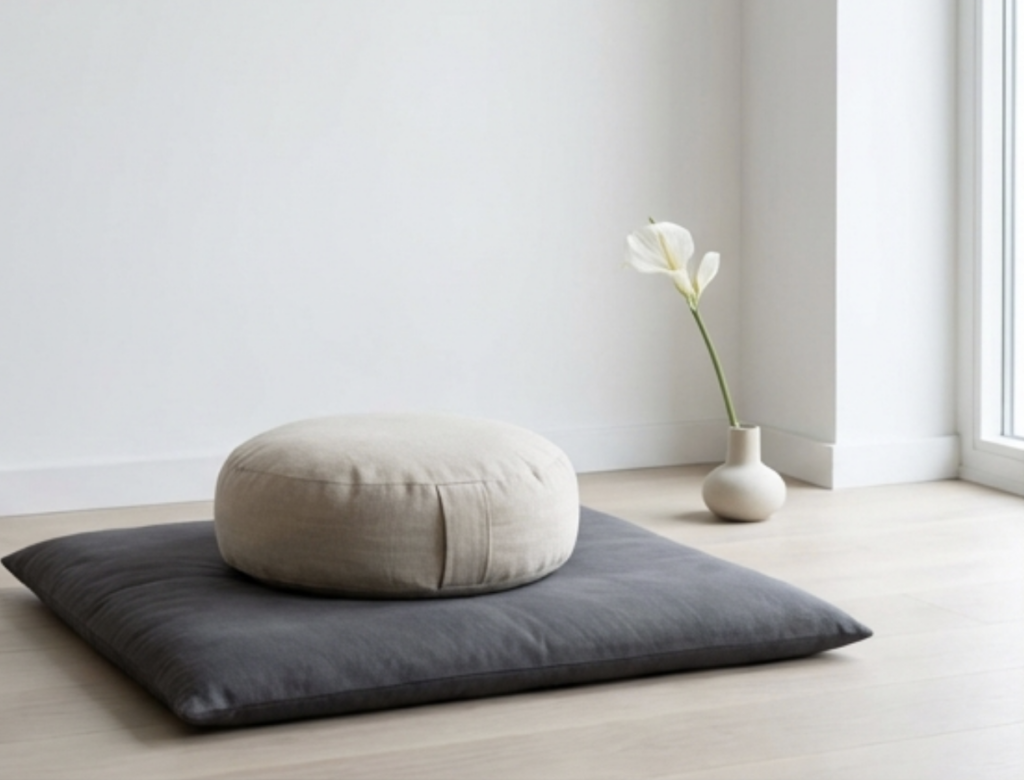
Zafu (Meditation Cushion): A zafu is a round cushion, typically 12-14 inches in diameter and 5-9 inches high when compressed. It elevates your hips above your knees, creating the proper pelvic tilt for maintaining an upright spine. You can purchase traditional zafus filled with kapok or buckwheat hulls, or use a firm pillow or folded blankets as alternatives.
Zabuton (Meditation Mat): This rectangular mat (typically 24×30 inches) cushions your knees and ankles. A yoga mat, folded blanket, or thick towel can substitute.
Chair (Alternative): If sitting on the floor is difficult due to knee problems, age, or injury, a sturdy chair is perfectly acceptable. Choose one with a flat seat and no arms. The key is maintaining an upright, dignified posture, not the specific furniture used.
Timer: A meditation timer that can be set for specific durations and has a gentle ending bell is helpful. Many smartphone apps serve this purpose (Insight Timer, Zazen Meditation Timer).
Creating a Simple Altar (Optional)
Many practitioners create a small altar as a focal point, though this is entirely optional. A simple altar might include:
- A small table or shelf at eye level when seated
- A candle (representing the light of awareness)
- Incense (optional—traditional scents include sandalwood or Japanese incense)
- A simple flower or plant
- A statue or image of the Buddha (optional)
The altar serves as a visual reminder of your intention and commitment to practice. Keep it simple and uncluttered.
The Complete Guide to Zazen Posture
Proper posture is fundamental to zazen. The body-mind connection in Zen is direct—when the body is correctly aligned, the mind more easily settles. Master Dogen wrote: “When you find your place where you are, practice occurs” (Tanahashi, 1985).
The Seven-Point Posture
Traditional zazen instruction includes seven key points:
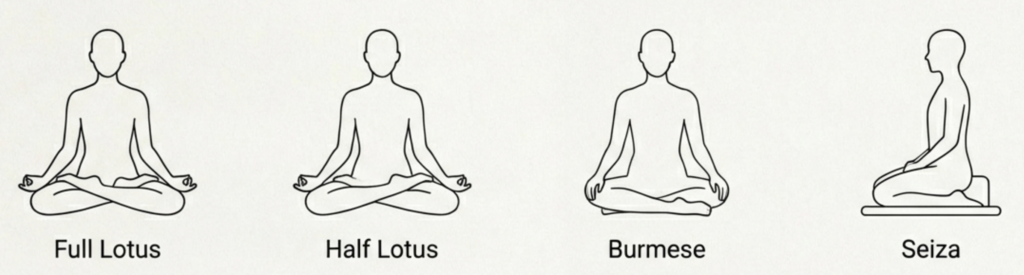
1. Leg Position
Full Lotus (Kekkafuza): The most stable position but also the most challenging. Place your right foot on your left thigh, then your left foot on your right thigh. Both knees should touch the mat, creating a three-point foundation with your sitting bones.
Half Lotus (Hankafuza): Place one foot on the opposite thigh, the other foot tucked under the opposite thigh. This is more accessible than full lotus while maintaining stability.
Burmese Position: Both feet rest flat on the mat, one in front of the other, without placing either on the thighs. This is easier on the knees while still providing a stable base.
Seiza (Kneeling): Kneel with your buttocks resting on a zafu or seiza bench placed between your heels. This removes pressure from the knees while maintaining an upright posture.
Chair Sitting: Sit on the front third of a chair, feet flat on the floor, hip-width apart. Avoid leaning against the backrest.
Important Note: Choose the position you can maintain comfortably for your sitting duration. Stability and sustainability matter more than achieving advanced positions. As your flexibility increases over months of practice, you can experiment with different positions.
Leg Position
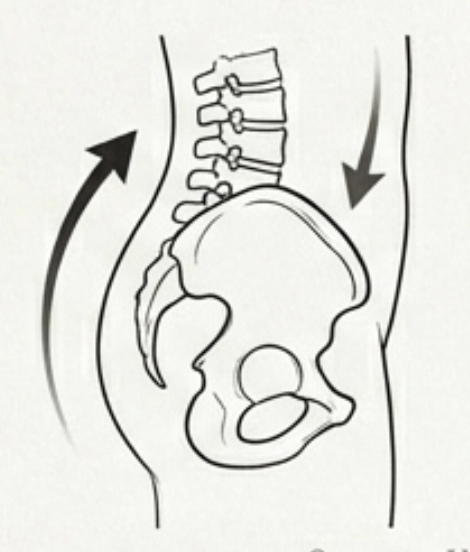
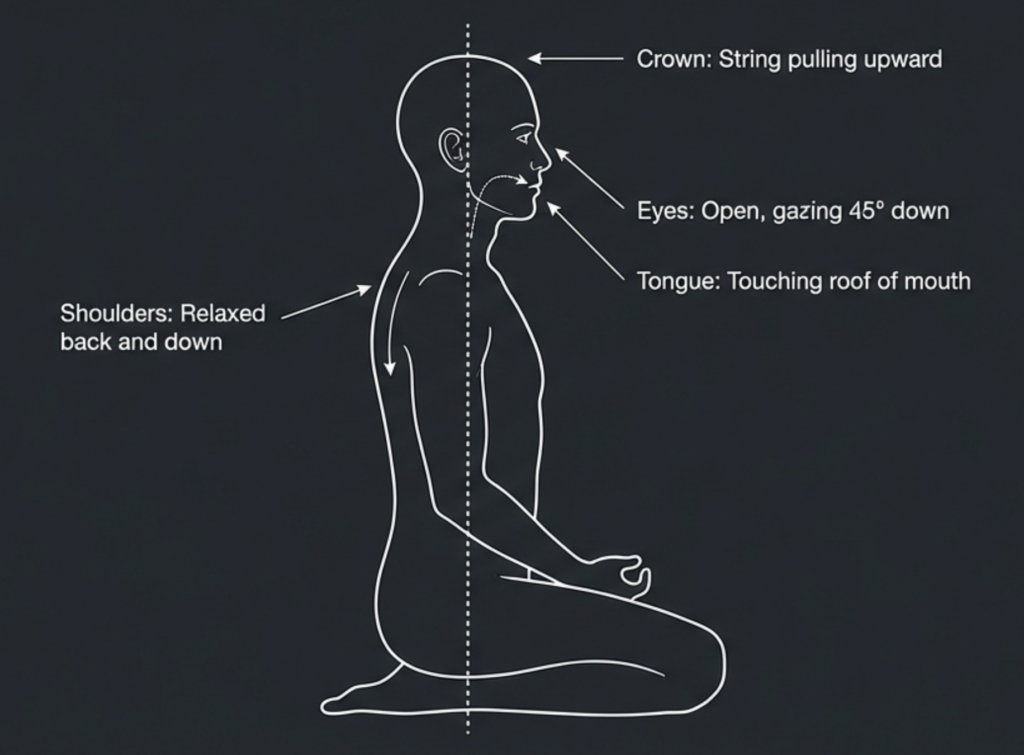
2. Pelvic Tilt and Spinal Alignment
This is perhaps the most crucial element of zazen posture:
- Rock your pelvis forward slightly, creating a natural curve in your lower back
- Your sitting bones should form the base of a triangle, with your knees the other two points
- Imagine a string attached to the crown of your head, gently pulling upward
- Your spine should have its natural S-curve—not ramrod straight, not slouched
- Your chin should be slightly tucked, elongating the back of your neck
- Your ears should be in line with your shoulders when viewed from the side
This alignment allows you to sit for extended periods without back strain while maintaining alertness.
Pelvic Tilt and Spinal Alignment
3. Hand Position (Cosmic Mudra)
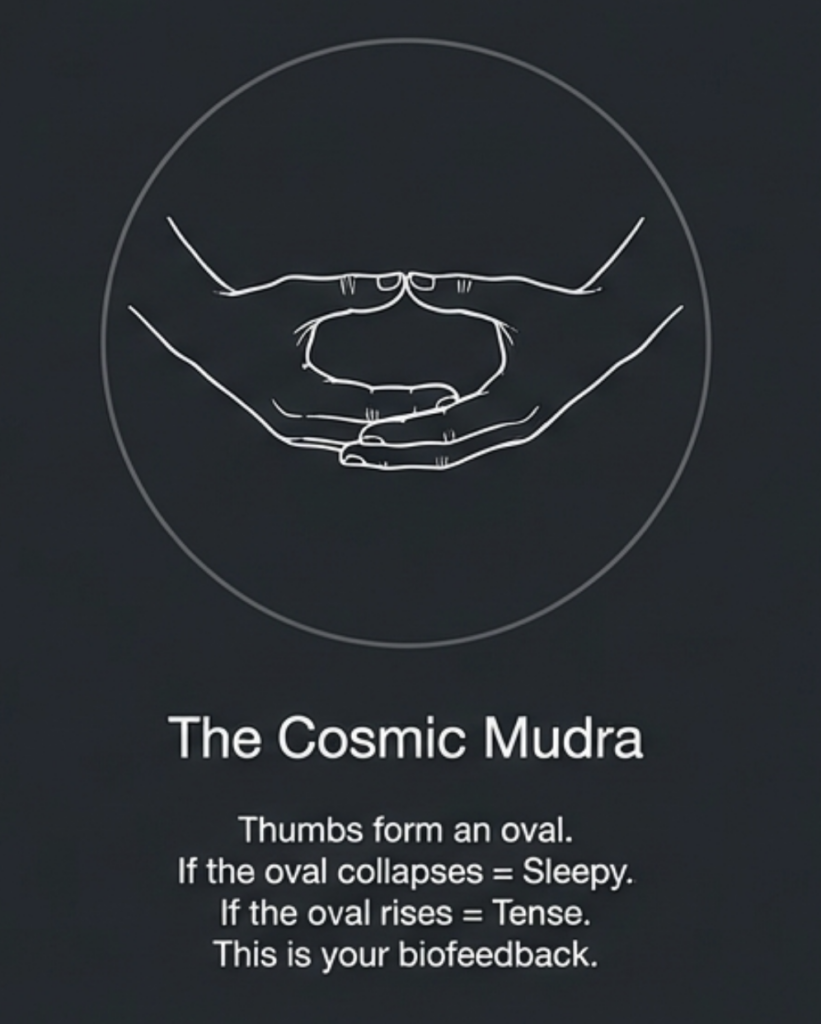
The traditional hand position in Soto Zen is called the cosmic mudra (hokkaijoin):
- Rest your hands in your lap, dominant hand palm-up underneath
- Place your non-dominant hand palm-up on top
- Touch your thumbs lightly together, forming an oval shape
- Hold this mudra about 2-3 inches below your navel
- Keep your arms relaxed, elbows slightly away from your body
- The oval formed by your thumbs should remain horizontal—if it collapses or becomes too arched, this indicates tension or sleepiness
This mudra serves as a subtle biofeedback mechanism. The position of your thumbs reflects your mental state.
Hand Position
4. Shoulder Position
- Draw your shoulders back and down slightly
- Release any tension in your shoulders and upper back
- Allow your shoulder blades to settle naturally
- Keep your chest open without puffing it out
Many people carry chronic tension in their shoulders. Take a moment before each sitting to consciously relax this area.
5. Eye Position
Unlike many meditation traditions that close the eyes, zazen is practiced with eyes slightly open:
- Lower your gaze approximately 45 degrees downward
- Rest your eyes on a spot about 2-3 feet in front of you on the floor
- Keep your eyes half-closed or slightly open—just enough to see light and shadow
- Don’t focus sharply on anything; maintain a soft, diffused gaze
- Avoid looking around or following visual stimuli
This eye position prevents drowsiness (easier with closed eyes) while avoiding visual distraction (more likely with wide-open eyes).
6. Tongue Position
- Rest the tip of your tongue against the roof of your mouth, just behind your upper front teeth
- This reduces salivation and the need to swallow during meditation
- Keep your jaw relaxed, teeth not clenched
7. Breathing
- Breathe naturally through your nose
- Don’t try to control your breath initially
- Allow breathing to settle into its natural rhythm
- The breath should originate from the belly (diaphragmatic breathing) rather than shallow chest breathing
Common Postural Mistakes to Avoid
Leaning Forward or Backward: Many beginners lean slightly forward or backward without realizing it. Have someone check your posture from the side, or practice near a mirror initially. Your torso should be vertical.
Shoulders Hunched or Tense: Regularly check in with your shoulders during sitting. If you notice tension, take a breath and consciously release it.
Head Tilting: Your head should be level, not tilted to one side. Check that your ears are level with each other.
Over-Arching the Lower Back: While you want a slight natural curve in your lower back, avoid excessive arching, which causes strain. The tilt should be subtle.
Gripping or Tension: The zazen posture should be firm yet relaxed, dignified yet comfortable. If you notice gripping or holding tension anywhere, consciously relax that area.
Breathing in Zazen: The Natural Breath
One of the most common questions beginners ask is: “What do I do with my breath?”
The Natural Breathing Method
In Soto Zen, the instruction is beautifully simple: breathe naturally. Don’t try to control your breath, slow it down, or make it deeper. Simply allow breathing to happen as it will.
Why Natural Breathing?
- Controlling the breath keeps you in your conceptual mind, the very thing zazen aims to transcend
- Natural breathing allows your breath to reflect and calm your mental state organically
- It’s sustainable for long periods without creating tension or fatigue
Belly Breathing vs. Chest Breathing
While you don’t control your breath in zazen, most people naturally shift from shallow chest breathing to deeper abdominal breathing as they relax into meditation:
Chest Breathing (Shallow):
- Common in stress and anxiety
- Shorter, more rapid breaths
- Minimal belly movement
- Associated with sympathetic nervous system activation
Belly Breathing (Diaphragmatic):
- Natural relaxed breathing
- Slower, fuller breaths
- Belly expands on inhale, contracts on exhale
- Associated with parasympathetic nervous system (rest and digest)
As you sit in zazen, your breathing will naturally deepen and slow without you trying to make this happen. Trust the process.
Counting Breaths (Susokukan) – For Beginners
If your mind is particularly scattered or if you’re just beginning zazen, counting breaths can provide a gentle anchor:
Method 1: Count to Ten
- Count “one” on the exhale
- Inhale naturally
- Count “two” on the next exhale
- Continue to “ten,” then start over
- If you lose count or pass ten, simply return to “one” without judgment
Method 2: Count Both Inhale and Exhale
- Count “one” on the inhale, “two” on the exhale
- Continue to “ten,” then start over
The counting is not a goal or achievement. It’s simply a temporary support to help settle the mind. As your practice matures, you may abandon counting naturally, simply sitting with the breath as it is.
What to Do When Your Mind Wanders
Your mind will wander—this is guaranteed and completely normal. Even experienced practitioners’ minds wander. The practice is in what you do when you notice:
- Notice that your mind has wandered (without judgment)
- Gently return attention to your breath or the present moment
- Continue sitting
That’s it. No self-criticism, no frustration. Noticing and returning is the practice. In fact, each time you notice your mind has wandered, you’re actually having a moment of awareness—this is success, not failure.
Master Shunryu Suzuki famously said: “When you are practicing zazen, do not try to stop your thinking. Let it stop by itself. If something comes into your mind, let it come in, and let it go out. It will not stay long. When you try to stop your thinking, it means you are bothered by it. Do not be bothered by anything” (Suzuki, 1970).
Related guide: the tea ceremony as moving Zen meditation
Working with Your Mind During Zazen
The relationship between awareness and thoughts is at the heart of zazen practice.
The Three Layers of Experience
1. Sensory Experience: Sounds, physical sensations, smells, tastes, the play of light against your eyelids. These arise continuously.
2. Thoughts and Emotions: Mental commentary, memories, plans, emotions, mental images. This is the “monkey mind” constantly chattering.
3. Awareness Itself: The spacious awareness that notices both sensory experience and thoughts. This is sometimes called “original mind” or “Buddha nature.”
In zazen, you’re not trying to eliminate layers 1 and 2. You’re recognizing and resting in layer 3—the awareness that witnesses everything without being caught up in it.
The Sky and Clouds Metaphor
Your awareness is like the sky—vast, open, unchanging. Thoughts and sensations are like clouds passing through. Some clouds are wispy and light (subtle thoughts), others are dark and stormy (intense emotions or thoughts). But no matter what kind of clouds pass through, the sky remains the sky, unchanged and unaffected.
In zazen, you’re learning to identify as the sky rather than the clouds. This doesn’t mean the clouds disappear—they keep coming. But you’re no longer tossed around by them.
Common Mental States and How to Work with Them
Drowsiness: If you feel sleepy during zazen:
- Check your posture—slouching promotes sleep
- Open your eyes wider
- Take a few deeper breaths
- If necessary, stand up and do walking meditation (kinhin)
- Consider practicing at a different time when you’re more alert
- Ensure you’re getting adequate sleep at night
Restlessness and Agitation: If your mind is racing or you feel physically restless:
- Don’t fight the energy—acknowledge it’s present
- Return attention to physical sensations and breathing
- Notice that even restlessness comes and goes in waves
- Consider doing some gentle stretching or walking before sitting
- You might experiment with longer sessions—sometimes restlessness peaks then subsides
Boredom: Boredom is actually quite interesting when you examine it closely:
- What exactly is the sensation of boredom?
- Where do you feel it in your body?
- Is it truly constant, or does it fluctuate?
- What thoughts accompany the feeling?
By investigating boredom rather than trying to escape it, you transform it into an object of meditation.
Strong Emotions: When strong emotions arise (anger, sadness, anxiety):
- Don’t suppress them or indulge in their stories
- Notice where you feel the emotion in your body
- Observe how it changes moment to moment
- Notice the thoughts attached to the emotion
- Return to breath and present moment awareness
- Remember: emotions are like weather—they arise, peak, and pass
Mental Proliferation: When you notice you’ve been completely lost in thought for several minutes:
- The moment of noticing is the moment of return to awareness
- Don’t judge yourself harshly—this happens to everyone
- Simply return to the present moment
- Each return strengthens your awareness muscle
The Practice of Non-Grasping
A key instruction in zazen is to neither grasp at pleasant experiences nor push away unpleasant ones. Whether you experience profound peace, boring neutrality, or uncomfortable agitation, the practice is the same: notice, don’t grasp, return to presence.
This is counter to our usual approach to life, where we spend enormous energy pursuing pleasure and avoiding pain. Zazen teaches a third way: being present with what is, as it is.
Duration and Timing: How Long Should You Sit?
Duration and Timing: How Long Should You Sit?
Week 1-2: 10-15 Minutes Daily Most beginners should start with 10-15 minute sessions. This is long enough to settle into the practice but short enough to avoid overwhelming physical discomfort or mental resistance.
Weeks 3-4: 15-20 Minutes As your body adapts and your mind becomes more familiar with the practice, gradually extend to 15-20 minutes.
Months 2-3: 20-30 Minutes Once zazen becomes a comfortable habit, 20-30 minutes becomes a sustainable daily practice for most people.
Long-Term Practice: 30-40 Minutes Traditional zazen periods are typically 30-40 minutes (one sitting period is called a “sit”). This duration allows the mind to move through initial restlessness into deeper stillness.
The Importance of Consistency Over Duration
Twenty minutes daily is far more valuable than 90 minutes once a week. Zazen is cumulative—like physical exercise, regular practice builds capacity and depth. As Master Suzuki taught: “The most important thing is remembering the most important thing” (Suzuki, 1970). Make showing up for practice your priority.
Best Times to Practice
Early Morning (Before Breakfast):
- Your mind is fresh and less cluttered
- Fewer distractions and interruptions
- Sets a calm tone for the entire day
- Traditional monastic schedule begins at 4-5 AM
Evening (Before Bed):
- Helps process the day’s experiences
- Promotes better sleep
- Creates a buffer between daily activities and rest
Midday:
- Breaks up the workday
- Resets mental energy
- Useful for stress management
Choose a time you can sustain consistently. The specific time matters less than the regularity.
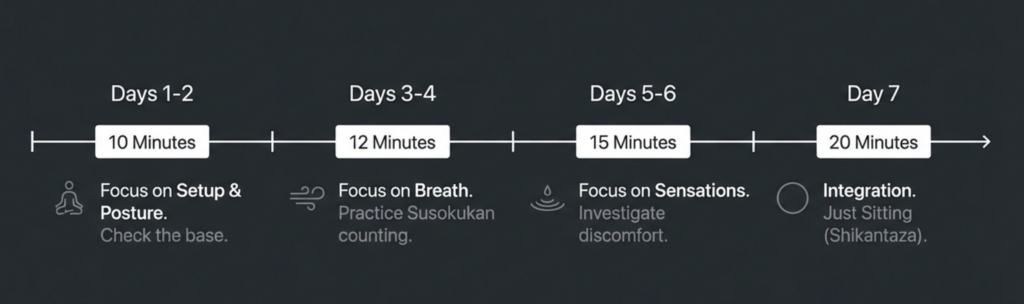
The 7-Day Beginner’s Plan
Here’s a practical plan to establish your zazen practice:
Day 1: Setup and First Sit
- Prepare your meditation space
- Set up cushion/chair
- Sit for 10 minutes using the posture guidelines
- Use breath counting if helpful
- Journal afterward: What did you notice?
Day 2: Focus on Posture
- Review the seven-point posture
- Sit for 10 minutes
- Check each postural point during your sitting
- Notice which points need most attention
Day 3: Working with Breath
- Sit for 12 minutes
- Practice natural breathing
- Notice where you feel the breath (nose, chest, belly)
- When mind wanders, return to breath sensation
Day 4: Noticing Thoughts
- Sit for 12 minutes
- Focus on the relationship between thoughts and awareness
- Practice the “sky and clouds” approach
- Don’t judge the content of thoughts—just notice them arising and passing
Day 5: Body Sensations
- Sit for 15 minutes
- Notice physical sensations: pressure, temperature, tingling
- When discomfort arises, investigate it with curiosity
- Practice staying present with minor discomfort
Day 6: Emotional Awareness
- Sit for 15 minutes
- Notice what emotions are present (calm, restless, bored, peaceful, anxious)
- Observe where emotions manifest in the body
- Practice non-grasping with whatever arises
Day 7: Integration Practice
- Sit for 15-20 minutes
- Integrate all elements: posture, breath, thoughts, sensations, emotions
- Practice “just sitting” without focusing on any particular aspect
- Afterward, reflect on the week: What changed? What challenges arose? What insights occurred?
The 7-day beginner’s roadmap
Common Challenges and How to Overcome Them
Physical Discomfort
Leg Numbness and Tingling: Numbness from reduced circulation is common, especially when beginning. Some numbness is acceptable, but sharp pain is not.
Solutions:
- Shift your position slightly
- Try a different leg position
- Use a higher cushion
- Take breaks and do walking meditation
- Build sitting capacity gradually—your body will adapt
Knee Pain: Sharp knee pain should never be ignored.
Solutions:
- Use the Burmese position or seiza bench
- Switch to chair sitting
- Consult a teacher about proper positioning
- Consider physical therapy if pain persists
Back Pain: Usually indicates postural issues or insufficient core strength.
Solutions:
- Check your pelvic tilt—it should be slight, not excessive
- Strengthen core muscles with exercises outside of meditation
- Use a higher cushion to elevate your hips more
- Consider brief chair sitting until back strength develops
Neck and Shoulder Tension: Often from unconscious holding patterns.
Solutions:
- Consciously relax shoulders every few minutes
- Gently roll shoulders backward before sitting
- Check that you’re not craning your neck forward
- Consider gentle yoga or stretching before zazen
Mental and Emotional Challenges
“I Can’t Stop Thinking”: This is the most common complaint from beginners. Remember: zazen is not about stopping thoughts.
Reframe: You’re not trying to stop thinking. You’re learning to change your relationship with thoughts—to observe them without being swept away by them.
Impatience and Frustration: Many beginners expect rapid results and become frustrated.
Reframe: Zazen is not a goal-oriented practice. The sitting itself is the point, not some future state of enlightenment. As Dogen taught, practice and enlightenment are one and the same.
Self-Judgment: “I’m doing it wrong,” “My mind is too busy,” “I’m bad at meditation.”
Reframe: These judgments are just more thoughts arising. Notice them, and let them go like any other thought. There’s no such thing as bad meditation—showing up is the practice.
Lack of Motivation: Some days you simply won’t feel like sitting.
Strategy: Commit to sitting even when unmotivated. Often, the sessions you resist most yield the deepest insights. As they say in Zen: “Before enlightenment, chop wood, carry water. After enlightenment, chop wood, carry water.” Practice doesn’t depend on feeling motivated.
Practical Challenges
Finding Time: Modern life is busy, and finding daily practice time can be difficult.
Solutions:
- Wake up 20 minutes earlier
- Use lunch breaks
- Replace social media scrolling with meditation
- Remember: you have the time for what you prioritize
Interruptions: Family members, pets, phones, doorbells.
Solutions:
- Communicate your practice time to family
- Put your phone on airplane mode
- Put a “Do Not Disturb” sign on your door
- Consider pet barriers or closed doors
- If interrupted, simply resume where you left off
Inconsistency: Missing days and struggling to maintain routine.
Solutions:
- Set a specific time and protect it
- Use reminder alarms
- Track your practice on a calendar
- Consider joining an online sangha for accountability
- Be compassionate when you miss—just begin again
Walking Meditation (Kinhin) – The Moving Practice
Kinhin is walking meditation practiced between periods of zazen in Zen monasteries. It’s an excellent complement to sitting practice and helps with circulation and focus.
How to Practice Kinhin
Basic Form:
- Stand with your hands in shashu position (left hand in a fist at your chest, right hand covering it)
- Walk very slowly, coordinating breath with steps
- Traditional pace: move about half a foot with each full breath cycle
- Keep your gaze lowered, as in zazen
- Walk in a circuit or back and forth in a straight line
- Maintain the same meditative awareness as in sitting
When to Use Kinhin:
- Between sitting periods during longer practice sessions
- When drowsiness or restlessness makes sitting difficult
- As an alternative practice when sitting is not possible
- To maintain continuity of practice while stretching the legs
Duration: Typically 5-10 minutes between sitting periods.
Deepening Your Practice: Next Steps
Finding a Teacher and Sangha
While this guide provides comprehensive instruction for home practice, connecting with a teacher and community (sangha) significantly deepens practice:
Benefits of a Teacher:
- Corrects postural and technical errors
- Provides guidance during difficult periods
- Validates insights and experiences
- Transmits teachings that can’t be found in books
Finding a Zen Center:
- Search for Soto or Rinzai Zen centers in your area
- Many offer beginner’s instruction and introductory workshops
- Look for centers affiliated with established lineages
Online Sanghas: If no local center exists, several reputable online communities offer:
- Live-streamed zazen sessions
- Video meetings with teachers
- Online courses and dharma talks
- Virtual practice groups
Examples include: Treeleaf Zendo, Village Zendo, San Francisco Zen Center online programs.
Attending a Zen Retreat (Sesshin)
A sesshin is an intensive meditation retreat, typically lasting 1-7 days, following a structured schedule with multiple zazen periods daily.
What to Expect:
- 5-8 periods of zazen daily (30-40 minutes each)
- Walking meditation between sits
- Work practice (cleaning, cooking)
- Meals eaten in meditative style (oryoki)
- Dharma talks by teachers
- Optional individual meetings with teachers
- Noble silence (no unnecessary talking)
Benefits:
- Accelerated development of concentration
- Deeper insights emerge when distractions are removed
- Experience of sustained practice
- Sangha connection
When to Attend: After establishing at least 3-6 months of regular daily home practice, consider a weekend retreat. This builds gradually to longer sesshin as your practice stabilizes.
Integrating Zazen into Daily Life
The ultimate goal is not to create a split between “practice time” and “regular life,” but to bring zazen awareness into all activities:
Informal Practice:
- Mindful eating (one meal per day eaten in silence, slowly, with full attention)
- Mindful walking (even short distances)
- Bringing full attention to routine tasks (dishwashing, showering, brushing teeth)
- Brief pauses throughout the day to check in with breath and body
The Three-Breath Practice: When you notice stress, anxiety, or mental scattering:
- Stop what you’re doing
- Take three conscious breaths
- Return to your activity with fresh presence
This builds the bridge between formal zazen and daily life.
Related guide: practice zazen at authentic Zen temples in Kyoto
Related guide: staying overnight in a Japanese temple
Frequently Asked Questions
How long until I experience benefits from zazen?
Some benefits—like feeling calmer or more centered—can occur within days or weeks. Deeper transformations typically emerge after several months of consistent practice. However, zazen is not primarily a self-improvement technique. The practice itself is the benefit, whether you notice immediate results or not.
What’s the difference between zazen and mindfulness meditation?
Mindfulness meditation often uses directed attention (focusing on breath, body sensations, sounds) as a concentration practice. Zazen, especially in the Soto tradition, involves “just sitting” without focusing on any particular object—a more expansive, objectless awareness. Both are valuable; zazen tends to be simpler in instruction but subtler in execution.
Can I practice zazen if I’m not Buddhist?
Absolutely. While zazen developed within Zen Buddhism, the practice itself is universal. Many Christians, Jews, atheists, and people from various backgrounds practice zazen. You can approach it as a spiritual practice, a mental training technique, or simply a way to be more present in your life.
Is it normal to feel worse after starting meditation?
Sometimes yes. When you sit still and become quiet, suppressed emotions and unprocessed experiences can surface. This is actually healthy—you’re becoming aware of what was already there. However, if you experience severe distress, panic attacks, or destabilization, consult a mental health professional. Meditation can be contraindicated for certain mental health conditions.
What should I do about intrusive or disturbing thoughts?
Treat all thoughts the same way—notice them, don’t engage with their content, return to present awareness. Intrusive thoughts have no more substance than any other thoughts; they just feel more compelling. If disturbing thoughts persist and cause distress outside of meditation, consider working with a therapist.
Should I meditate in the morning or evening?
Either works—choose what you’ll sustain consistently. Morning practice often feels fresher and sets a positive tone for the day. Evening practice helps process the day and promotes better sleep. Some practitioners do both—shorter sits twice daily.
How do I know if I’m making progress?
Progress in zazen is paradoxical—often those who worry about progress are too focused on goals. Look for subtle shifts: more patience in daily life, less reactivity to stress, moments of spontaneous presence, reduced mental chatter. But remember Suzuki Roshi’s wisdom: “In the beginner’s mind there are many possibilities, but in the expert’s there are few” (Suzuki, 1970). Maintain beginner’s mind.
Conclusion: Beginning the Pathless Path
You now have everything you need to establish a genuine zazen practice at home. You understand the posture, the breathing, how to work with your mind, and how to navigate common challenges. Most importantly, you have a 7-day plan to get started.
But understanding zazen intellectually is like reading a menu—it tells you about the food but doesn’t provide nourishment. The only way to truly know zazen is to practice it. Sit down, assume the posture, and experience this moment directly.
Some final encouragement from the Zen tradition:
Master Dogen wrote: “To study the Way is to study the self. To study the self is to forget the self. To forget the self is to be enlightened by all things” (Tanahashi, 1985).
This forgetting doesn’t happen through intellectual understanding but through the simple, radical act of sitting down, breathing, and being present.
Your journey begins now—not tomorrow, not after you’ve read more books or feel more prepared, but right now. Find your cushion, set your timer for just ten minutes, and take your seat.
The path is beneath your feet. Just sit.
Resources for Further Study
Essential Books:
- Zen Mind, Beginner’s Mind by Shunryu Suzuki (1970) – The classic introduction to Soto Zen practice
- The Three Pillars of Zen by Philip Kapleau (1965) – Comprehensive guide including both Soto and Rinzai approaches
- Opening the Hand of Thought by Kosho Uchiyama (1993) – Deep exploration of shikantaza practice
- Bring Me the Rhinoceros by John Tarrant (2004) – Working with koans in Rinzai Zen
Online Resources:
- Treeleaf Zendo (online Soto Zen community with daily live zazen)
- San Francisco Zen Center (talks, articles, online programs)
- Milwaukee Zen Center (excellent beginner resources)
Apps:
- Insight Timer (free meditation timer with Zen bells)
- Zazen Meditation Timer (specifically designed for Zen practice)
Finding Teachers:
- Soto Zen Buddhist Association (szba.org) – Directory of North American teachers
- American Zen Teachers Association (americanzenteachers.org)
References
Benson, H. (1975). The Relaxation Response. New York: Morrow.
Hölzel, B. K., Carmody, J., Vangel, M., Congleton, C., Yerramsetti, S. M., Gard, T., & Lazar, S. W. (2011). Mindfulness practice leads to increases in regional brain gray matter density. Psychiatry Research: Neuroimaging, 191(1), 36-43.
Kapleau, P. (1965). The Three Pillars of Zen. Boston: Beacon Press.
Shapiro, S. L., Oman, D., Thoresen, C. E., Plante, T. G., & Flinders, T. (2008). Cultivating mindfulness: Effects on well-being. Journal of Clinical Psychology, 64(7), 840-862.
Suzuki, S. (1970). Zen Mind, Beginner’s Mind. New York: Weatherhill.
Tanahashi, K. (Trans.). (1985). Moon in a Dewdrop: Writings of Zen Master Dogen. San Francisco: North Point Press.
Tang, Y. Y., Ma, Y., Wang, J., Fan, Y., Feng, S., Lu, Q., … & Posner, M. I. (2007). Short-term meditation training improves attention and self-regulation. Proceedings of the National Academy of Sciences, 104(43), 17152-17156.
Tarrant, J. (2004). Bring Me the Rhinoceros: And Other Zen Koans That Will Save Your Life. New York: Harmony Books.
Uchiyama, K. (1993). Opening the Hand of Thought: Foundations of Zen Buddhist Practice. (T. Wright & J. Okumura, Trans.). Boston: Wisdom Publications.