Furoshiki (風呂敷) is the traditional Japanese art of wrapping objects in square cloth, used for centuries to carry, protect, and present everything from gifts and groceries to clothing and bento boxes. The name literally means “bath spread”—originating in the Edo period when bathers used cloth squares to bundle their belongings at public bathhouses. Furoshiki wrapping requires no tape, glue, or disposable packaging, relying instead on folding and knotting techniques that adapt a single cloth to virtually any shape or size. As awareness of environmental sustainability grows worldwide, furoshiki has gained renewed attention as an elegant, zero-waste alternative to single-use wrapping paper and plastic bags, embodying the Japanese principle of mottainai (もったいない, “what a waste”).
The Cloth That Replaces Everything
Every December, the world produces roughly 4.6 million tons of wrapping paper. Most of it is used once—torn open in seconds, crumpled, and thrown away. The paper that took trees, water, and energy to produce becomes waste before the gift inside is even appreciated.
Japan solved this problem centuries ago—with a square of cloth.
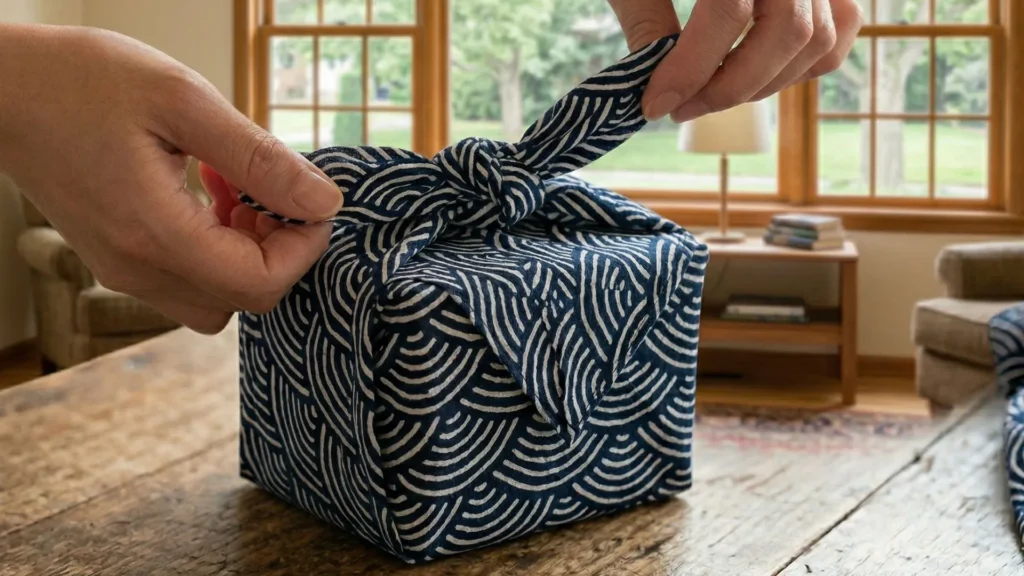
Furoshiki (風呂敷) is the Japanese practice of wrapping, carrying, and presenting objects using a single piece of fabric. No tape. No scissors. No glue. Just cloth, folded and knotted with techniques that have been refined over generations. A furoshiki cloth can wrap a book, a bottle of wine, a watermelon, a stack of clothes, or a bento box. Untied, it folds flat. Retied, it becomes a bag, a gift wrap, a table covering, or a wall decoration.
The word literally means “bath spread”—furo (風呂, bath) and shiki (敷, spread)—a reference to its origins in Japanese bathing culture. But furoshiki’s significance extends far beyond its name. It embodies a philosophy that is deeply relevant today: the belief that one well-made thing, used with care and creativity, is worth more than a hundred disposable alternatives.
This guide explores the history and philosophy of furoshiki, teaches you the essential wrapping techniques, and shows why a single square of cloth may be the most versatile object you will ever own.
From Bathhouse to Marketplace: A Brief History
Nara Period Origins (710–794)
The earliest known use of wrapping cloths in Japan dates to the Nara period, when fabric was used to protect valuable items in temple storage. These cloths—called tsutsumi (包み, “wrapping”)—were functional rather than decorative, used to bundle and transport goods.
The Bathhouse Connection (Muromachi Period, 1336–1573)
The name “furoshiki” emerged during the Muromachi period, when public bathhouses became popular among the Japanese aristocracy. Bathers would spread a cloth on the floor to stand on while changing, then use the same cloth to bundle their clothes. The Ashikaga shoguns are said to have used furoshiki marked with their family crests to distinguish their belongings from those of other bathers.
Edo Period Boom (1603–1868)
Furoshiki became truly universal during the Edo period, when the merchant class adopted it as the primary method of transporting goods. Shopkeepers wrapped their wares in furoshiki for delivery. Travelers bundled their belongings for the road. The cloth became so integral to daily commerce that furoshiki patterns and colors developed into a visual language—certain patterns signaled the type of goods inside, and the quality of the fabric communicated the status of the sender.
Decline and Revival
The introduction of plastic bags in the mid-twentieth century nearly killed furoshiki culture. By the 1970s, most Japanese had abandoned the practice in favor of disposable packaging. The revival began in the early 2000s, driven by Japan’s growing environmental movement. In 2006, Japan’s Minister of the Environment, Koike Yuriko, publicly promoted furoshiki as an alternative to plastic bags—appearing on national television demonstrating wrapping techniques. Since then, furoshiki has experienced a global resurgence, embraced by the zero-waste and sustainable living movements as both a practical solution and a cultural art.
The Philosophy of Wrapping
Mottainai: Too Precious to Waste
Furoshiki is inseparable from the Japanese concept of mottainai (勿体無い)—a word that expresses regret at waste and a deep respect for the resources that go into making anything. Mottainai is not simply “don’t waste.” It carries an emotional and spiritual weight: the sense that discarding something useful is a form of disrespect—to the materials, to the labor, and to the interconnected web of processes that brought the object into existence.
A furoshiki cloth embodies mottainai perfectly. It is used, washed, reused, given a different shape, used again. When it finally wears thin after years or decades of service, it can be repurposed as a cleaning cloth, a patch, or material for sashiko stitching. Nothing is wasted. The cloth’s lifecycle is a circle, not a line.
Related guide: Sashiko: The Japanese Art of Stitching, Mending, and Finding Beauty in Repair
The Act of Wrapping as Respect
In Japanese culture, how you present something matters as much as what you present. Wrapping is not concealment—it is care. The time you spend folding and knotting a furoshiki around a gift communicates to the recipient that the gift was considered, that the presentation was intentional, that you valued the moment of giving enough to prepare for it.
This is the same principle that governs the tea ceremony—where the host’s preparation of the space, the selection of utensils, and the precise sequence of movements all communicate respect for the guest. Furoshiki wrapping is, in miniature, the same act: transforming a simple exchange into a moment of attention.
Related guide: Tea Ceremony: History, Philosophy & How to Experience It
One Cloth, Infinite Forms
A furoshiki cloth is nothing—a flat square of fabric. And yet from that nothing, any form can emerge. A bag. A bundle. A cushion cover. A gift. The same cloth transforms from one purpose to another with nothing more than a change in how it is folded and knotted.
This is a quietly Zen idea: that form is not fixed. That a single, simple thing—approached with creativity and presence—contains infinite possibilities. The cloth does not need to be more than it is. It needs only to be used with attention.
Comprehensive guide: Wabi Sabi : The Japanese Philosophy of Finding Beauty in Imperfection
Choosing Your Furoshiki
Size Guide
Furoshiki cloths come in standard sizes, each suited to different purposes:
| Size | Uses |
|---|---|
| 45 cm (small) | Lunch box wrapping, small gifts, handkerchief, coaster |
| 70 cm (medium) | Books, wine bottles, bento boxes, everyday carrying |
| 90 cm (large) | Gift wrapping, shopping bag, clothing bundle, travel packing |
| 105 cm (extra large) | Large gifts, picnic blanket, large bag, tablecloth |
For your first furoshiki, start with 70 cm. This is the most versatile size—large enough to wrap a wine bottle or carry groceries, small enough to fold into a pocket when not in use.
Materials
Cotton is the most practical choice for everyday use—durable, washable, and available in traditional Japanese patterns. Silk is reserved for formal gift-giving—the fabric’s sheen and drape elevate the presentation, but it requires more careful handling. Polyester chirimen (crinkled polyester) offers a good middle ground—the look of traditional fabric with easier care. Linen is excellent for larger furoshiki used as bags or table coverings.
Patterns and Their Meanings
Traditional furoshiki patterns carry cultural significance:
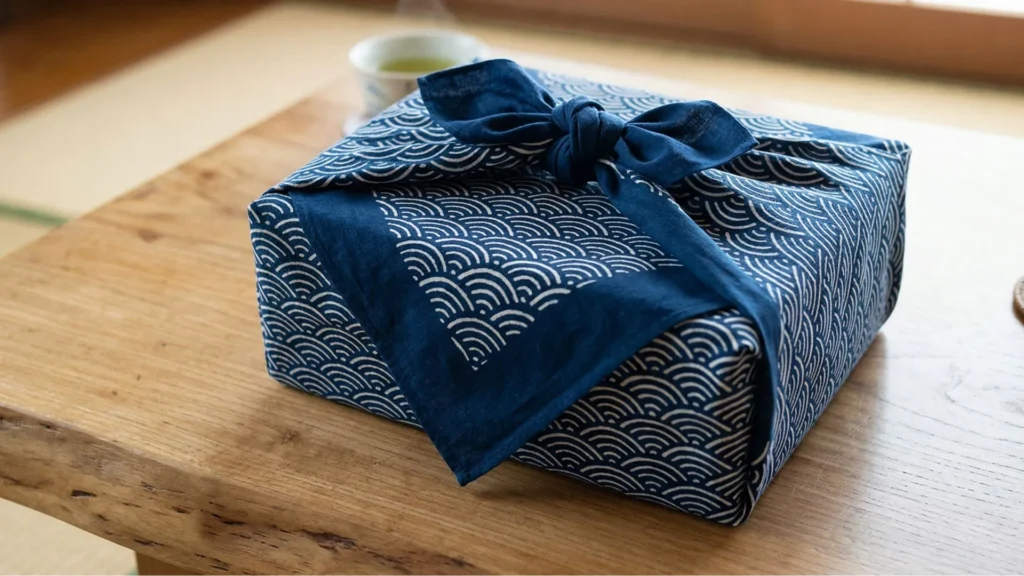
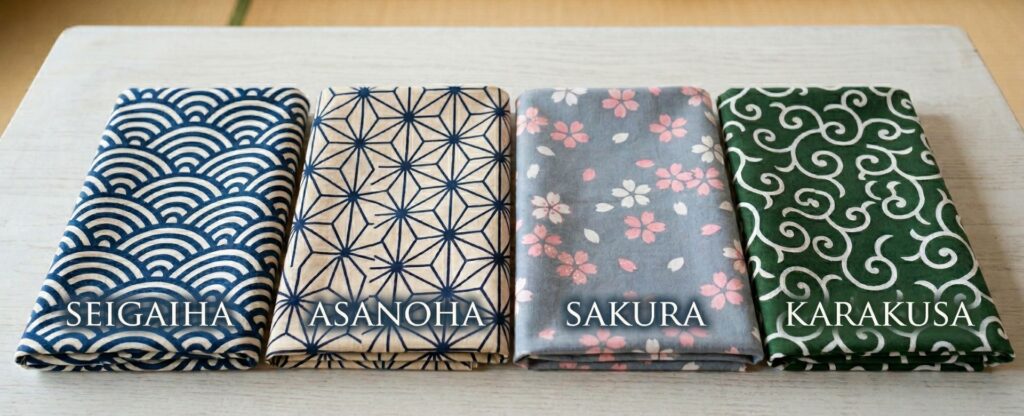
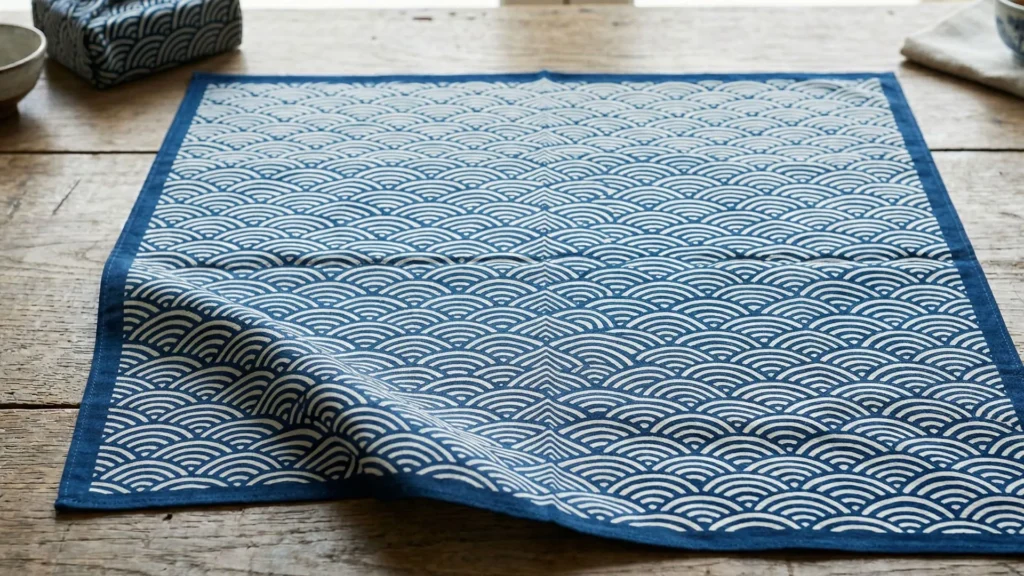
Seigaiha (青海波) — Blue Ocean Waves. Overlapping concentric arcs symbolizing calm seas and endless good fortune. One of the most recognizable Japanese patterns.
Asanoha (麻の葉) — Hemp Leaf. A geometric star pattern representing healthy growth—traditionally used for gifts to new parents or children.
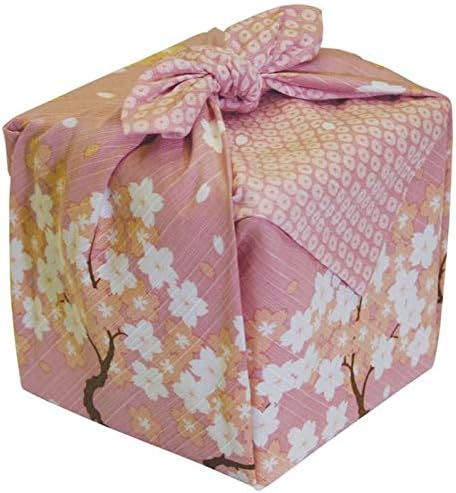
Sakura (桜) — Cherry Blossom. Representing the beauty of impermanence—spring’s most fleeting and most celebrated flower.
Karakusa (唐草) — Arabesque Vine. A flowing vine pattern symbolizing longevity and the endless connection of family. The most classic furoshiki pattern, often in green on white.
Five Essential Wrapping Techniques
Every furoshiki technique builds on two basic elements: the fold and the knot (ma-musubi, 真結び—a square knot that holds securely but unties easily). Master the square knot first, and every technique that follows becomes intuitive.
1. Otsukai Tsutsumi (お使い包み) — The Basic Wrap
The foundational technique for wrapping box-shaped gifts or carrying items.
Step 1: Place the furoshiki flat, patterned side down, with one corner pointing toward you (diamond orientation).
Step 2: Place the object in the center.
Step 3: Fold the corner nearest you over the object and tuck it underneath.
Step 4: Fold the far corner over toward you, tucking any excess under the object. Step 5: Bring the left and right corners up and tie them in a square knot on top.
The result: a neat, secure bundle with the pattern displayed on the outside and a decorative knot on top.
2. Futatsu Musubi (ふたつ結び) — The Two-Knot Gift Wrap
The most elegant technique for formal gift presentation.
Step 1: Place the furoshiki flat, patterned side down.
Step 2: Position the gift slightly off-center.
Step 3: Roll the gift forward, wrapping it in the cloth.
Step 4: Bring the two side flaps up and tie them in a square knot.
Step 5: Tuck the remaining fabric ends neatly under the knot or fan them out decoratively.
3. Bin Tsutsumi (瓶包み) — The Bottle Wrap
Perfect for wine bottles, sake, olive oil, or any cylindrical gift.
Step 1: Place the bottle in the center of the furoshiki (70 cm cloth recommended). Step 2: Roll the cloth around the bottle tightly.
Step 3: Stand the bottle upright. The excess fabric at the top fans out.
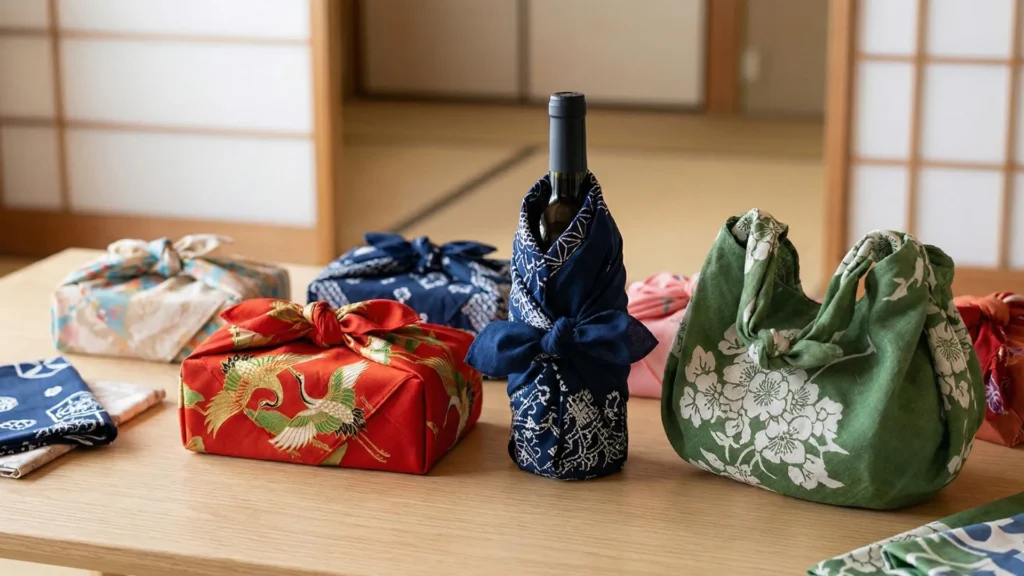
Step 4: Twist the two sides of the excess fabric, then bring them around and tie in a square knot at the front, creating a handle.
The result: a bottle that stands upright in an elegant cloth sleeve with a carrying handle—far more striking than a paper bag.
4. Suika Tsutsumi (すいか包み) — The Round Object Wrap
Named for watermelons but works for any spherical or irregularly shaped object.
Step 1: Place the round object in the center of a large furoshiki (90 cm or larger). Step 2: Gather two opposite corners and tie them over the top of the object in a square knot.
Step 3: Gather the remaining two corners and tie them in a second square knot over the first.
The result: a secure, nest-like cradle with a carrying handle formed by the knots.
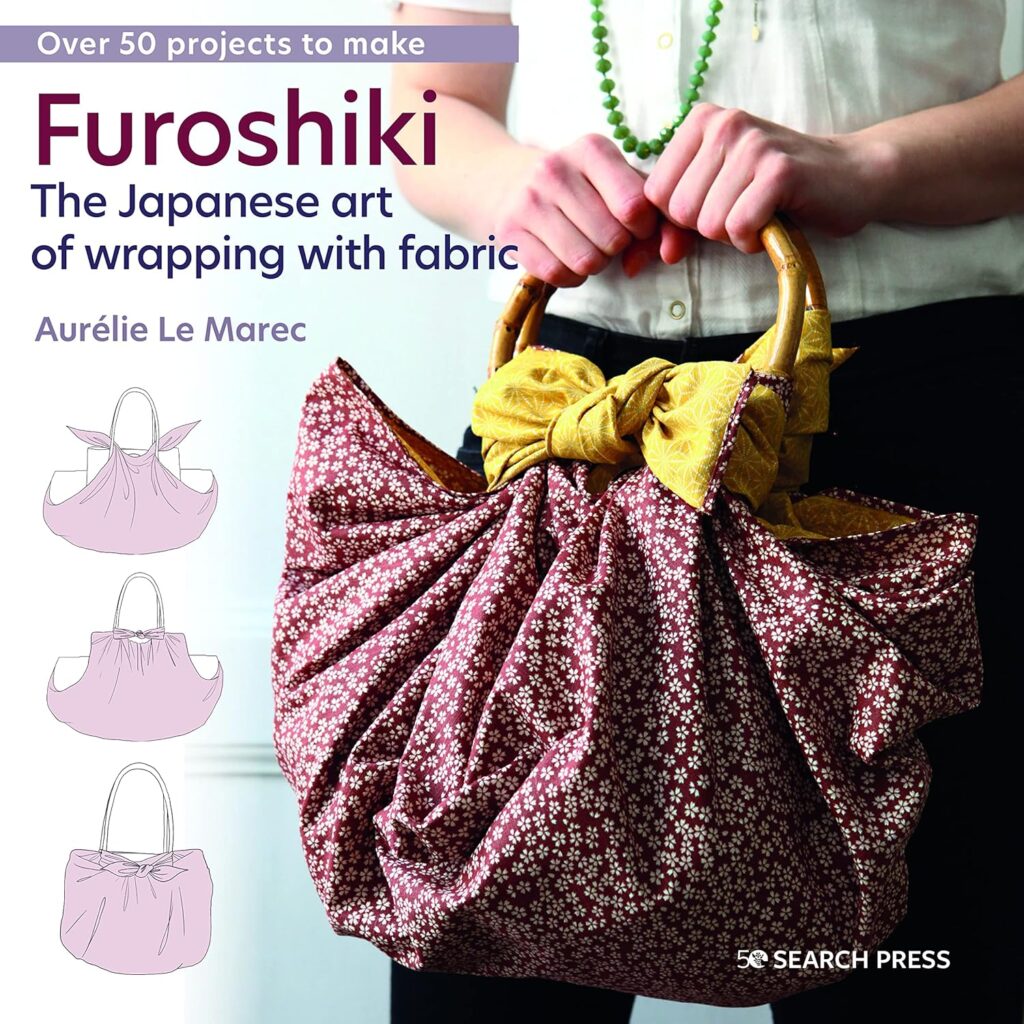
5. Furoshiki Bag (しずく型バッグ) — The Drop Bag
The technique that transforms a furoshiki from wrapping cloth into an everyday carry bag.
Step 1: Lay the furoshiki flat. Tie a knot in two adjacent corners (not opposite—adjacent), creating two small loops.
Step 2: Tie a knot in the other two adjacent corners.
Step 3: Thread one pair of knotted corners through the loops of the other pair.
Step 4: Pull to tighten. The cloth forms a bag with two handles.
This bag can carry groceries, books, gym clothes, or anything you would put in a tote. When emptied, it unties and folds flat into a pocket. One cloth replaces dozens of disposable bags.
Beyond Gift Wrap: Everyday Uses
Furoshiki’s versatility extends far beyond gift presentation. Once you begin thinking in terms of “what can a square of cloth do?”, the applications multiply:
Market bag. The drop bag technique replaces plastic and paper bags entirely. Keep a furoshiki folded in your jacket pocket or handbag—it weighs almost nothing and unfolds into a full-sized carrying bag in seconds.
Bento wrap. A 45 cm furoshiki wraps a bento box perfectly, with the knot serving as a handle. Open it at lunch, and the cloth becomes a placemat.
Travel packing. Use different furoshiki cloths to organize clothing in a suitcase—one for shirts, one for undergarments, one for accessories. Each bundle is visible, separated, and compresses better than packing cubes.
Scarf. A silk or fine cotton furoshiki in 70 cm or 90 cm works as a lightweight scarf or shawl. The same cloth that wraps a gift one day drapes over your shoulders the next.
Interior accent. A large furoshiki with a beautiful pattern serves as a table runner, a wall hanging, a cushion cover, or a tray liner. In a Japandi interior, a furoshiki draped over a shelf or framed on a wall introduces Japanese pattern and textile warmth with zero commitment—change it with the season.
Related guide: Japandi Style: Where Japanese Wabi-Sabi Meets Scandinavian Design
Book cover. In Japan, bookstores offer to wrap purchases in paper covers. A furoshiki cloth serves the same purpose—protecting the book while adding beauty. The Japanese reverence for books extends to how they are carried and presented.
FAQ
Q: What is furoshiki?
A: Furoshiki (風呂敷) is the Japanese art of wrapping, carrying, and presenting objects using a single square of cloth. The name means “bath spread,” referring to its origin in Japanese bathing culture where cloths were used to bundle clothing. Today, furoshiki serves as reusable gift wrapping, everyday bags, travel organizers, and decorative textiles—an elegant, waste-free alternative to disposable packaging.
Q: What size furoshiki should I start with?
A: A 70 cm furoshiki is the most versatile starting size—large enough to wrap a wine bottle, a book, or a standard gift box, and to tie into a functional shopping bag. If you plan to use it primarily for large gifts or as a bag for groceries, choose 90 cm. For bento boxes and small gifts, 45 cm is ideal.
Q: Can I wash a furoshiki?
A: Yes. Cotton and linen furoshiki can be machine-washed on a gentle cycle and hung to dry. Silk furoshiki should be hand-washed or dry-cleaned. Polyester chirimen furoshiki are the most low-maintenance—machine washable and quick-drying. With proper care, a quality cotton furoshiki lasts for years.
Q: Is it rude to keep a furoshiki given as wrapping?
A: In traditional Japanese etiquette, the furoshiki wrapping is part of the presentation—it belongs to the giver, not the receiver. When receiving a furoshiki-wrapped gift, you would traditionally unwrap it, admire the cloth, and return it to the giver. However, in modern practice—especially outside Japan—many people give the furoshiki itself as part of the gift. If you are unsure, simply ask: “Should I return the cloth?” Either answer is gracious.
Q: How is furoshiki different from regular fabric wrapping?
A: Furoshiki is not simply fabric used as wrapping—it is a system of specific techniques developed over centuries. Each wrapping method (tsutsumi) is designed for a particular shape or purpose, using folds and square knots rather than tape, pins, or adhesive. The techniques ensure the cloth holds securely, presents beautifully, and unties easily for reuse. This systematic approach—where a single cloth adapts to any object through technique rather than cutting or permanently altering the fabric—is what distinguishes furoshiki from improvised fabric wrapping.
What One Cloth Teaches
There is something unexpectedly moving about wrapping a gift in cloth instead of paper. The extra thirty seconds it takes—smoothing the fabric, finding the center, tying the knot—transforms a routine act into a small ceremony. You are no longer just covering an object. You are composing something. The pattern, the fold, the placement of the knot—each is a choice, and the accumulated effect of those choices is a presentation that communicates more than any pre-printed gift bag ever could.
This is the lesson that furoshiki shares with kintsugi, with sashiko, with ikebana, and with every Japanese art form that appears in the pages of this site: beauty is not found in expensive materials or complex techniques. It is found in attention. In the willingness to do a simple thing with care.
Related guide: Kintsugi: The Art of Golden Repair and Finding Beauty in Broken Things
A furoshiki cloth costs less than a roll of wrapping paper. It lasts longer than a thousand rolls. It produces zero waste. And every time you use it—folding, knotting, presenting, untying, folding again—you practice something that no amount of convenience can replace: the act of giving your full attention to a single, simple task.
One cloth. No waste. All care.
References
- Marec, A (2022). Furoshiki: The Japanese Art of Wrapping. Search Press.
- Ministry of the Environment, Japan. Furoshiki: A Japanese Traditional Eco-Wrapping Culture. Government of Japan.
- Koren, L. (1994). Wabi-Sabi for Artists, Designers, Poets & Philosophers. Imperfect Publishing.
- Juniper, A. (2003). Wabi Sabi: The Japanese Art of Impermanence. Tuttle Publishing.