The Word That Only Japan Has
Every culture walks in forests. Humans have been walking among trees for as long as there have been humans and trees. But only one culture looked at this universal activity and said: this is not merely walking. This is something else. This needs its own word.
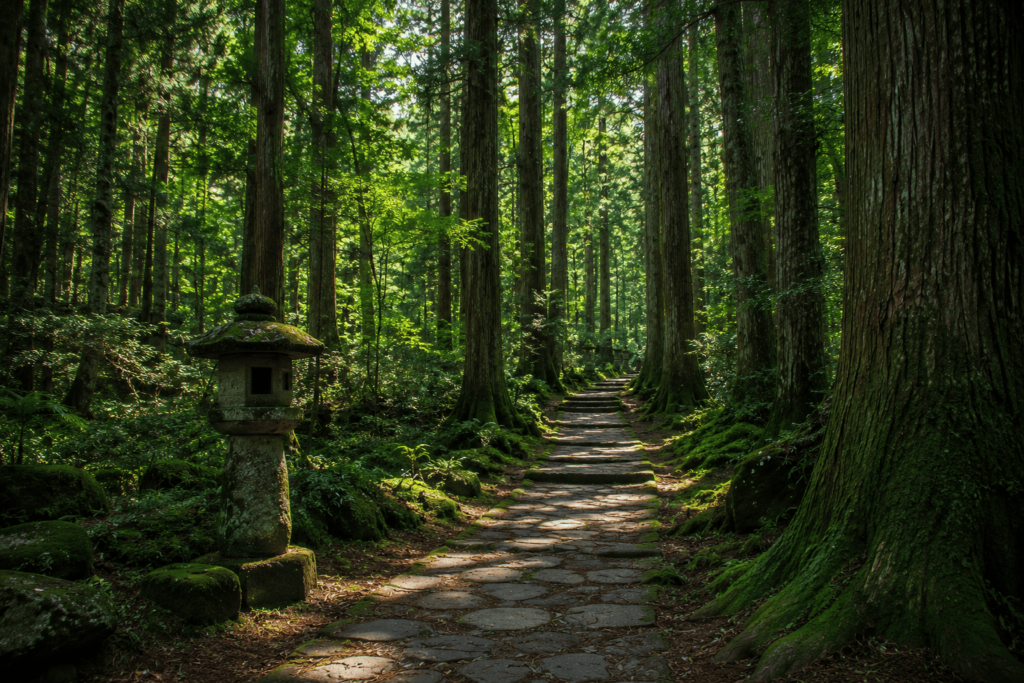
In 1982, the Japanese Ministry of Agriculture, Forestry and Fisheries introduced a term for a practice it wanted to promote as a public health strategy: shinrin-yoku (森林浴). The word translates literally as “forest bathing”—shinrin (森林, forest) and yoku (浴, bathing). Not hiking. Not exercising. Bathing—immersing yourself in the forest the way you immerse yourself in water, letting it surround you, letting it enter you through every sense.
The term was new. The practice was ancient. What Japan did in 1982 was not invent something but name something—giving language to an experience that millions of people had been having without knowing it had a name. And as with so many Japanese concepts—wabi-sabi, ichigo ichie, mono no aware—the act of naming transformed the experience from something accidental into something intentional.
This guide explores why Japan named what no other culture named, what shinrin-yoku actually involves, what science has discovered about its effects, and how to practice it wherever you are—even if the nearest forest is a city park.
What Shinrin-yoku Means
Shinrin-yoku (pronounced shin-rin yoh-koo) is written with three kanji:
森 (shin/mori) — forest. The character itself is a picture: three trees (木木木) standing together.
林 (rin/hayashi) — woods, grove. Two trees (木木). Together with 森, the compound 森林 means a deep, substantial forest—not a garden or a park but a place where trees outnumber everything else.
浴 (yoku) — bathing, immersion. The same character used in onsen (温泉) and nikko-yoku (日光浴, sunbathing). The radical on the left (氵) means water. Yoku does not mean washing. It means being enveloped—surrounded by something that touches every surface of your body.
The compound is precise: forest bathing is not walking through the forest. It is being in the forest the way you are in water—surrounded, held, immersed. The forest is not a backdrop to your activity. The forest is the activity.
Why Japan Named What No One Else Named
The question is not trivial. Germans have the Waldspaziergang (forest walk). Scandinavians have friluftsliv (open-air living). Koreans have sanlimyok (산림욕), borrowed directly from the Japanese. But none of these carry quite the same meaning as shinrin-yoku—the insistence that the forest is not a place to do something but a place to receive something.
Three cultural currents converge in shinrin-yoku to explain why Japan, specifically, produced this concept.
Shinto: Nature as Sacred Presence
In Shinto, Japan’s indigenous spiritual tradition, the natural world is inhabited by kami—spirits or forces that reside in trees, rivers, rocks, and mountains. A forest is not a collection of biological organisms. It is a community of presences, each worthy of acknowledgment and respect.
This belief does not require formal religious practice. It is simply the way most Japanese relate to nature—with a baseline awareness that the natural world is alive in a way that extends beyond biology. When you enter a forest with this awareness, you are not entering a resource or a recreation area. You are entering a space that has its own character, its own intelligence, its own way of responding to your presence.
Zen: Direct Sensory Experience
Zen Buddhism has cultivated, for centuries, the discipline of paying attention to what is actually happening—not what you think about what is happening, but the raw, unfiltered data of sensory experience. The smell of pine. The sound of wind in leaves. The texture of bark under your fingertips. The quality of light that changes every few steps as the canopy shifts.
Conprehensive guide: What Is Zen Buddhism?
Shinrin-yoku is, in this sense, a Zen practice without a cushion. It asks you to do what zazen asks you to do—attend to the present moment through your senses—but it provides a richer sensory environment than a meditation hall. The forest gives your attention something to rest on: birdsong, fragrance, the play of light through leaves. For people who find seated meditation difficult, the forest offers a gentler entry point into the same quality of awareness.
The 1980s Crisis: A Nation Returns to Its Forests
The immediate trigger for shinrin-yoku’s naming was a public health crisis. By the early 1980s, Japan was deep into its economic miracle—and the human cost was becoming visible. The term karōshi (過労死, death from overwork) entered the national vocabulary. Stress-related illness was epidemic. The population was urbanizing rapidly, and the average Japanese worker’s contact with the natural world was shrinking toward zero.
The Ministry’s promotion of shinrin-yoku was, at one level, a practical public health intervention—an attempt to get stressed, urbanized workers back into the forests that cover 67% of Japan’s land area. But the concept resonated far beyond policy because it connected to something the culture already knew: the forest heals. The ministry did not need to prove this. It only needed to remind people of it.
Shinrin-yoku Is Not Hiking
This distinction matters more than any other in understanding what shinrin-yoku is.
Hiking has a destination. You are going somewhere—a summit, a waterfall, a viewpoint. The trail is a means to an end. Speed matters. Distance matters. Your fitness level is relevant. You bring a map.
Shinrin-yoku has no destination. You are not going anywhere. You are arriving—continuously, with every step—at the place you already are. Speed is irrelevant; slower is better. Distance is irrelevant; less is better. Your fitness level does not matter. You bring nothing except your senses.
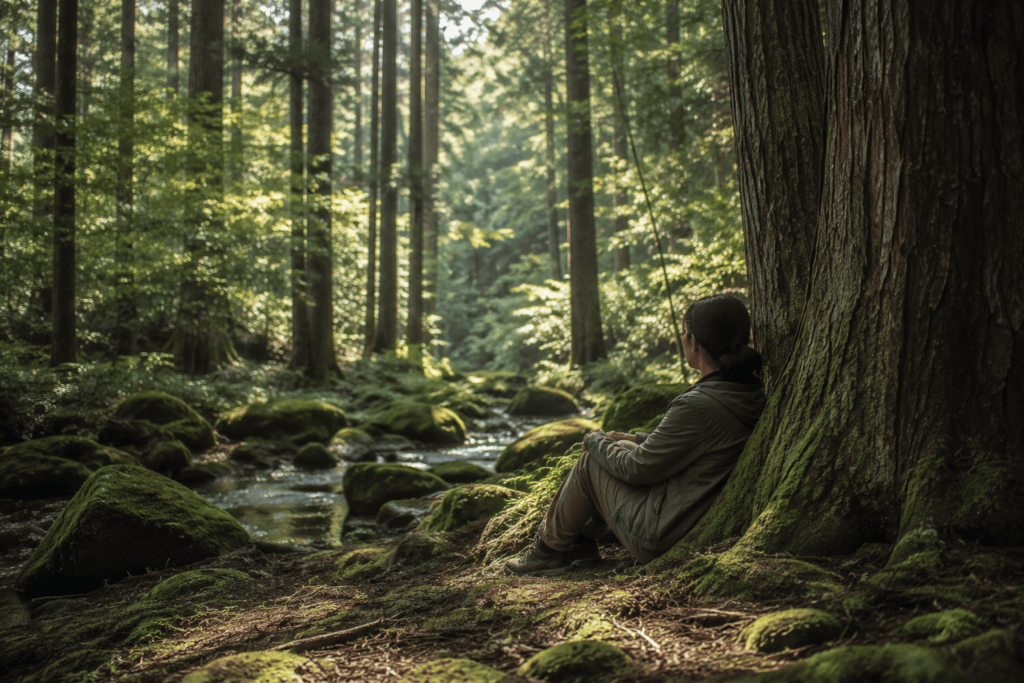
A typical shinrin-yoku session covers less than two kilometers in two to three hours. By hiking standards, this is absurdly slow—a pace that any able-bodied person would find unchallenging. But the challenge of shinrin-yoku is not physical. It is attentional. Can you walk this slowly without feeling that you should be going faster? Can you stop at a tree and simply look at it for five minutes without checking your phone? Can you sit on a rock by a stream and listen—not to music, not to a podcast, not to your own thoughts, but to the water—for ten unbroken minutes?
Comprehensive guide: How to Practice Zazen meditation at Home:Step-by-Step Guide for Beginners
Most people discover, when they try this, that it is harder than it sounds. The mind does not want to walk slowly. It does not want to look at bark. It wants destinations, progress, the next thing. Shinrin-yoku is the practice of letting go of the next thing and being fully with this thing—this tree, this sound, this breath of forest air.
This is why yoku (bathing) is the right word. You do not rush through a bath. You do not bathe with a goal. You sink in, you let the warmth reach you, and you stay until something inside you unclenches. The forest bath works the same way—but instead of hot water, you are immersed in air, light, fragrance, and the ancient patience of trees.
The Science (Briefly)
Since the early 2000s, Japanese researchers—most notably Dr. Qing Li of the Nippon Medical School—have been measuring what happens to the human body during and after forest bathing. The findings are remarkably consistent:
Stress hormones drop. Cortisol levels decrease significantly after just twenty minutes among trees. Blood pressure and heart rate follow. The sympathetic nervous system (fight-or-flight) downshifts, and the parasympathetic system (rest-and-digest) activates.
Immune function improves. Trees emit volatile organic compounds called phytoncides—airborne chemicals that protect the tree from insects and pathogens. When humans inhale phytoncides, their natural killer (NK) cell activity increases—a measurable boost to the immune system that persists for up to seven days after a single forest visit.
Mental clarity increases. Studies show improved concentration, reduced rumination, and lower scores on psychological measures of anxiety and depression after forest bathing sessions. The effect is stronger and longer-lasting than equivalent time spent walking in urban environments.attention.
Related guide: Japanese Incense and Kōdō: The Ancient Art of Listening to Fragrance
These findings have made shinrin-yoku a subject of serious medical research worldwide. But it is worth noting what science discovered: the Japanese already knew this. They had been bathing in forests for centuries before anyone measured cortisol levels. The science confirms what the body always reported—that being among trees makes you feel better. The contribution of science is not the discovery but the measurement.
How to Practice Shinrin-yoku
1. Choose a Place
A forest is ideal—particularly one with old trees, diverse species, and running water. But a large park, a botanical garden, or even a tree-lined avenue will work. The essential requirement is that trees outnumber people and that you can walk for twenty minutes without encountering traffic noise.
You do not need to travel to Japan. Shinrin-yoku works wherever trees grow. The forest does not need to be Japanese. It needs to be present—a real, living community of trees, not a photograph of one.
2. Slow Down
Walk at half the speed you would normally walk, then slow down again. The pace should feel almost uncomfortably slow. You are not going anywhere. You are arriving.
If you find yourself walking at a normal pace, stop. Stand still for thirty seconds. Then begin again, slower. The body’s habit is to move with purpose. Shinrin-yoku asks you to move without purpose—and this is more difficult than it sounds.
3. Open Your Senses, One at a Time
Sound first. Stop walking. Close your eyes. Listen to everything you can hear—birdsong, wind, water, rustling leaves, the creak of branches, the silence beneath the sounds. Stay for two minutes.
Smell. Breathe through your nose. The forest smells different at ground level and at shoulder height. It smells different near water and near bark. These are the phytoncides that science has measured—but you do not need to know the chemistry. You need only breathe.
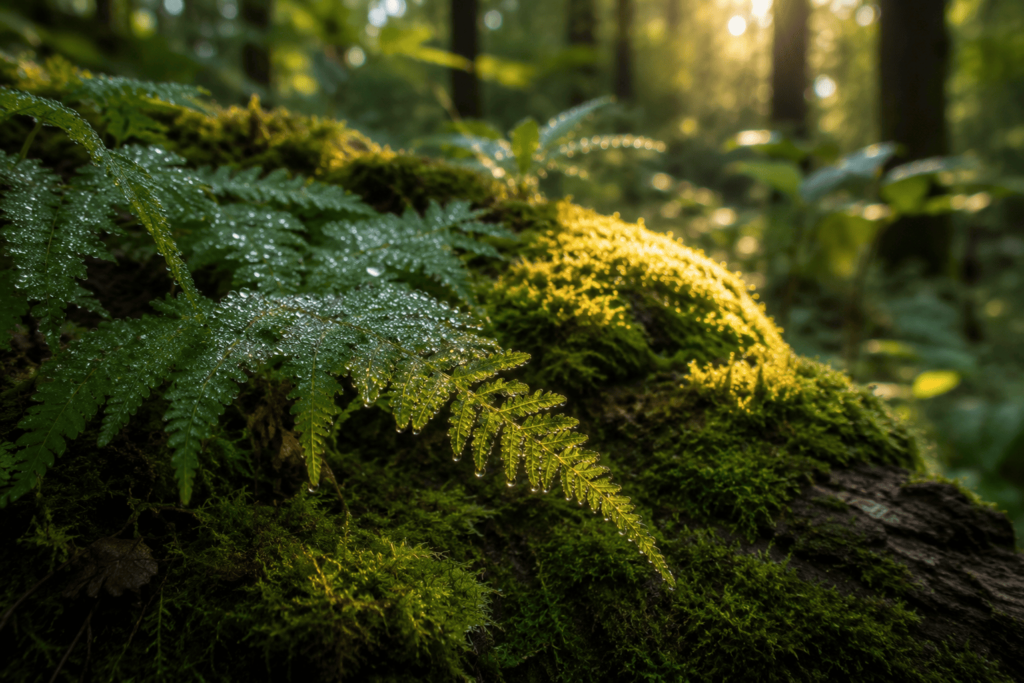
Touch. Run your hand along bark. Pick up a fallen leaf. Feel the texture of moss. Remove your shoes if the ground allows and stand on earth, stone, or leaf litter. The soles of your feet contain thousands of nerve endings that spend their entire lives inside shoes.
Sight. Look up. Most people never look up in a forest. The canopy—the overlapping layers of leaves and light—is one of the most complex visual environments in nature. Look at the patterns. Look at the movement. Look at the way the light changes every time the wind shifts a branch.
4. Start with Twenty Minutes
A full shinrin-yoku session lasts two to three hours, but even twenty minutes among trees produces measurable physiological changes. Begin with what is sustainable. The practice deepens with repetition—not because the forest changes but because your capacity to notice it does.
5. Leave Your Phone Behind
Or put it in airplane mode. The practice does not work if you are available to the world outside the forest. For the duration of the walk, the forest is the world—the only world. Everything else can wait.
Related guide: Mono no Aware: The Japanese Philosophy of Bittersweet Beauty
FAQ
Q: What is shinrin-yoku?
A: Shinrin-yoku (森林浴) is the Japanese practice of “forest bathing”—immersing yourself in a forest environment using all five senses. Unlike hiking, shinrin-yoku has no destination, no distance goal, and no physical challenge. The practice involves walking very slowly (or sitting still) among trees, paying attention to the sensory experience of the forest—sounds, smells, textures, light, and air. Introduced as a public health concept by the Japanese government in 1982, shinrin-yoku has since been validated by extensive scientific research showing measurable benefits to immune function, stress reduction, and mental health.
Q: How is shinrin-yoku different from hiking?
A: Hiking has a destination and measures progress in distance. Shinrin-yoku has no destination and measures nothing. A typical shinrin-yoku session covers less than two kilometers in two to three hours—a pace that prioritizes sensory awareness over physical exertion. Hiking engages the body; shinrin-yoku engages the senses. Both happen in nature, but the quality of attention is fundamentally different.
Q: Can I practice shinrin-yoku in a city?
A: Yes. While a deep forest provides the richest experience, any green space with enough trees to create a sense of enclosure will work—a large park, a botanical garden, a tree-lined cemetery, or a riverside path with mature trees. The essential elements are trees, relative quiet, and the willingness to slow down. Dr. Qing Li’s research has shown measurable stress reduction even in urban parks.
Q: How long should a shinrin-yoku session be?
A: The research suggests that twenty minutes among trees produces measurable physiological changes (reduced cortisol, lower blood pressure). A full guided shinrin-yoku session typically lasts two to three hours. For daily practice, even fifteen to twenty minutes in a green space is beneficial. The key is regularity rather than duration—a short daily walk among trees is more effective than a monthly marathon.
Q: What are the best books on shinrin-yoku?
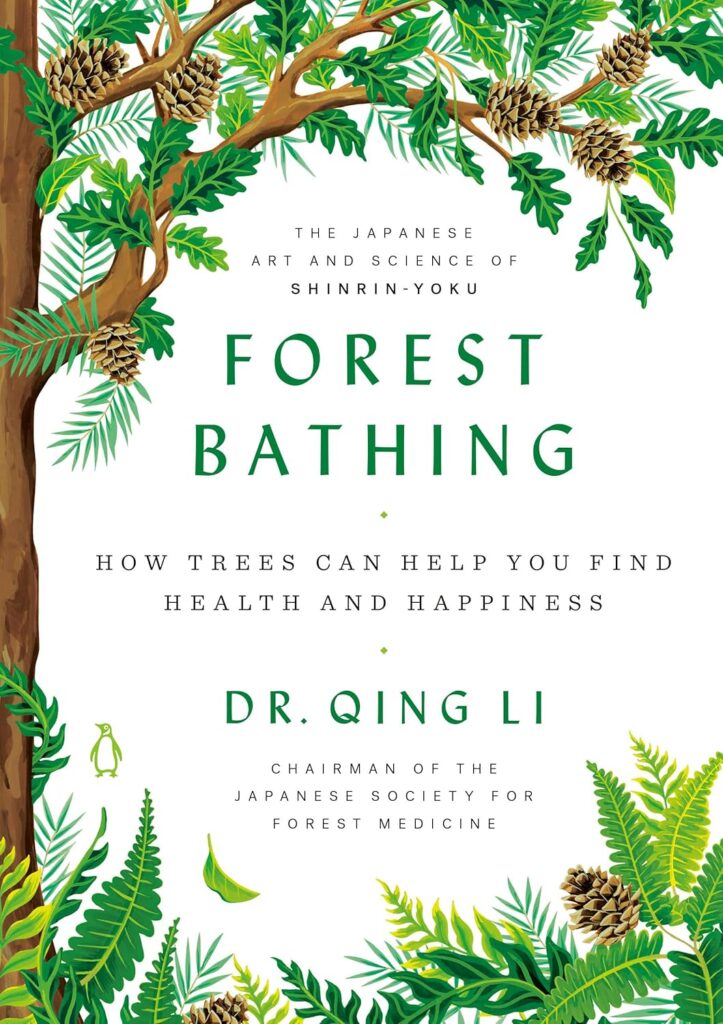
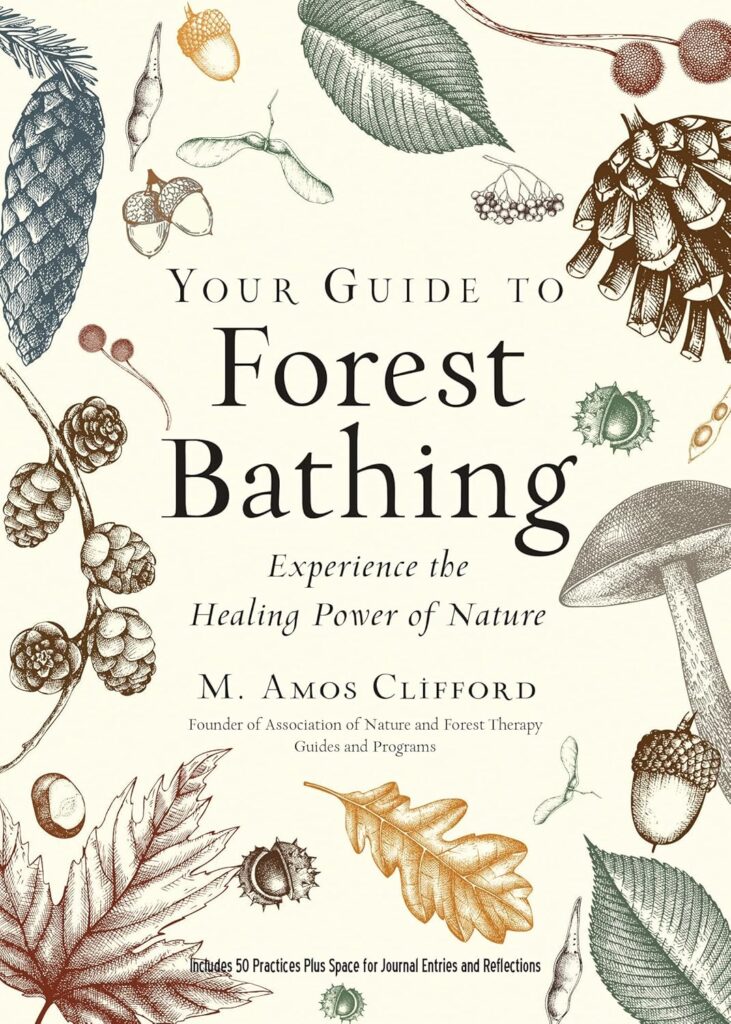
A: Shinrin-Yoku: The Art and Science of Forest Bathing by Dr. Qing Li is the most comprehensive guide, combining scientific research with practical instruction. Your Guide to Forest Bathing by Amos Clifford provides a structured introduction to the practice with specific exercises. The Hidden Life of Trees by Peter Wohlleben, while not specifically about shinrin-yoku, transforms your understanding of what you are walking among—and makes every forest walk richer.
What the Trees Already Know
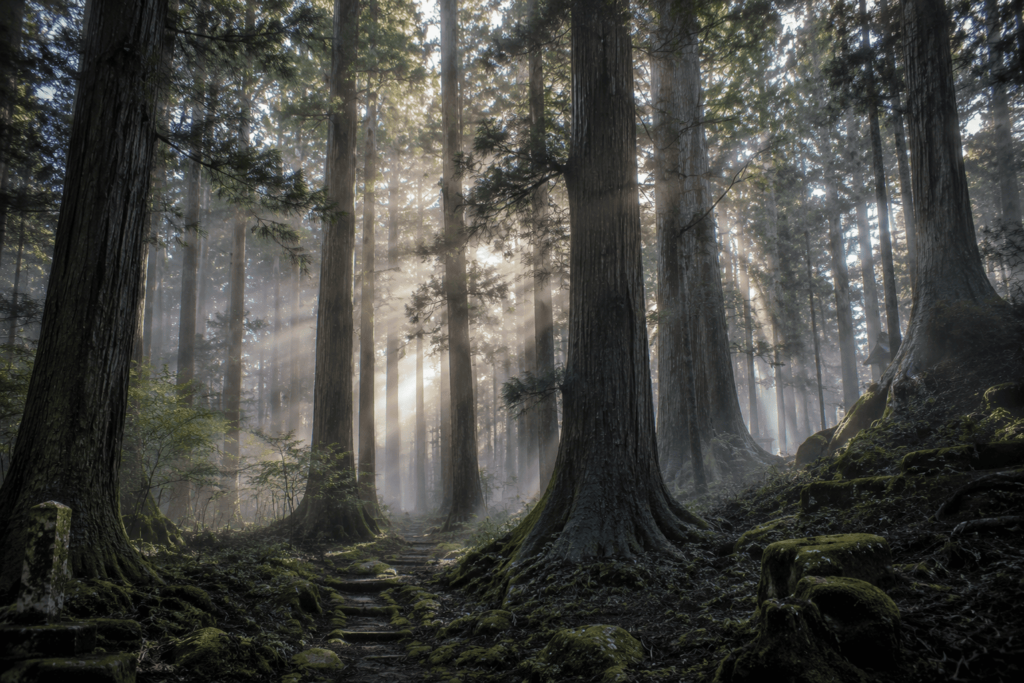
The forest does not teach you anything. It does not have a lesson. It does not offer advice or instruction or a seven-step program for a better life.
What the forest does is simpler and more radical: it gives you back your senses.
In the course of an ordinary day, you see screens, hear notifications, smell air conditioning, touch keyboards, and taste food you did not prepare. Your senses are active, but they are processing a narrow band of artificial stimuli. The forest opens the band. In the forest, your senses encounter what they evolved to encounter—the complexity, the subtlety, the infinite variation of the living world. Your eyes track the movement of light through leaves. Your ears distinguish between wind in cedar and wind in bamboo. Your nose detects the difference between wet earth and dry earth, between morning air and afternoon air.
Comprehensive guide: Wabi Sabi : The Japanese Philosophy of Finding Beauty in Imperfection
None of this requires effort. It requires only presence. The forest does the work—your job is to show up and stop doing everything else.
This is why the Japanese word for it is bathing, not walking. You do not effort your way through a bath. You let the water hold you. You let the warmth reach the places that are cold. You let your weight go.
Related guide: Onsen: A Guide to Japan’s Hot Springs and the Art of Bathing
The forest is waiting. It has been waiting for a very long time. It will not run out of patience before you arrive.
Take off your headphones. Put away your map. Walk slowly. Breathe.
The trees will take care of the rest.
References
- Li, Q. (2018). Shinrin-Yoku: The Art and Science of Forest Bathing. Viking.
- Clifford, A. (2018). Your Guide to Forest Bathing. Conari Press.
- Miyazaki, Y. (2021). Walking in the Woods: Go back to nature with the Japanese way of shinrin-yoku
- Park, B. J. et al. (2010). “The Physiological Effects of Shinrin-yoku.” Environmental Health and Preventive Medicine, 15(1), 18-26.
- Wohlleben, P. (2015). The Hidden Life of Trees. Greystone Books.