Mono no aware (物の哀れ, “the bittersweet awareness of the passing of things”) is a Japanese aesthetic and philosophical concept describing the deep, gentle emotion that arises when one perceives the beauty and transience of life simultaneously. First formalized as a literary principle by the 18th-century scholar Motoori Norinaga through his analysis of The Tale of Genji, mono no aware captures a sensibility that has shaped Japanese art, poetry, and culture for over a thousand years. Unlike nostalgia, which looks backward, mono no aware operates in the present moment—the feeling of being moved by cherry blossoms while they are still blooming, precisely because you know they will fall. It is the recognition that impermanence is not the enemy of beauty but the condition that makes beauty possible.
The Beauty You Cannot Keep
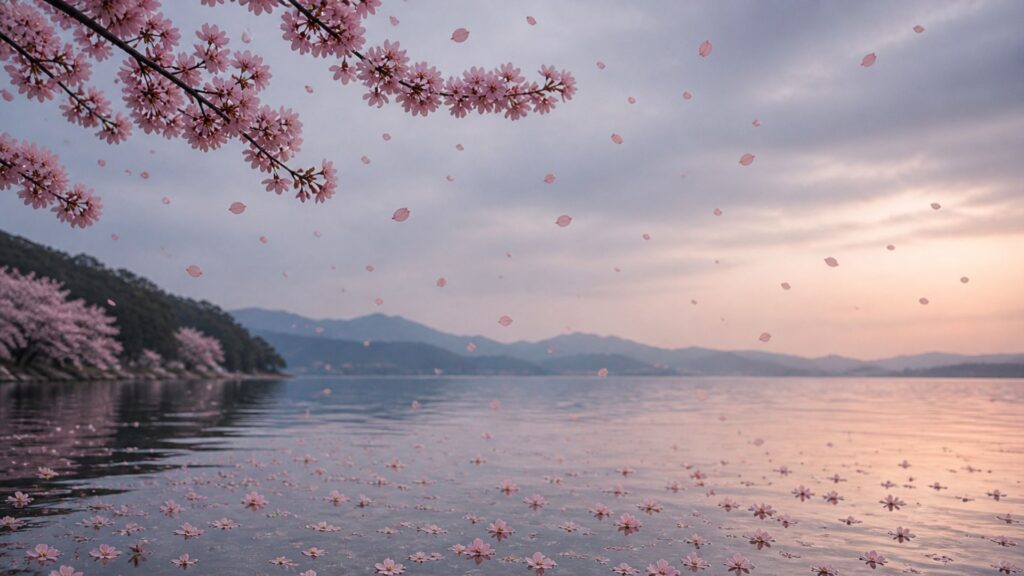
Cherry blossoms bloom in Japan for roughly ten days. During that brief window, millions of people gather beneath the trees to eat, drink, and watch the petals fall. They call this hanami (花見)—flower viewing—and it is one of the oldest and most deeply felt traditions in Japanese culture.
But hanami is not a celebration of beauty in the way that a festival celebrates beauty. There is no triumphant feeling to it. The atmosphere beneath the cherry trees is closer to tenderness—a collective recognition that what is beautiful is also leaving. The petals are already falling as you watch them. The most perfect afternoon is already becoming a memory. You cannot hold the blossoms. You cannot slow the wind. You can only be present while the beauty lasts, knowing that its transience is not a flaw but the very thing that makes it beautiful.
The Japanese language has a name for this feeling. It is called mono no aware (物の哀れ).
What Mono no Aware Means
Mono no aware (pronounced moh-noh noh ah-wah-reh) is composed of two elements:
Mono (物) — things, the world, the stuff of experience. Not just physical objects but situations, moments, relationships, seasons—anything that exists and passes.
Aware (哀れ) — a deep, spontaneous emotional response. Often translated as “pathos” or “sadness,” but this is misleading. Aware is closer to a sigh than a sob—the sound you make when something moves you so deeply that words are insufficient. It contains tenderness, wonder, gratitude, and grief in a single breath.
Together, mono no aware means something like “the bittersweet awareness of the passing of things”—the capacity to be moved by the beauty of a world in which nothing lasts.
This is not pessimism. It is the opposite of pessimism. Mono no aware says: because the cherry blossoms fall, because the summer evening ends, because the child grows up, because the person you love will not always be here—because of all this, not in spite of it—the experience of being alive is unbearably beautiful. Impermanence is not the enemy of beauty. It is the condition that makes beauty possible.
Comprehensive guide: What Is Zen Buddhism?
Origin: Motoori Norinaga and The Tale of Genji
The Scholar Who Named a Feeling
Mono no aware existed as a feeling long before it had a name. The term was formalized in the eighteenth century by Motoori Norinaga (本居宣長, 1730–1801), a scholar of Japanese literature who spent thirty-five years analyzing The Tale of Genji (源氏物語)—the eleventh-century novel widely considered the first great work of fiction in any language.
Motoori argued that the heart of The Tale of Genji was not its plot, its politics, or its portrayal of court life. It was mono no aware—the quality of deep emotional sensitivity that allows the characters (and the reader) to be moved by the beauty and sadness of human experience. Prince Genji’s affairs are not merely romantic adventures. They are encounters with impermanence—each relationship brilliant and brief, each parting a small rehearsal for the ultimate parting.
Motoori used the term to describe what he believed was the defining characteristic of Japanese culture: an unusual sensitivity to the emotional texture of transient experience. Where Chinese literature of the same period valued moral instruction and where Western literature valued heroic action, Japanese literature valued aware—the capacity to feel deeply in the presence of beauty that is passing away.
Before Motoori: A Thousand Years of Aware
The feeling Motoori named had been expressed in Japanese art for centuries before he gave it a word. The poetry of the Man’yōshū (万葉集, eighth century) is saturated with it—poems about autumn grasses, departing lovers, the cry of wild geese at dusk. The Pillow Book of Sei Shōnagon (清少納言, circa 1000) catalogs the small, piercing beauties of daily life—the way snow clings to plum blossoms, the sound of an ox-cart passing in the night.
In all these works, beauty and transience are not separate. Beauty is transience perceived with an open heart.
Mono no Aware and Wabi-Sabi: Two Faces of Impermanence
Mono no aware and wabi-sabi are often confused, and understandably so—both are rooted in the Buddhist insight that all things are impermanent, and both find beauty where impermanence is visible. But they operate in different registers.
Comprehensive guide: Wabi Sabi : The Japanese Philosophy of Finding Beauty in Imperfection
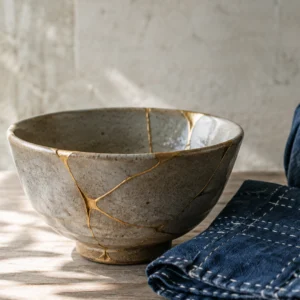
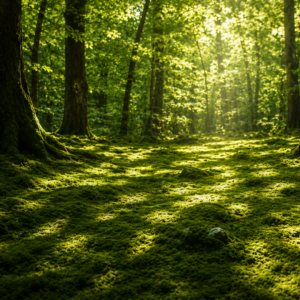
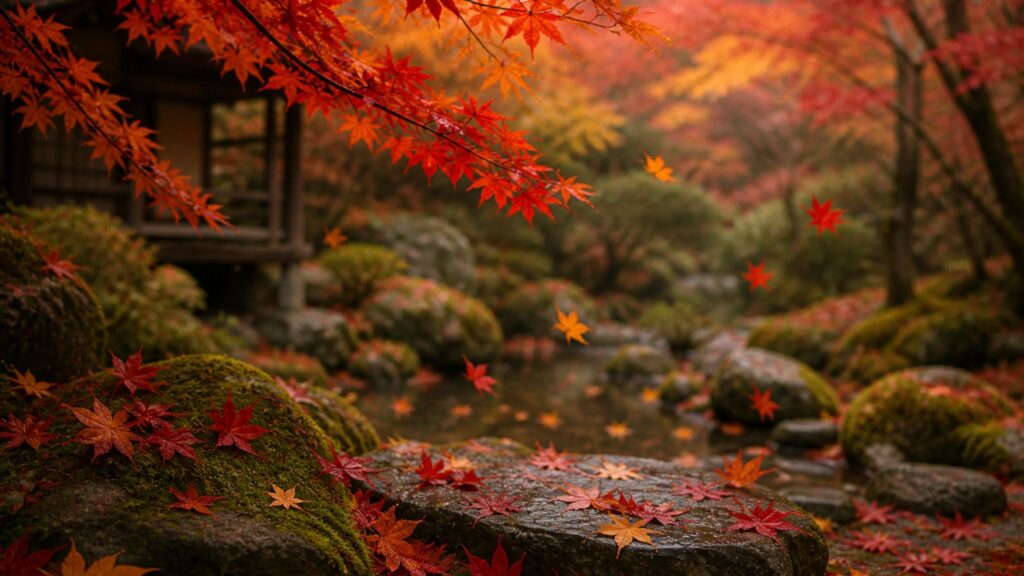
Wabi-sabi is an aesthetic of objects and spaces. It finds beauty in the cracked tea bowl, the weathered wood, the moss-covered stone—things that show the passage of time in their physical substance. Wabi-sabi looks at the world and says: this is beautiful because it is imperfect, incomplete, and impermanent.
Mono no aware is an aesthetic of experience and emotion. It finds beauty not in the object itself but in the feeling that arises when you encounter something beautiful that is passing away. Mono no aware looks at the world and says: I am moved because this will not last.
Wabi-sabi is what the object carries. Mono no aware is what the heart feels.
They are not competing philosophies. They are complementary—two lenses through which the same truth becomes visible. A kintsugi bowl embodies wabi-sabi in its cracked, gold-repaired surface. But the feeling of holding that bowl—knowing its history, sensing its fragility, appreciating it more because it has already broken once—that is mono no aware.
Related guide: Kintsugi: The Art of Golden Repair and Finding Beauty in Broken Things
Mono no Aware and Ichigo Ichie: The Pair
If you have read about ichigo ichie (一期一会)—the principle that every encounter is unrepeatable—you have already encountered a close relative of mono no aware. The two concepts are partners, but they face in different directions.
Related guide: Ichigo Ichie: The Japanese Art of Living in the Unrepeatable Moment
Ichigo ichie is a call to action. It says: this moment will not come again, so be fully present for it. The emphasis is on commitment—the decision to bring your complete attention to the encounter at hand.
Mono no aware is a call to feeling. It says: this moment will not come again, and the recognition of that fact is itself a form of beauty. The emphasis is on receptivity—the willingness to be moved by what is happening rather than rushing past it.
Together, they form a complete response to impermanence. Ichigo ichie gives you the discipline. Mono no aware gives you the heart. One without the other is incomplete—discipline without feeling produces rigid attention; feeling without discipline produces sentimental nostalgia. The Japanese aesthetic tradition insists on both.
Related guide: Koi no Yokan: The Japanese Feeling of Knowing Love Is Coming
Where You Already Feel It
Mono no aware is not an exotic concept that requires Japanese cultural knowledge to understand. You have felt it. You may not have had a name for it, but you have felt it. Here are five moments where mono no aware is already present in your life.
The Last Day of a Trip
You are leaving a place you love—a city, a coast, a mountain. Tomorrow you fly home. Today, everything is sharper: the light, the smell of the street, the taste of the local coffee. You know you are leaving, and that knowledge does not ruin the experience. It deepens it. You see more clearly on the last day because you know you are seeing it for the last time—or at least, for the last time in this form, in this season, with this version of yourself.
That heightened perception is mono no aware.
A Child’s Birthday
Your child turns seven, or twelve, or seventeen. You celebrate. You also grieve, just a little—not the child’s growth, which you welcome, but the version of them that no longer exists. The three-year-old who pronounced spaghetti as “pasketti” is gone. The seven-year-old who believed in magic is going. Each birthday is a celebration and a farewell happening simultaneously.
That dual feeling—joy braided with loss—is mono no aware.
The End of a Season
The first cold morning after a long summer. The last warm afternoon before winter. The moment in October when the light changes and you realize that the angle of the sun has shifted, that the days are shorter, that the year is tilting toward darkness. You feel something—not sadness exactly, but a recognition that time has moved and that the season you were living in has quietly ended.
That recognition is mono no aware.
An Old Photograph
You find a photograph of yourself at twenty, or of your parents when they were young, or of a friend you have lost touch with. The people in the photograph do not know what is coming—the moves, the marriages, the losses, the changes that will reshape their lives. You know. The tenderness you feel toward them—toward their innocence, their unawareness, their beautiful not-knowing—is mono no aware.
Music That Ends
A piece of music you love reaches its final note. The sound fades. The silence that follows is not empty—it is full of the music that was just there. You sit in that silence for a moment, not wanting to break it, holding the afterimage of sound in your body. That silence—inhabited by what has passed—is mono no aware.
Related guide: Tea Ceremony: History, Philosophy & How to Experience It
Related guide: Haiku: The Zen Art of Saying Everything in Seventeen Syllables
Living With Mono no Aware
Mono no aware is not a practice in the way that zazen is a practice or ikebana is a practice. You cannot schedule it or follow instructions to produce it. It arrives on its own—or rather, it is always arriving, and the question is whether you are available to receive it.
Comprehensive guide: How to Practice Zazen meditation at Home:Step-by-Step Guide for Beginners
Related guide: Komorebi: The Japanese Word for Sunlight Filtering Through Leaves
Related guide: Tsundoku: The Japanese Art of Letting Books Pile Up (and Why It Matters)
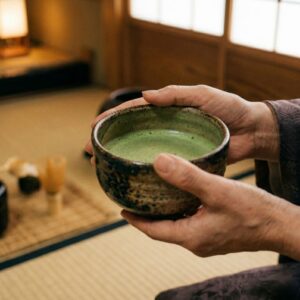
But you can cultivate the conditions. You can slow down enough to notice the shift in the seasons. You can put away your phone during a conversation with someone you love. You can sit with a cup of tea and watch the steam rise instead of reaching for the next task. You can stand beneath the cherry blossoms and resist the impulse to photograph them before you have actually looked at them.
Mono no aware does not require you to seek out extraordinary beauty. It requires you to notice the extraordinary beauty that is already present in ordinary life—and to let yourself be moved by the fact that it is passing.
The Japanese have been practicing this for a thousand years. Not as a technique, but as a way of being human. A way of keeping the heart open in a world where everything you love is temporary—and finding, in that openness, not despair but a beauty so sharp it takes your breath away.
FAQ
Q: What does mono no aware mean?
A: Mono no aware (物の哀れ) is a Japanese term meaning “the bittersweet awareness of the passing of things.” It describes the deep, gentle feeling of being moved by the beauty and transience of life—the recognition that impermanence is not a flaw in the world but the quality that makes beauty possible. The term was formalized by the eighteenth-century scholar Motoori Norinaga but describes a sensibility that has been central to Japanese art and literature for over a thousand years.
Q: How do you pronounce mono no aware?
A: Mono no aware is pronounced moh-noh noh ah-wah-reh. Each syllable is given roughly equal weight—Japanese does not have the strong stress patterns of English. The final “e” in “aware” is pronounced as a separate syllable (reh), not as the English word “aware.”
Q: What is the difference between mono no aware and wabi-sabi?
A: Both relate to impermanence, but they operate differently. Wabi-sabi is an aesthetic of objects and spaces—it finds beauty in the cracked bowl, the weathered wood, the aged surface. Mono no aware is an aesthetic of experience and emotion—it describes the feeling of being moved by beauty that is passing away. Wabi-sabi is what the object carries; mono no aware is what the heart feels. They are complementary, not competing.
Q: Is mono no aware the same as nostalgia?
A: Not exactly. Nostalgia is directed backward—it longs for a past that has already gone. Mono no aware can operate in the present—you can feel it while the beautiful thing is still happening, because you are aware that it will end. The cherry blossoms are still blooming when you feel mono no aware beneath the tree. It is not longing for what was. It is tenderness toward what is—because you know it will not remain.
Q: Why is mono no aware popular as a tattoo?
A: Mono no aware has become a meaningful tattoo choice because it captures a universal human experience in elegant Japanese characters (物の哀れ). The concept resonates across cultures—everyone has felt the bittersweet beauty of something precious that is passing away. As a tattoo, it serves as a permanent reminder to stay open to the beauty of impermanence—a paradox (permanent ink for a philosophy of transience) that many people find fitting.
What the Petals Teach
The cherry blossoms will come again next spring. But they will not be the same blossoms. The tree will be a year older. The branches will have shifted. The wind will come from a different direction. And you—you will be a year older too, carrying a year’s worth of experiences, losses, and discoveries that will change the way you see the petals fall.
This is not a sad thought. It is the thought that makes the seeing worthwhile.
Mono no aware does not ask you to do anything. It asks you to feel something—and to not look away from the feeling when it arrives. To let yourself be moved by the beauty of an evening, a conversation, a season, a face, a cup of tea growing cold. To recognize that the ache you feel in the presence of something beautiful is not a weakness. It is the deepest form of attention. It is your heart telling you that what is in front of you matters—and that it matters precisely because it will not stay.
The petals fall. The tea cools. The conversation ends. The child grows up. The summer turns to autumn.
And in each of these small departures, if you are paying attention, there is a beauty so complete that it needs no improvement—only a heart open enough to receive it.
That is mono no aware. It has been here all along.
References
- Motoori, N. (1796). Genji Monogatari Tama no Ogushi [The Jeweled Comb of The Tale of Genji]. (Referenced in secondary sources.)
- Murasaki, S. (c. 1000/2001). The Tale of Genji. Translated by Royall Tyler. Viking.
- Sei Shōnagon. (c. 1002/1967). The Pillow Book. Translated by Ivan Morris. Columbia University Press.
- Parkes, G. (2011). “Japanese Aesthetics.” Stanford Encyclopedia of Philosophy.
- Tanizaki, J. (1933/1977). In Praise of Shadows.
- Suzuki, D. T. (1959). Zen and Japanese Culture. Princeton University Press.
- Koren, L. (1994). Wabi-Sabi for Artists, Designers, Poets & Philosophers. Imperfect Publishing.