Kintsugi (金継ぎ, “golden joinery”) is the Japanese art of repairing broken ceramics with lacquer mixed with powdered gold, silver, or platinum. Rather than disguising damage, kintsugi illuminates every crack, transforming the history of breakage into visible beauty. The practice emerged in 15th-century Japan at the intersection of the urushi lacquer tradition and the Zen-influenced tea ceremony aesthetic championed by Sen no Rikyū. Rooted in the philosophy of wabi-sabi and the Buddhist concept of mushin (acceptance of what is), kintsugi teaches that an object’s fractures are not flaws to hide but experiences to honor—making the repaired piece more valuable than the original.
When Breaking Makes Something More Beautiful
A tea bowl slips from your hands and shatters on the stone floor. In most cultures, this is the end of the story. You sweep up the fragments and throw them away. The object is gone.
In Japan, this can be a beginning.
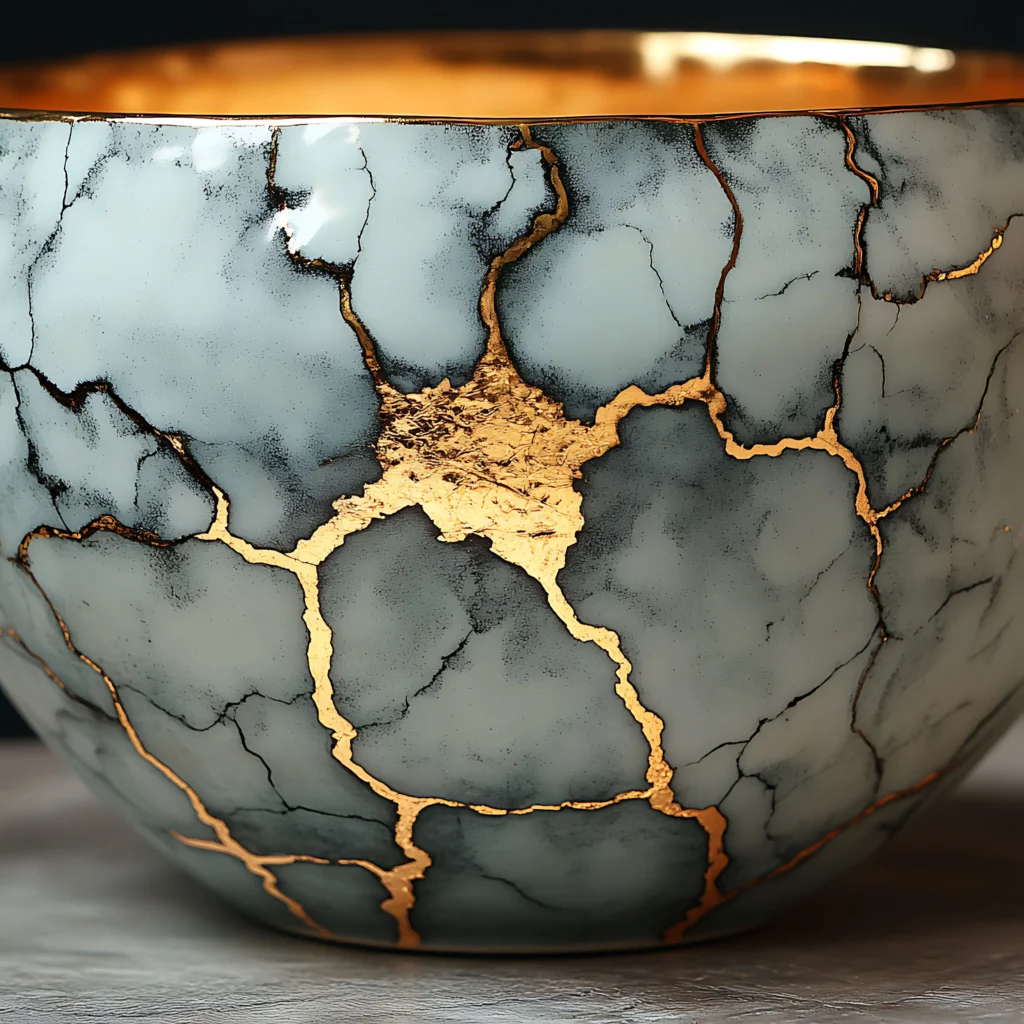
Kintsugi (金継ぎ), literally “golden joinery,” is the centuries-old Japanese art of repairing broken ceramics with lacquer mixed with powdered gold, silver, or platinum. Rather than disguising the damage, kintsugi does the opposite—it illuminates every crack, transforming the history of breakage into something luminous.
The philosophy behind this practice runs deep into the heart of Zen Buddhism and the aesthetic tradition of wabi-sabi (侘び寂び). Where Western culture often equates damage with diminished value, kintsugi insists that an object’s fractures are not flaws to hide but experiences to honor. A bowl repaired with gold is not “as good as new.” It is better—richer in meaning, more honest in its beauty, and utterly unique in a way no factory-perfect piece can be.
Comprehensive guide: Explore Wabi-Sabi Philosophy
This guide explores the history, philosophy, and practice of kintsugi—from its origins in 15th-century tea culture to its modern resonance as a metaphor for resilience. Whether you are drawn to kintsugi as art, as philosophy, or as something you want to try with your own hands, this article will help you understand why a broken bowl with golden scars has captivated the world.
A History Written in Gold and Lacquer
The Legend of Ashikaga Yoshimasa
The most widely told origin story of kintsugi centers on Ashikaga Yoshimasa (1436–1490), the eighth shōgun of the Muromachi period. According to tradition, Yoshimasa broke a favorite Chinese tea bowl and sent it back to China for repair. It returned held together with ugly metal staples—a common repair method at the time. Dissatisfied, Yoshimasa challenged Japanese craftsmen to find a more aesthetically pleasing solution. The answer was urushi (漆) lacquer dusted with gold powder: a technique that transformed the repair itself into art.
Whether this specific story is historical fact or cultural legend, its message carries truth. Kintsugi emerged at the intersection of two powerful forces in Japanese culture: the urushi lacquer tradition, which dates back over 9,000 years in Japan, and the evolving aesthetics of the tea ceremony, which was increasingly shaped by Zen Buddhist thought.
Tea Culture and the Birth of an Aesthetic
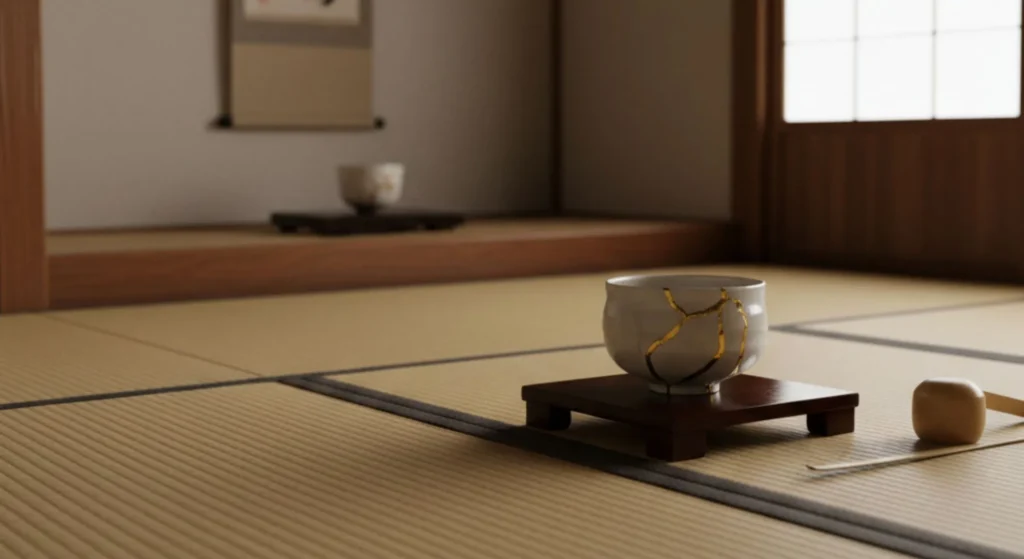
Kintsugi’s development is inseparable from the Japanese tea ceremony (chadō). In the 15th and 16th centuries, tea masters—most notably Murata Jukō and later Sen no Rikyū—were radically redefining Japanese aesthetics. Moving away from the Chinese-influenced preference for flawless, symmetrical objects, they embraced rough, irregular, and imperfect tea wares. A cracked Raku tea bowl was not inferior; in the right context, it was more expressive than a perfect one.
Within this cultural environment, kintsugi was not merely a repair technique. It was a statement. To repair a bowl with gold was to declare that breakage and repair are part of the object’s honest history—not something to conceal.
Over time, the practice became so valued that collectors reportedly began intentionally breaking ceramics to have them repaired with gold—though this misses the point entirely. Kintsugi honors the accidental nature of breakage. Deliberately shattering a bowl for aesthetic effect is a contradiction: it seeks to manufacture what can only be authentic when unplanned.
Related guide: Tea Ceremony: History, Philosophy & How to Experience It
The Philosophy: Why Gold in the Cracks?
Mushin: The Acceptance of What Is
At its philosophical core, kintsugi embodies the Zen concept of mushin (無心)—”no mind” or the absence of clinging. When a cherished bowl breaks, the natural reaction is distress: attachment to the object as it was, resistance to what has happened. Kintsugi offers a different response. Rather than grieving the loss of the original form or pretending the break never occurred, it fully accepts the reality of what happened and finds creative possibility within it.
This is not passive resignation. It is an active, even joyful engagement with impermanence. The gold does not say “this was never broken.” It says “this was broken, and that is beautiful.”
Comprehensive guide: Impermanence in Zen Buddhism
Wabi-Sabi: Beauty in Imperfection
Kintsugi is perhaps the most tangible expression of wabi-sabi aesthetics. The seven principles of wabi-sabi—simplicity, asymmetry, naturalness, subtlety, unconventionality, tranquility, and austerity—are all visible in a kintsugi-repaired piece. The golden seams are asymmetrical by nature. They follow paths determined not by design but by the physics of impact. No two breaks are alike, meaning every kintsugi repair is unrepeatable.
The gold itself introduces an element that might seem to contradict wabi-sabi’s emphasis on modesty—yet in practice, the metallic lines serve not as ostentatious decoration but as honest illumination. They draw the eye precisely to where the damage occurred, celebrating rather than concealing the truth of the object’s experience.
Related guide: Japanese Calligraphy (Shodō): The Zen Art of Brush and Ink
Related guide: Raku Pottery: The Zen Art of Imperfect Tea Bowls
Three Repair Methods, Three Philosophies
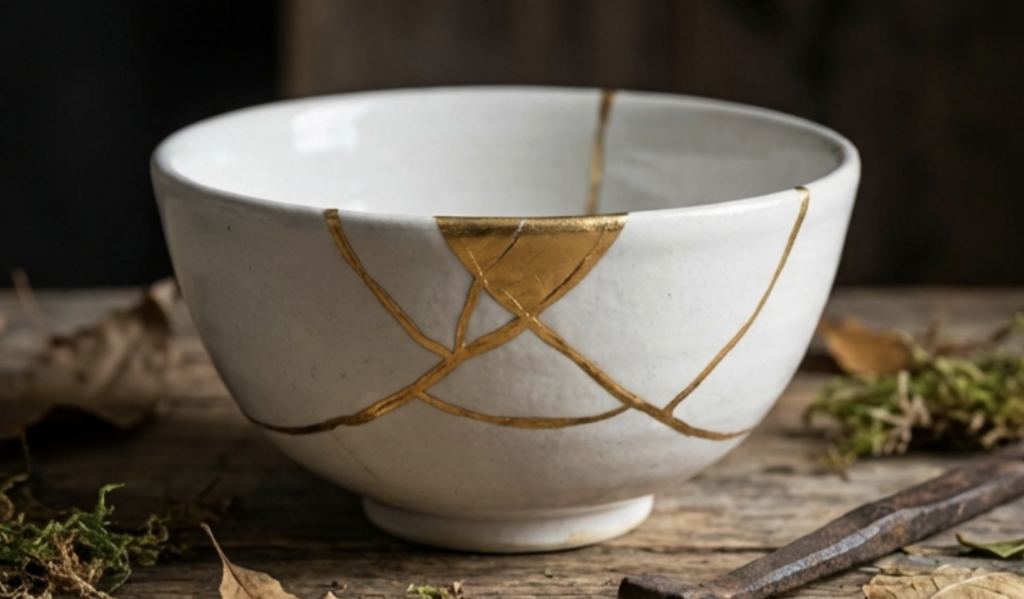
Traditional kintsugi actually encompasses three distinct techniques, each reflecting a slightly different philosophical approach:
Crack method (hibi). Gold lacquer fills only the cracks, following the break lines. This is the most common and recognizable form—the broken object restored to its original shape with golden veins.
Piece method (kake no kintsugi-naohi). When a fragment is missing entirely, gold lacquer fills the gap, creating a new section made purely of gold. The absence becomes a golden presence.
Joint call (yobi-tsugi). A fragment from a completely different ceramic is used to replace the missing piece, joined with gold. Two unrelated objects become one—a philosophical statement about interconnection and the beauty of unexpected combinations.
Each method transforms loss into something new. The crack method honors history. The piece method embraces absence. The joint call celebrates unlikely harmony.
Related guide: Sashiko: The Japanese Art of Stitching, Mending, and Finding Beauty in Repair
The Traditional Kintsugi Process
Understanding how kintsugi is made deepens appreciation for the finished work. Traditional kintsugi is not a quick fix—it is a patient, meditative process that can take weeks or months to complete.
Materials
The essential material is urushi (漆), a natural lacquer harvested from the sap of the Toxicodendron vernicifluum tree. Urushi has been used in Japan for millennia as both adhesive and protective coating. It is remarkably durable—archaeological urushi artifacts dating back 9,000 years have been found in remarkably good condition.
The gold component is typically maki-e gold powder, the same material used in traditional Japanese lacquerware decoration. Silver and platinum are also used, offering different visual effects: silver produces cooler, subtler lines, while platinum falls between silver and gold in warmth.
Step by Step
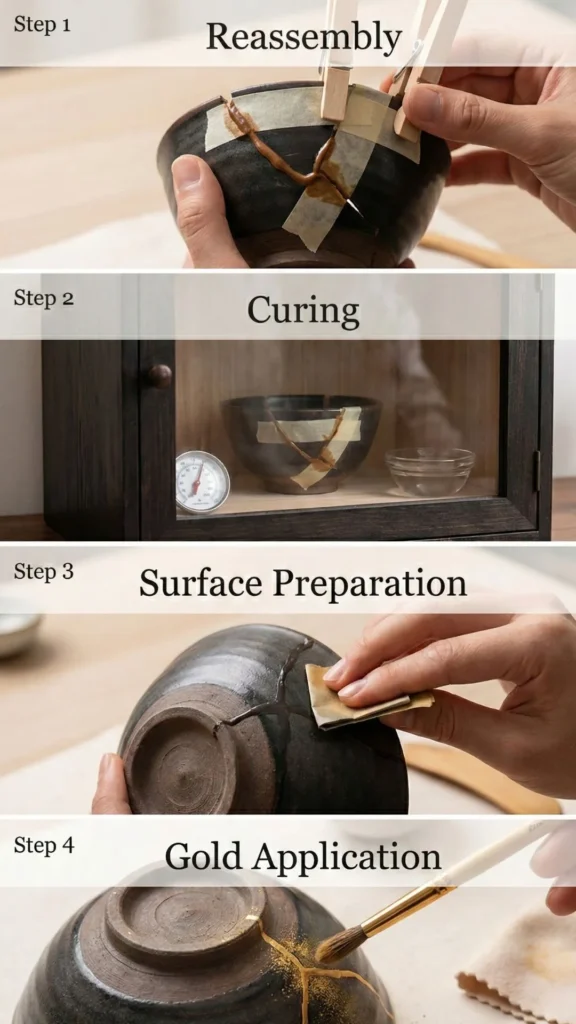
The traditional process unfolds in careful stages:
Step 1 — Reassembly. Broken pieces are fitted together and bonded using urushi lacquer mixed with flour or clay powder to create a strong adhesive. This requires precision—each fragment must align exactly.
Step 2 — Curing. The lacquer must cure in a controlled humid environment (muro chamber) for days or weeks. Unlike synthetic glues that dry by evaporating solvents, urushi polymerizes in the presence of moisture—an almost poetic reversal where dampness creates strength.
Step 3 — Surface preparation. Once cured, excess lacquer is carefully scraped and sanded to create a smooth surface along the repair lines.
Step 4 — Gold application. A final coat of urushi is applied to the seams, and while still tacky, fine gold powder is dusted onto the surface using a soft brush. After another curing period, excess gold is gently polished away.
The result is a piece that is structurally sound, food-safe (when properly cured), and visually transformed. The golden lines are permanent—they will outlast the ceramic itself.
Try It Yourself: A Beginner’s Guide
While traditional urushi kintsugi requires specialized materials and considerable patience (plus caution, as raw urushi can cause skin irritation similar to poison ivy), modern alternatives make the practice accessible to beginners.
Modern Kintsugi Kits
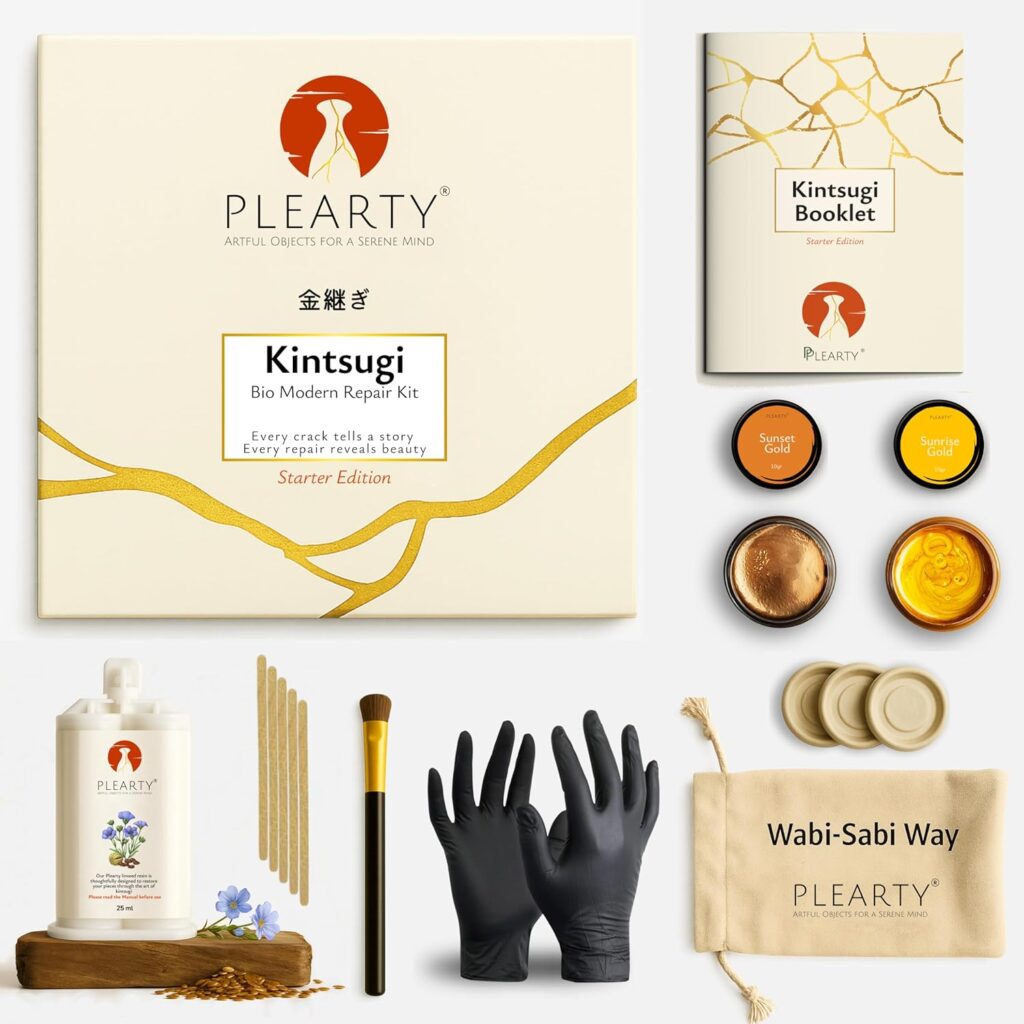
Several companies now produce kintsugi repair kits that use food-safe epoxy or ceramic adhesive combined with gold powder or gold-effect paint. These kits simplify the process to a single afternoon while preserving the essential experience: the meditative attention to broken pieces, the creative acceptance of damage, and the satisfaction of transformation.
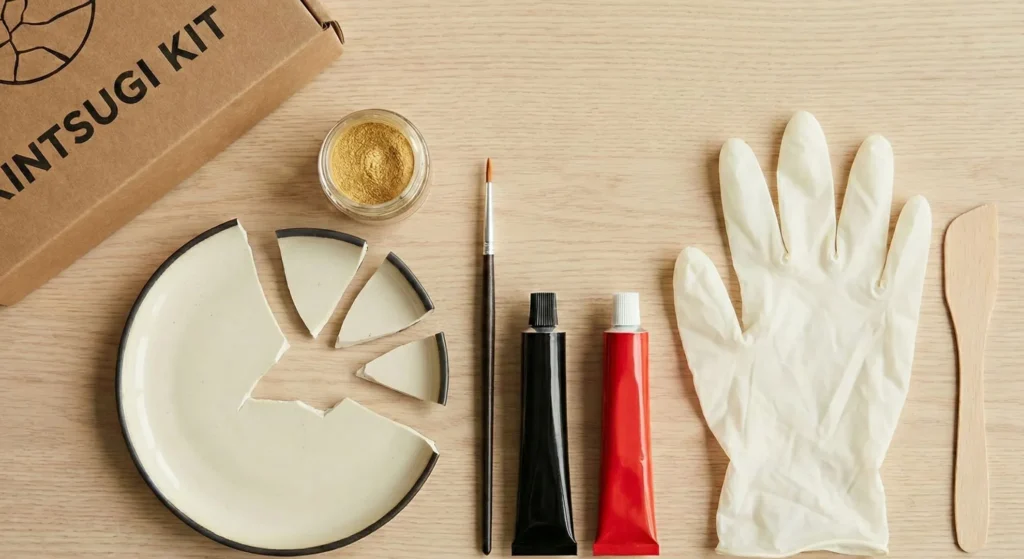
What You Need
For modern kintsugi:
- A broken ceramic piece (a plate, bowl, or mug—something meaningful to you)
- Kintsugi kit (includes adhesive, gold powder, mixing tools, and brush) or:
- Food-safe epoxy adhesive
- Mica gold powder or genuine gold powder
- Fine-tip brush
- Sandpaper (400-600 grit)
- Painter’s tape
- Disposable gloves
- A clean, well-lit workspace
Step-by-Step Beginner Method
1. Clean the pieces. Wash all fragments thoroughly and dry completely. Ensure no dust or grease remains on the broken edges—clean surfaces bond more effectively.
2. Dry fit. Before applying any adhesive, arrange all pieces to understand how they fit together. For complex breaks, consider numbering the fragments with pencil marks to track reassembly order.
3. Mix the adhesive. Following your kit instructions, mix the epoxy with a small amount of gold powder. This creates a gold-tinted adhesive that will be visible along the seam lines—the essence of kintsugi’s honesty.
4. Bond the pieces. Apply the gold-mixed adhesive to the broken edges and press the pieces together firmly. Use painter’s tape to hold them in position while the adhesive sets. Work in stages if the piece broke into multiple fragments—secure two pieces first, let them cure, then add the next.
5. Cure. Allow the adhesive to cure fully according to the product instructions—typically 24 hours for epoxy. Patience here is itself a practice.
6. Refine. Once cured, gently sand any excess adhesive with fine-grit sandpaper. Apply additional gold powder with a fine brush along the seam lines for a more pronounced golden effect.
7. Seal (optional). For pieces that will hold food or liquid, apply a food-safe clear sealant over the repair.
The Practice, Not Just the Product
As you work, notice something: kintsugi demands presence. Fitting broken pieces together requires careful attention. Applying adhesive to fine edges requires a steady hand and a quiet mind. There is no way to rush the curing process.
This is not accidental. Kintsugi is, in its deepest sense, a contemplative practice. The hands are busy, the mind grows still, and in that stillness you may begin to understand why Zen monks have valued this art for five centuries.
Comprehensive guide: How to Practice Zazen at Home
Kintsugi as Life Philosophy
In recent years, kintsugi has become a powerful global metaphor for resilience, healing, and growth through adversity. Therapists reference it when discussing recovery from trauma. Self-help authors invoke it as an image of post-traumatic growth. Social media is filled with kintsugi-inspired quotes about embracing one’s scars.
There is genuine wisdom in this metaphorical application—but also a risk of oversimplification. The Zen understanding of kintsugi is not simply “what doesn’t kill you makes you stronger.” It is subtler than that.
Kintsugi does not promise that breaking makes you better. It does not glorify suffering. What it offers instead is a shift in perspective: damage is not the end of the story, and the attempt to return to an unblemished “before” state is both impossible and unnecessary. The golden seams do not erase the break. They integrate it. The bowl is not restored to its original condition—it becomes something new, something that could only exist because of what happened to it.
This is the Zen teaching at the heart of kintsugi: reality includes both wholeness and fragmentation, and wisdom lies not in choosing one over the other but in finding beauty in the full truth.
Comprehensive guide: Zen Mindfulness in the Modern Workplace
Related guide: Mono no Aware: The Japanese Philosophy of Bittersweet Beauty
Related guide: Ikebana: The Japanese Art of Flower Arrangement and Its Zen Roots
Related guide: Wabi-Sabi Interior Design: A Room-by-Room Guide to Living with Imperfection
Related guide: Japandi Style: Where Japanese Wabi-Sabi Meets Scandinavian Design
Related guide: Furoshiki: The Japanese Art of Wrapping and the Philosophy of One Cloth
FAQ
Q: Is kintsugi food-safe? A: Traditional kintsugi using fully cured urushi lacquer and genuine gold is food-safe—Japanese artisans have used urushi for food vessels for thousands of years. However, the lacquer must cure completely, which takes several weeks. Modern epoxy-based kintsugi kits vary: check the product specifications, and if in doubt, use the repaired piece for decorative purposes rather than daily dining.
Q: How much does professional kintsugi repair cost? A: Professional traditional kintsugi ranges from approximately $100 to $500+ depending on the complexity of the break, the number of fragments, and whether genuine gold or silver is used. The cost reflects the time-intensive process—multiple stages of lacquer application and curing over weeks. For sentimental pieces, many owners find the investment worthwhile.
Q: Can I use any broken ceramic for kintsugi? A: Most broken ceramics work well—porcelain, stoneware, earthenware, and even glass. Pieces that have shattered into very fine fragments are more challenging. Ideally, start with a piece that has broken into two to four large sections with clean break lines. Heavily chipped rims and hairline cracks are also excellent candidates.
Q: How long does kintsugi take? A: Modern kit-based kintsugi can be completed in one to two days (including curing time). Traditional urushi kintsugi requires three to four weeks minimum, as each lacquer layer needs extended curing in humid conditions. The waiting is itself part of the practice.
Q: Where can I see kintsugi in Japan? A: Several museums in Japan display kintsugi pieces, including the Tokyo National Museum, the Kyoto National Museum, and the MOA Museum of Art in Atami. Many Kyoto tea houses also use kintsugi-repaired wares in their ceremonies—experiencing tea from a gold-seamed bowl is unforgettable.
Related guide: 10 Must-Visit Zen Temples in Kyoto
The Gold Between the Cracks
Kintsugi asks a disarmingly simple question: what if the most beautiful thing about an object is what happened to it?
In a culture of disposability—where a cracked screen means a new phone and a chipped plate means the trash bin—kintsugi offers a radical alternative. It suggests that repair is a creative act. That history, even painful history, adds value rather than subtracting it. That the honest acknowledgment of damage is more beautiful than the illusion of perfection.
Pick up a broken cup that you have been meaning to throw away. Turn the fragments over in your hands. Imagine them joined with gold.
Then consider: what in your own life might be worth repairing rather than discarding?
Comprehensive guide: Japanese Zen Garden Design
References
- Koren, L. (1994). Wabi-Sabi for Artists, Designers, Poets & Philosophers. Imperfect Publishing.
- Juniper, A. (2003). Wabi Sabi: The Japanese Art of Impermanence. Tuttle Publishing.
- Bartlett, C. (2008). Flickwerk: The Aesthetics of Mended Japanese Ceramics. Herbert Press.
- De Waal, E. (2015). The White Road: Journey into an Obsession. Farrar, Straus and Giroux.
- Suzuki, D. T. (1959). Zen and Japanese Culture. Princeton University Press.
- Okakura, K. (1906). The Book of Tea. Putnam’s Sons.
- Kopplin, M. (2008). Gold und Lack: Das ostasiatische Abenteuer der europäischen Lackmöbel. Hirmer Verlag.