Ikebana (生け花, “making flowers alive”) is the Japanese art of flower arrangement, also known as kadō (花道, “the way of flowers”). One of Japan’s three classical arts of refinement alongside chadō and kōdō, ikebana traces its origins to 15th-century Buddhist temple offerings and was formalized through schools such as Ikenobō, Ohara, and Sogetsu. Unlike Western floral arrangements that emphasize abundance and color, ikebana focuses on line, form, and the meaningful use of empty space (ma). Built on an asymmetric triangular structure of three main branches—shin (truth), soe (supporting), and hikae (contrasting)—each arrangement is an exercise in impermanence (mujō), designed to be appreciated precisely because it will not last.
One Flower, One Universe
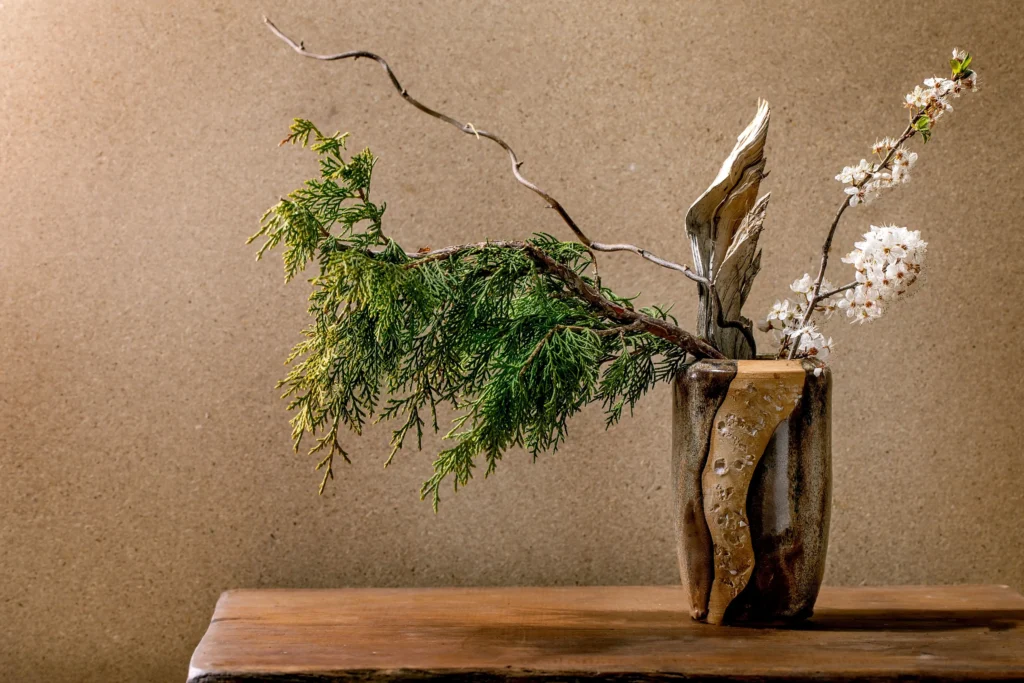
Walk into a Western florist and you will find bouquets designed by addition—more stems, more colors, more fullness. Walk into a Japanese tea room and you may find a single branch of plum blossom in a rough ceramic vessel, leaning slightly to one side, with a space of emptiness around it that feels as deliberate as the branch itself.
This is ikebana (生け花)—the Japanese art of flower arrangement. The name combines ikeru (生ける, “to give life”) and hana (花, “flower”), but this translation barely scratches the surface. Ikebana is not about decorating a room with flowers. It is about using flowers, branches, and empty space to express something that words cannot—the movement of seasons, the tension between growth and decay, the beauty of a single moment that will never repeat.
The practice has roots stretching back over six hundred years to Buddhist temple offerings, and its deepest principles are inseparable from the philosophy of wabi-sabi (侘び寂び)—the Japanese aesthetic of finding beauty in imperfection, impermanence, and incompleteness.
Comprehensive guide: Wabi Sabi : The Japanese Philosophy of Finding Beauty in Imperfection
Where a Western arrangement asks “How do I fill this vase?”, ikebana asks “What is the minimum I need to reveal the essential nature of these materials?” This reductive approach—finding abundance through restraint—is what makes ikebana one of the most meditative art forms in the Japanese tradition, and one of the most rewarding to learn.
This guide explores ikebana from its Buddhist origins to its three major schools, the Zen philosophy that shapes every arrangement, and everything you need to create your first composition at home.
From Temple Altar to Living Art
Buddhist Beginnings
Ikebana’s origins lie in kuge (供花)—the Buddhist practice of offering flowers at temple altars. When Buddhism arrived in Japan in the sixth century, monks placed flowers before Buddhist images as expressions of reverence and impermanence. These early arrangements were simple and symmetrical, their purpose devotional rather than artistic.
Comprehensive guide: What Is Zen Buddhism?
The transformation from devotional offering to art form began in the fifteenth century at Rokkaku-dō temple in Kyoto, where monks of the Ikenobō (池坊) lineage began developing formal principles for flower arrangement. The name Ikenobō literally means “by the pond”—a reference to the priests’ quarters beside the temple pond where these innovations took place.
The Three Revolutions
Ikebana’s evolution can be understood through three pivotal moments:
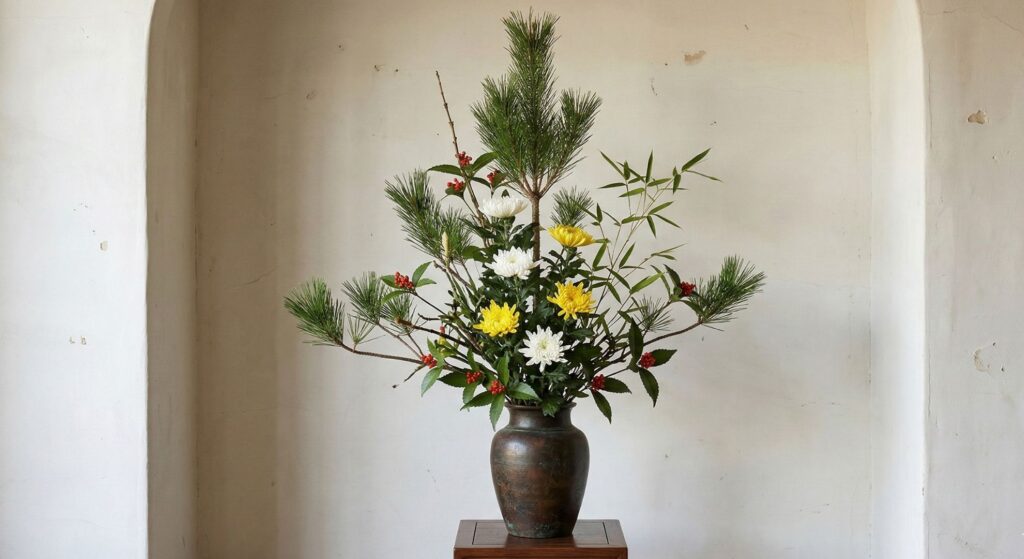
Rikka (立花, “standing flowers”), 15th–16th century. The first formal ikebana style, developed by Ikenobō Senkei. Rikka arrangements were elaborate, vertical compositions meant to represent the mythical Mount Sumeru—the center of the Buddhist cosmos. They could contain seven, nine, or more branches, each assigned a symbolic role representing elements of the natural landscape: distant mountains, waterfalls, valleys, and meadows.
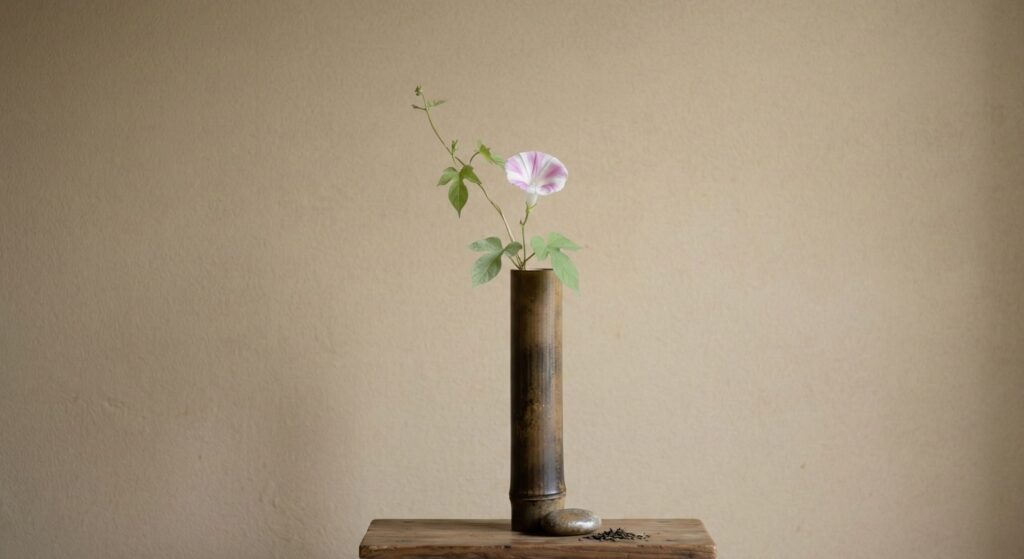
Chabana (茶花, “tea flowers”), 16th century. The tea master Sen no Rikyū revolutionized not only the tea ceremony but also the flower arrangements within the tea room. Rikyū rejected the elaborate rikka style in favor of radical simplicity—a single flower in a bamboo container, arranged to look as natural as if it had just been found growing in a field. This was ikebana filtered through Zen: stripped to its essence, freed from ostentation.
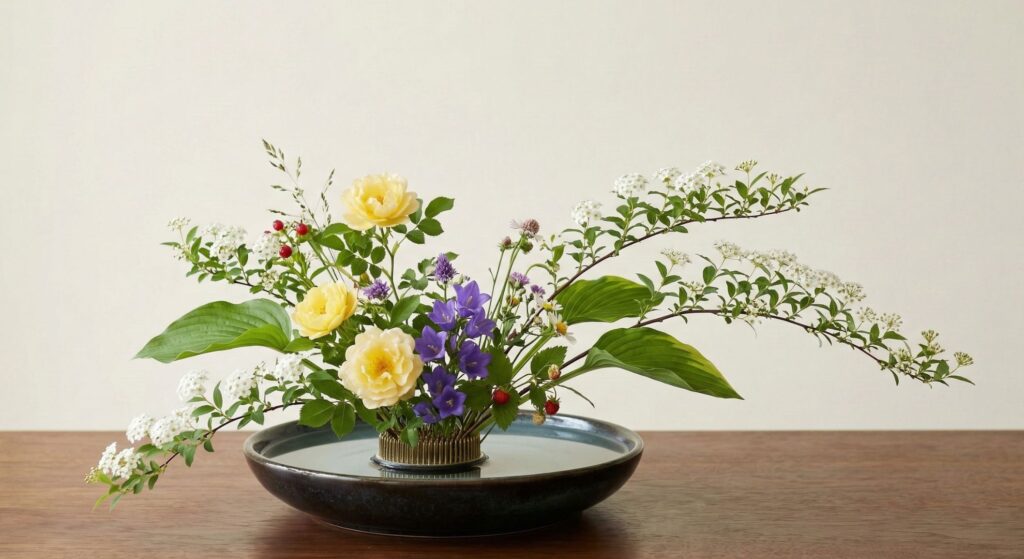
Moribana (盛花, “piled-up flowers”), early 20th century. Ohara Unshin created this style using shallow, wide containers and a kenzan (剣山, metal pin holder), allowing arrangements to spread horizontally rather than only vertically. Moribana opened ikebana to Western flowers and modern sensibilities, and remains the most accessible style for beginners today.
The Zen of Flowers: Philosophy in Practice
Ma: The Space Between
If there is one concept that separates ikebana from every other form of flower arrangement in the world, it is ma (間)—the Japanese understanding of meaningful emptiness. In ikebana, the spaces between branches are not voids waiting to be filled. They are compositional elements as important as the branches themselves.
A skilled ikebana practitioner thinks in terms of what to remove, not what to add. Every leaf that is stripped away, every secondary branch that is cut, creates space—and that space allows the remaining elements to breathe, to be truly seen. This is the same principle that governs the design of Zen rock gardens, where raked gravel and empty expanses give meaning to the stones they surround.
Comprehensive guide: Japanese Zen Garden Design
Asymmetry and Imperfection
Ikebana almost never uses symmetry. The fundamental structure of most arrangements is built on a triangle of three main lines—shin (真, truth/primary), soe (副, secondary/supporting), and hikae (控え, tertiary/contrasting)—placed at different heights and angles. This deliberate asymmetry creates visual tension and movement, preventing the arrangement from feeling static or complete.
A branch that curves unexpectedly, a stem that bends under the weight of its own blossom, a leaf with an insect’s bite taken from its edge—these are not flaws to be hidden. They are expressions of the natural world’s refusal to conform to human ideals of perfection. In this way, ikebana shares a philosophical foundation with kintsugi (金継ぎ), the art of repairing broken pottery with gold—both practices find beauty precisely where conventional aesthetics would see damage.
Related guide: Kintsugi: The Art of Golden Repair and Finding Beauty in Broken Things
Related guide: Sashiko: The Japanese Art of Stitching, Mending, and Finding Beauty in Repair
Related guide: Japanese Incense and Kōdō: The Ancient Art of Listening to Fragrance
Impermanence as the Point
Unlike a painting or sculpture, an ikebana arrangement is explicitly temporary. Flowers wilt. Branches dry. Water evaporates. The arrangement you create today will look different tomorrow and will be gone within a week. This is not a limitation—it is the teaching.
Every ikebana composition is an exercise in mujō (無常, impermanence)—the Buddhist understanding that nothing lasts, and that awareness of this transience is what gives each moment its depth. When you create an arrangement knowing it will not last, you bring a quality of attention to the work that is itself a form of meditation. You are not making something permanent. You are honoring something fleeting.
Three Schools, Three Philosophies
Modern ikebana is practiced through hundreds of schools, but three major traditions define the art. Understanding their differences helps you choose an approach that resonates with your own sensibility.
Ikenobō (池坊) — The Origin
Founded in the fifteenth century at Rokkaku-dō temple in Kyoto, Ikenobō is the oldest and most traditional school. Its arrangements tend toward formality and spiritual depth, with strong connections to Buddhist symbolism.
Style: Structured, often elaborate. Ikenobō preserves the classical rikka style alongside the simpler shōka (生花) form, which uses just three main stems in a tall, narrow vase. Philosophy: Nature as sacred. Each arrangement represents an idealized landscape—a microcosm of the natural world arranged with reverence. Best for: Students drawn to tradition, spiritual practice, and the meditative discipline of working within formal rules.
Sōgetsu (草月) — The Avant-Garde
Founded in 1927 by Teshigahara Sōfū, Sōgetsu broke radically from tradition. Teshigahara declared that ikebana could be practiced by anyone, anywhere, with any materials—including driftwood, metal, glass, and found objects.
Style: Free, experimental, sculptural. Sōgetsu arrangements often look more like contemporary art installations than traditional flower compositions. Philosophy: Individual expression. The artist’s creativity is paramount; rules exist to be understood and then transcended. Best for: Artists, designers, and those who want ikebana as a creative practice without strict traditional constraints.
Ohara (小原) — The Bridge
Founded in 1895 by Ohara Unshin, this school created the moribana style—using shallow containers and a kenzan to allow horizontal, landscape-like compositions. Ohara was the first school to incorporate Western flowers into ikebana.
Style: Naturalistic, landscape-oriented. Ohara arrangements often evoke scenes from nature—a meadow, a riverbank, a forest clearing. Philosophy: Harmony between Japanese and Western aesthetics. Nature as seen through human eyes, but not idealized beyond recognition. Best for: Beginners, those who appreciate both Eastern and Western floral traditions, and anyone drawn to naturalistic rather than abstract compositions.
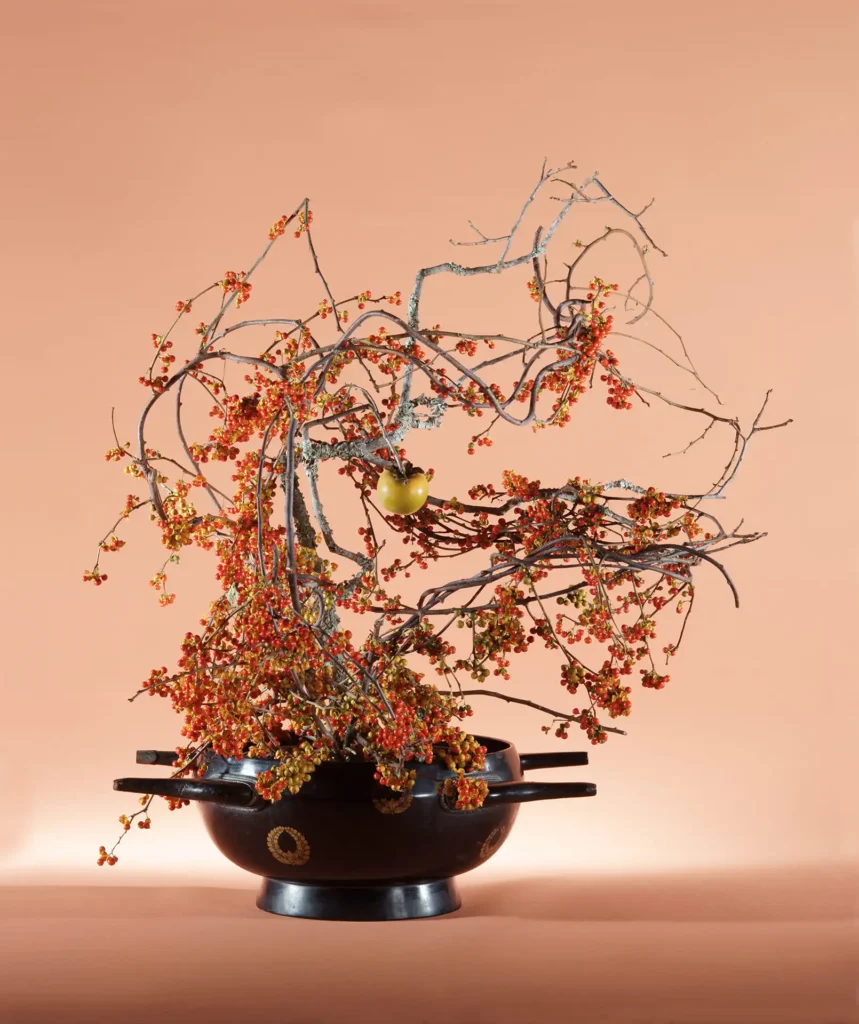
Work by Akane Teshigahara, Iemoto (Photo: Chukyo Ozawa)
Getting Started: Your First Ikebana Arrangement
You do not need years of study to begin practicing ikebana. The moribana style, with its shallow container and kenzan, is designed for accessibility. Here is what you need and how to create your first arrangement.
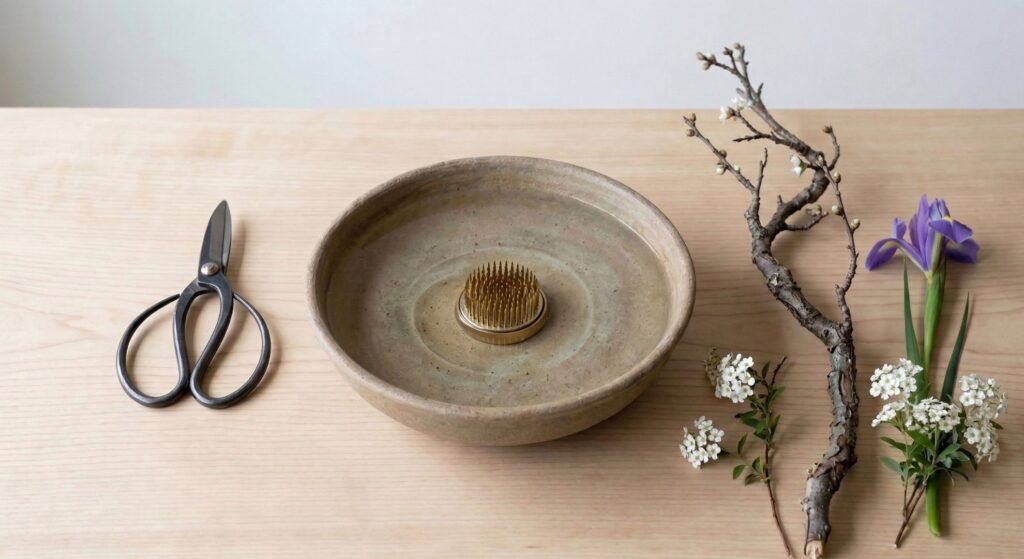
Essential Materials
Kenzan (剣山) — Pin Holder. A heavy metal disc studded with sharp brass pins that holds stems in place. This is the foundation of moribana-style ikebana. A 7–8cm round kenzan is ideal for beginners.
Vessel. A shallow, wide bowl or dish—ceramic, glass, or even a simple plate with a low rim. The vessel should be understated; it supports the arrangement without competing with it.
Hasami (花鋏) — Flower Scissors. Traditional ikebana scissors with short, thick blades designed for cutting woody stems as well as soft flower stalks. Standard garden shears will work initially, but proper hasami make cleaner cuts.
Plant Material. For your first arrangement, gather three elements from your garden, a market, or even a walk through your neighborhood:
- One branch (something with an interesting line or curve—this becomes shin, your primary line)
- One or two flowers (these become soe and hikae)
- A few leaves for accent and grounding
Creating Your First Moribana Arrangement
Step 1: Observe your materials. Before you touch your kenzan, spend a few minutes simply looking at your branch and flowers. Turn them in your hands. Notice where they curve naturally, which side catches the light, where the leaves cluster. Ikebana begins not with doing but with seeing.
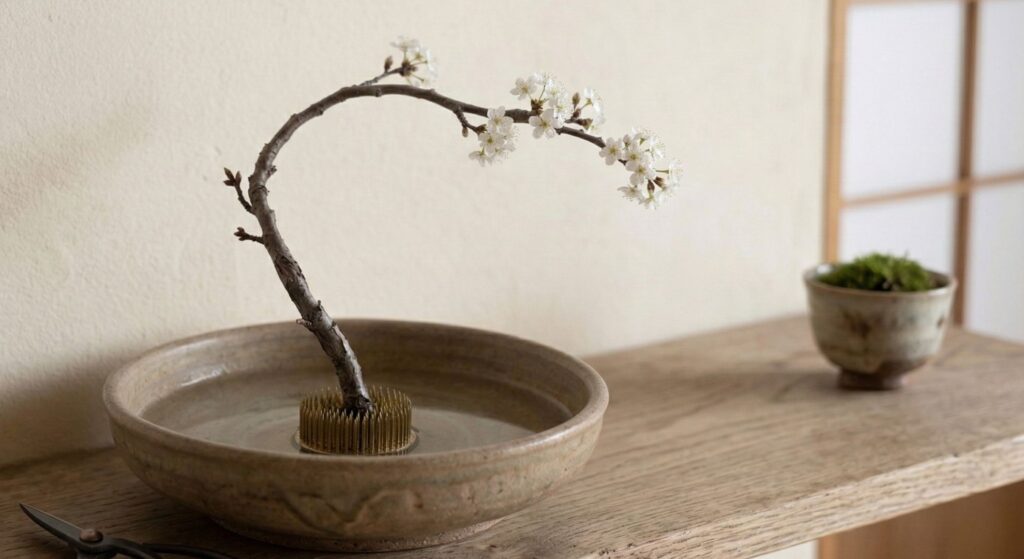
Step 2: Establish the primary line (shin). Cut your main branch to approximately 1.5 times the width of your vessel. Press it firmly into the kenzan at a slight angle—not vertical, not horizontal, but leaning forward or to one side. This asymmetry is essential.
Step 3: Add the secondary element (soe). Place your second stem at roughly two-thirds the height of the first, angling it in a different direction. The relationship between shin and soe creates the tension that gives the arrangement its energy.
Step 4: Complete with the tertiary element (hikae). The shortest stem, placed low and forward, grounds the composition and connects it visually to the vessel and the water surface.
Step 5: Edit ruthlessly. Remove any leaf or secondary branch that clutters the composition. In ikebana, every cut is a creative decision. Ask yourself with each element: does this serve the arrangement, or does it distract? When in doubt, remove it.
Step 6: Add water. Fill the vessel so the water is visible but not overflowing—the water surface becomes part of the composition, reflecting light and creating a sense of depth.
Place your finished arrangement where you will see it throughout the day. Watch how it changes as the light moves. Notice when a flower begins to droop or a leaf begins to curl. This is not the arrangement failing—it is the arrangement teaching you about impermanence.
Deepening Your Practice
For those who wish to go further, several excellent books provide comprehensive instruction:
Other recommended titles include Diane Norman’s Ikebana: A Fresh Approach, which bridges traditional technique with contemporary design, and the Ikenobō school’s own published manuals for those drawn to the classical lineage.
For hands-on learning, ikebana classes are available in most major cities worldwide, and in Japan, visitor workshops provide an immersive introduction to the tradition.
Experiencing Ikebana in Japan
While ikebana can be practiced anywhere in the world, seeing it in its cultural context in Japan adds a dimension that no book or class can replicate.
Ikenobō Headquarters, Rokkaku-dō Temple, Kyoto. The birthplace of ikebana. Ikenobō still operates from Rokkaku-dō, offering exhibitions and workshops. The annual exhibition in November fills the temple complex with hundreds of arrangements from practitioners around the world.
Sōgetsu Kaikan, Aoyama, Tokyo. The Sōgetsu school’s striking modernist headquarters, designed by Tange Kenzō, hosts rotating exhibitions and beginner workshops. The building itself—with its concrete forms and open spaces—embodies the school’s philosophy of bridging tradition and contemporary art.
Temple Ikebana. Many Zen temples display seasonal ikebana in their entrance halls and reception rooms. These are not museum exhibits—they are living expressions of the temple’s attention to the passing season. If you are visiting Kyoto’s temples, look for the small, often exquisite arrangement in the tokonoma (alcove) of any room open to visitors.
Related guide: 10 Must-Visit Zen Temples in Kyoto: Complete Visitor Guide
Related guide: Japanese Calligraphy (Shodō): The Zen Art of Brush and Ink
FAQ
Q: What does ikebana mean?
A: Ikebana (生け花) combines ikeru (生ける, “to arrange” or “to give life”) and hana (花, “flower”). The name suggests not merely arranging flowers but bringing them to life—revealing the essential nature of the materials through thoughtful composition. A more literal translation might be “living flowers” or “making flowers alive.”
Q: What are the basic rules of ikebana?
A: While rules vary by school, the fundamental principles include: use asymmetry rather than symmetry; work with odd numbers of stems; respect the natural growth direction of each material; leave space (ma) as a deliberate compositional element; use a triangular structure of primary, secondary, and tertiary lines (shin, soe, hikae); and always consider the relationship between the arrangement and its vessel. The deepest rule is simplicity—remove rather than add.
Q: How is ikebana different from Western flower arranging?
A: Western flower arranging typically aims for fullness, symmetry, and abundance—filling a vase with blooms of complementary colors. Ikebana works in the opposite direction: it uses minimal materials, embraces asymmetry, treats empty space as a compositional element, and includes branches, leaves, and even bare stems alongside flowers. The goal is not decoration but expression—each arrangement conveys a relationship between the materials, the season, and the surrounding space.
Q: Do I need to join a school to practice ikebana?
A: No. While formal study under a licensed instructor is the traditional path—and offers structured progression through increasingly complex techniques—you can begin practicing the principles of ikebana independently. Start with the moribana style described above, study books and online resources, and focus on developing your eye for line, space, and seasonal awareness. Many people find that even informal practice brings a meditative quality to their relationship with flowers and natural materials.
Q: What flowers are best for ikebana?
A: Ikebana uses whatever the season offers. In spring: cherry blossom branches, iris, tulips. Summer: hydrangea, lily, lotus. Autumn: chrysanthemum, maple branches, pampas grass. Winter: pine, camellia, narcissus. The key is not the species but the quality—choose materials with interesting lines, varied textures, and natural character. A single branch with a compelling curve is worth more in ikebana than a dozen perfect roses.
The Flower Teaches the Arranger
There is a saying in Ikenobō tradition: Hana wa hito no kokoro (花は人の心)—”Flowers reflect the heart of the person.” The arrangement you create reveals not your technical skill but your quality of attention. Are you rushing, or are you present? Are you imposing your will on the materials, or are you listening to what they want to become?
This is why ikebana has been practiced alongside Zen for centuries. Both disciplines ask the same question: can you be fully present with what is in front of you, right now, without adding anything unnecessary?
Comprehensive guide: Wabi Sabi : The Japanese Philosophy of Finding Beauty in Imperfection
You do not need a temple, a certification, or rare Japanese flowers to begin. You need a branch, a bowl, some water, and the willingness to spend twenty minutes seeing—really seeing—what nature has offered you today. Cut away what does not belong. Leave space for what remains to breathe.
In that space, something will appear that you did not plan. That is ikebana.
References
- Sato, S. (2013). Ikebana: The Art of Arranging Flowers. Tuttle Publishing.
- Norman, D. (2017). Ikebana: A Fresh Approach. Timber Press.
- Ikenobō Sen’ei. (2006). The Essence of Ikenobō Ikebana. Ikenobō Society of Floral Art.
- Koren, L. (1994). Wabi-Sabi for Artists, Designers, Poets & Philosophers. Imperfect Publishing.
- Richie, D. (2007). A Tractate on Japanese Aesthetics. Stone Bridge Press.
- Suzuki, D. T. (1959). Zen and Japanese Culture. Princeton University Press.