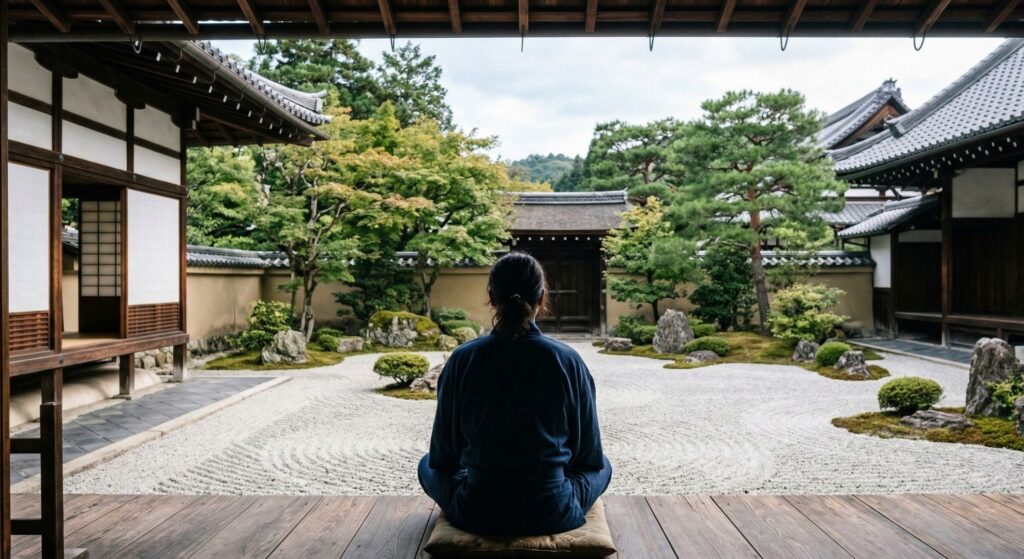
Kyoto’s Zen gardens represent the finest expressions of karesansui (枯山水, dry landscape) design in Japan, spanning over seven centuries of contemplative garden-making. From the iconic fifteen-stone arrangement at Ryōan-ji to the dramatic rock compositions of Daisen-in at Daitoku-ji, these gardens were created by Zen monks and master designers as physical expressions of Buddhist philosophy—impermanence, emptiness, and the unity of opposites. Kyoto remains the world’s richest concentration of Zen gardens because the city served as Japan’s imperial capital and the center of Zen culture throughout the Muromachi and Edo periods, attracting the patronage of shōguns, emperors, and tea masters who transformed temple grounds into landscapes of spiritual meaning.
Gardens That Think
Most garden guides tell you what to see. This one tells you what to think about while you are seeing it.
Kyoto’s Zen gardens are not parks. They are not scenic backdrops for photographs. They are philosophical arguments made from stone, gravel, moss, and empty space—designed not to please the eye but to challenge the mind. Each garden encodes specific ideas about impermanence, emptiness, and the nature of perception, and understanding even a fraction of this philosophy transforms a brief temple visit into something that stays with you long after you leave Japan.
The city contains dozens of Zen gardens, but a handful rise above the rest—not only for their beauty but for the depth of thought embedded in their design. This guide covers the essential gardens, the philosophy behind each one, and the practical information you need to visit them well.
Comprehensive guide: What Is Zen Buddhism?
Understanding Karesansui: The Dry Landscape Tradition
Before visiting individual gardens, it helps to understand the form they share. Most of Kyoto’s famous Zen gardens are karesansui (枯山水)—”dry mountain water” gardens that use stones and raked gravel to represent landscapes without using actual water. Mountains become boulders. Rivers become streams of white gravel. The ocean becomes an expanse of raked sand.
This tradition emerged in the Muromachi period (14th–16th century), when Zen Buddhism dominated Kyoto’s cultural life. The gardens were designed by monks and temple gardeners as physical expressions of Zen principles—spaces for meditation, contemplation, and the cultivation of insight.
The key to reading a karesansui garden is understanding that everything you see is also something you do not see. The gravel is water. The stones are mountains. The empty space is full of meaning. The garden exists as much in the viewer’s mind as it does in physical form—and different viewers, on different days, will see different things. This is intentional. A Zen garden does not deliver answers. It generates questions.
Comprehensive guide: Japanese Zen Garden Design: Principles, Symbolism, and How to Create Your Own
The Essential Gardens
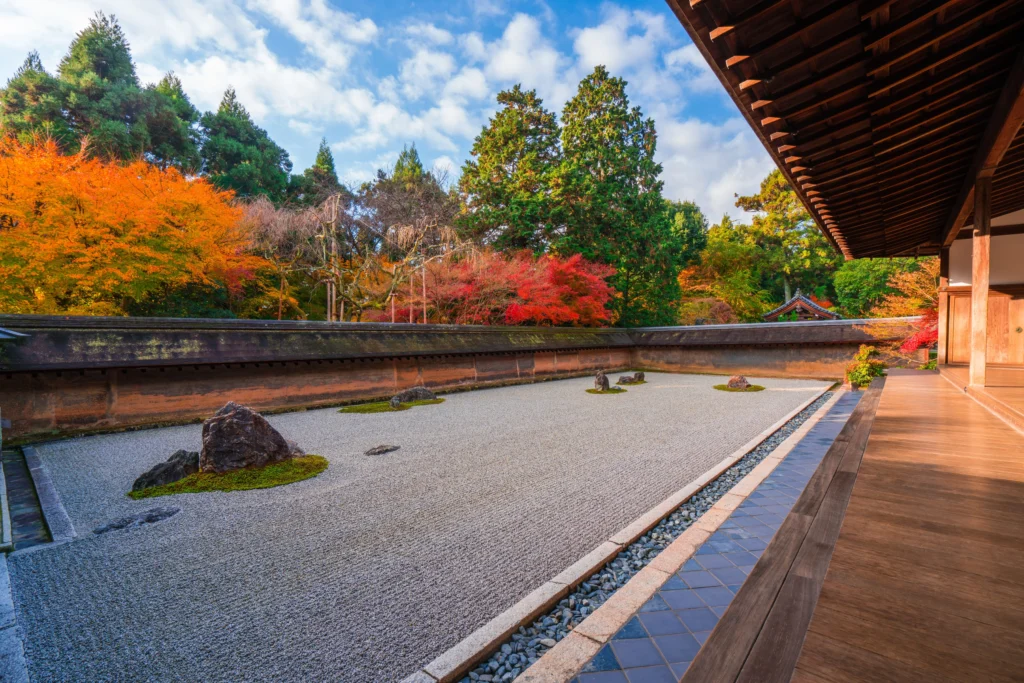
1. Ryōan-ji (龍安寺) — The Garden of Unknowing
The Garden: Fifteen stones arranged in five groups on a rectangle of raked white gravel, enclosed by a low earthen wall stained with age. That is all. No trees, no water, no flowers—just stones and space.
And yet Ryōan-ji is arguably the most famous garden in the world. It has been studied by philosophers, artists, mathematicians, and cognitive scientists for over five hundred years, and no one has definitively explained what it means. The stones are arranged so that from any seated position on the viewing veranda, at least one stone is always hidden from view—you can never see all fifteen at once. Whether this was intentional, and what it signifies, remains debated.
The Philosophy: Some scholars read the garden as islands in an ocean. Others see a tigress carrying cubs across a river—a reference to a Chinese Zen parable. Cognitive research has suggested that the arrangement creates subliminal tree-like branching patterns that produce a sense of calm. But perhaps the most Zen interpretation is the simplest: the garden resists explanation because it was designed to.
The experience of sitting before Ryōan-ji and not understanding is itself the teaching. The desire to decode, categorize, and explain is precisely the habit of mind that Zen practice aims to quiet. The garden asks you to sit with not-knowing—and to discover that not-knowing, held without anxiety, becomes a form of openness.
Visiting:
- Hours: 8:00–17:00 (March–November), 8:30–16:30 (December–February)
- Admission: ¥500
- Access: Bus #59 from Kyoto Station to Ryōan-ji-mae stop, or Keifuku Railway to Ryōan-ji station
- Time needed: 45–60 minutes
- Tip: Arrive at opening time. By mid-morning the veranda is crowded and the contemplative atmosphere is difficult to access. Early mornings in the off-season (January–February) offer the closest experience to sitting alone with the stones.
2. Daisen-in (大仙院) — The Universe in a Courtyard
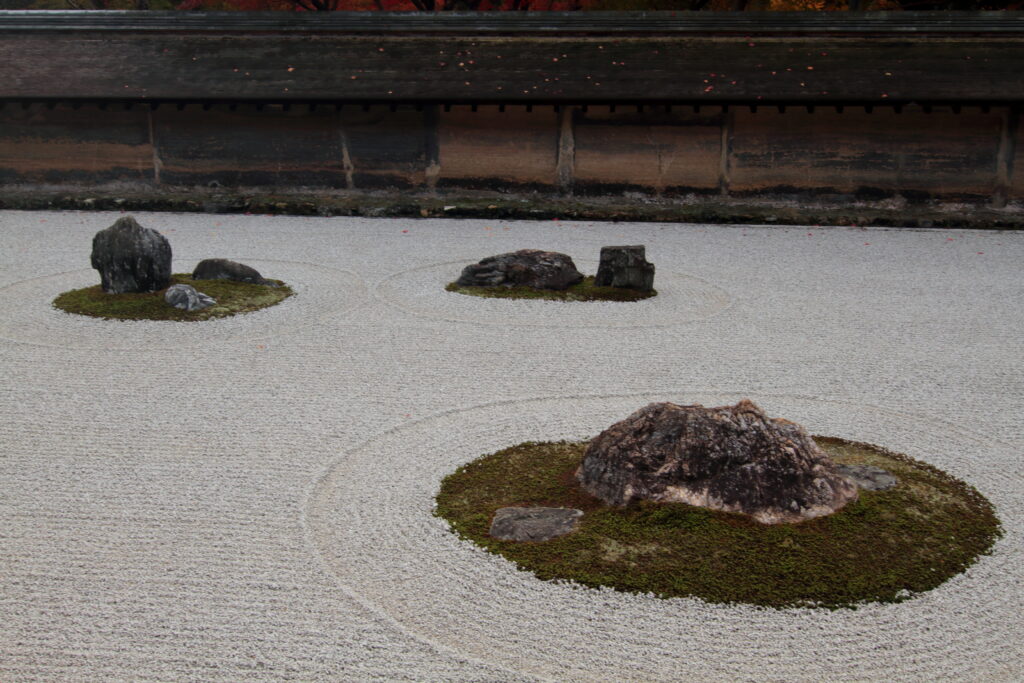
The Garden: Tucked within the vast Daitoku-ji temple complex, Daisen-in contains one of Kyoto’s most intricate and narratively rich Zen gardens in a remarkably small space. Two narrow L-shaped gardens wrap around the abbot’s quarters, using upright stones, white gravel, carefully placed rocks, and pruned shrubs to create what many consider a three-dimensional ink painting.
The Philosophy: Unlike Ryōan-ji’s radical abstraction, Daisen-in tells a story. The garden can be read as a metaphor for human life: water (represented by white gravel) begins as a narrow stream in the mountains (tall upright stones at the northeast corner), flows through a gorge, encounters obstacles (rocks placed in the stream’s path), passes under a bridge, and finally opens into a vast, calm ocean (the large expanse of raked gravel on the south side). The journey from turbulent mountain stream to still ocean mirrors the Zen path from agitation to equanimity.
A famous “treasure boat” stone sits in the river section, and the garden’s designer placed it facing upstream—sailing against the current. This is read as a metaphor for the Zen practitioner who moves toward difficulty rather than away from it.
Visiting:
- Hours: 9:00–17:00
- Admission: ¥500
- Access: Within Daitoku-ji complex. Bus #206 from Kyoto Station to Daitoku-ji-mae
- Time needed: 30–45 minutes
- Tip: The temple’s abbot is known for engaging visitors in informal Zen talks. If you visit when the temple is quiet, you may have this rare opportunity. Photography of the main garden is not permitted—bring your memory instead of your camera.
3. Tōfuku-ji Hōjō Gardens (東福寺方丈庭園) — Modernity Meets Tradition
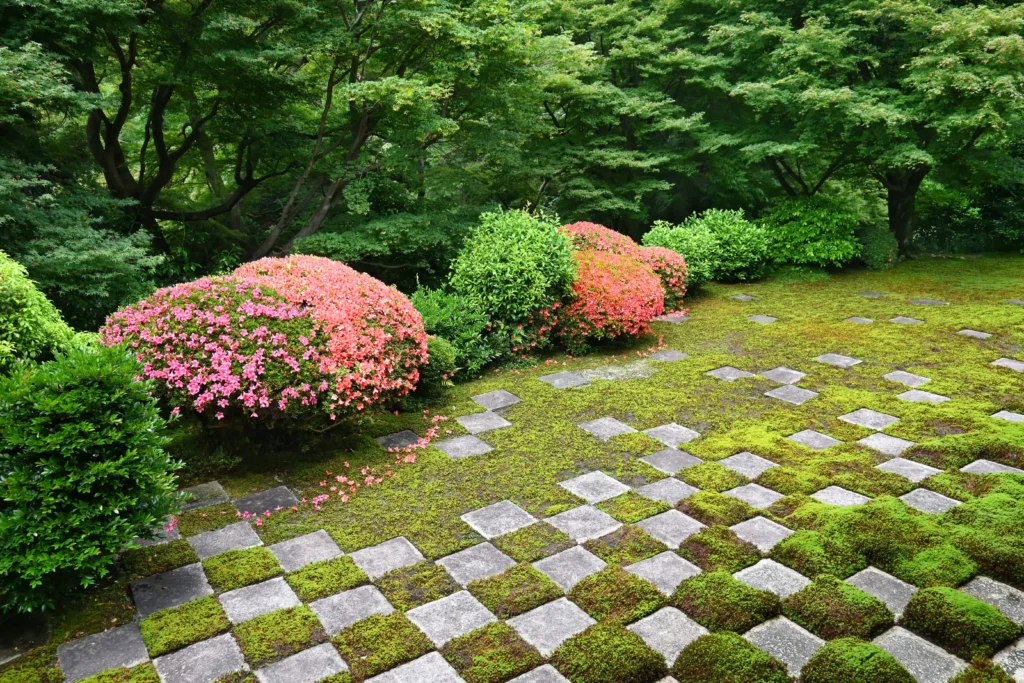
The Garden: Designed in 1939 by Shigemori Mirei (重森三玲), Japan’s most revolutionary modern garden designer, the four gardens surrounding Tōfuku-ji’s abbot’s hall are unlike anything else in Kyoto. Where traditional karesansui uses natural stones placed to appear unaltered, Shigemori introduced geometric patterns, checkered moss-and-stone grids, and sweeping curves of raked gravel that feel almost abstract-expressionist.
The Philosophy: Shigemori believed that garden design had become stagnant—trapped in imitation of historical models rather than expressing the living spirit of Zen. His Tōfuku-ji gardens demonstrate that tradition and innovation are not opposites. The north garden’s famous checkerboard pattern—alternating squares of moss and cut stone that gradually dissolve into randomness—is a meditation on the relationship between order and chaos, human intention and natural process.
The principle at work here is the same one that governs wabi-sabi (侘び寂び) aesthetics: perfection is not the goal. The beauty lies in the transition—in the space where control gives way to something unplanned.
Comprehensive guide: Wabi Sabi : The Japanese Philosophy of Finding Beauty in Imperfection
Visiting:
- Hours: 9:00–16:00
- Admission: ¥500 (Hōjō gardens); ¥600 (Tsūtenkyō bridge, autumn only—separate)
- Access: JR Nara Line or Keihan Line to Tōfuku-ji station, 10-minute walk
- Time needed: 45–60 minutes
- Tip: Tōfuku-ji is famous for autumn foliage (November), and the Tsūtenkyō bridge draws enormous crowds. Visit the Hōjō gardens first thing in the morning—most visitors go straight to the bridge, leaving the gardens relatively quiet.
4. Ginkaku-ji (銀閣寺) — The Silver Pavilion’s Sand Garden
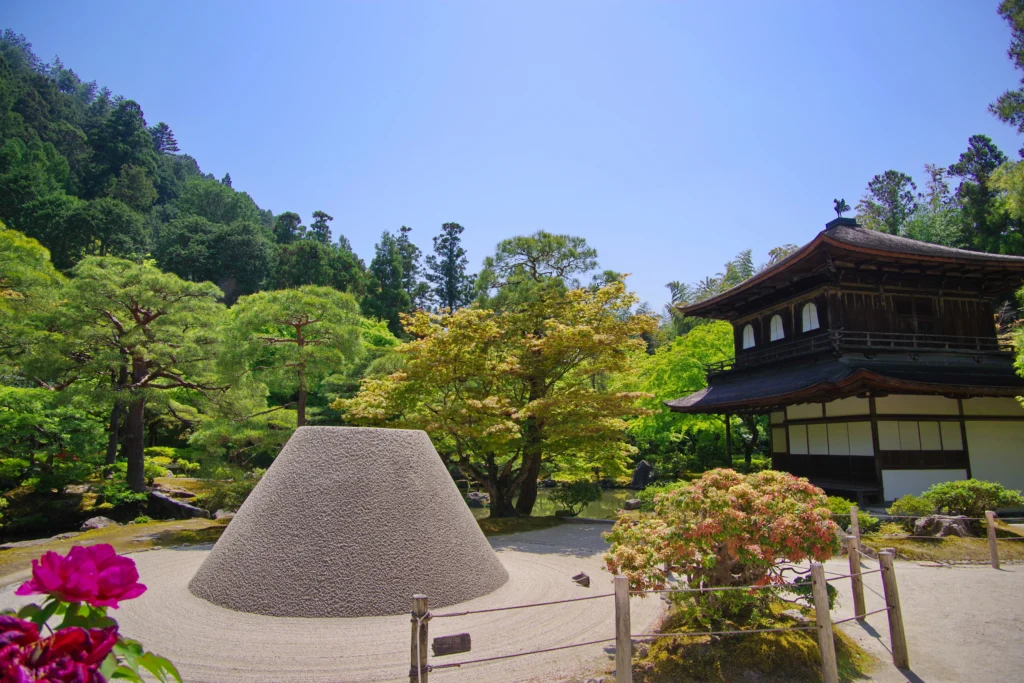
The Garden: Ginkaku-ji is technically not a Zen temple in the strict sense—it was built in 1482 as a retirement villa for Shōgun Ashikaga Yoshimasa. But its gardens, developed over centuries under Zen temple stewardship, contain one of Kyoto’s most striking visual experiences: the Ginshadan (銀沙灘), a raised platform of meticulously raked white sand, and the Kōgetsudai (向月台), a cone of sand said to represent Mount Fuji or, more poetically, a platform for viewing the moon reflected in the sand below.
The Philosophy: Ginkaku-ji’s sand garden works differently from Ryōan-ji or Daisen-in. Where those gardens are enclosed and intimate, the Ginshadan is an expansive, almost theatrical gesture—the sand catches and reflects moonlight, transforming the garden into a luminous field on clear nights. The aesthetic here is yūgen (幽玄)—the profound, mysterious beauty of things half-seen, half-imagined.
Yoshimasa built Ginkaku-ji during one of the most devastating periods in Japanese history—the Ōnin War had reduced much of Kyoto to ruins. That he chose to create a space of such refined beauty amid catastrophe speaks to a core Zen insight: meaning does not depend on circumstances.
Visiting:
- Hours: 8:30–17:00 (March–November), 9:00–16:30 (December–February)
- Admission: ¥500
- Access: Bus #5 or #17 from Kyoto Station to Ginkaku-ji-michi, then 10-minute walk along the Philosopher’s Path
- Time needed: 60 minutes (including the hillside walking path with panoramic views)
- Tip: Walk the Philosopher’s Path from Ginkaku-ji southward toward Nanzen-ji. The 2km canal-side path is itself one of Kyoto’s most meditative walks, lined with cherry trees and small temples.
5. Ryōgen-in (龍源院) — The Smallest and Most Intimate
The Garden: Also within the Daitoku-ji complex, Ryōgen-in contains several tiny gardens, including Totekiko (東滴壺)—reportedly the smallest rock garden in Japan. The entire garden fits in a space no larger than a few tatami mats, yet its composition—a handful of stones in raked gravel, representing drops falling into water and their expanding ripples—achieves an extraordinary sense of spaciousness.
The Philosophy: Ryōgen-in demonstrates that scale is irrelevant to depth. The garden’s power lies precisely in its smallness—there is nowhere for the eye or the mind to wander. You are confronted with a few stones and the concentric circles of raked gravel around them, and that is enough. This is Zen’s essential teaching about sufficiency: you do not need more. What is here, fully attended to, is complete.
The temple also contains Isshidan (一枝坦), a moss and stone garden representing the mythical islands of the immortals, and Kōdatei (滹沱底), a garden of raked sand and a single stone. Each is worth contemplating separately.
Visiting:
- Hours: 9:00–16:30
- Admission: ¥350
- Access: Within Daitoku-ji complex (same as Daisen-in)
- Time needed: 20–30 minutes
- Tip: Visit Ryōgen-in and Daisen-in together—they are within the same temple complex and offer complementary experiences (intimate and intricate versus narrative and expansive). Combined visit: approximately 60–75 minutes.
6. Nanzen-ji Hōjō Garden (南禅寺方丈庭園) — The Leaping Tiger
The Garden: Nanzen-ji is one of Kyoto’s most important Zen temples, and its abbot’s hall garden—attributed to the great garden designer Kobori Enshū—is a masterwork of suggestion. Known as the “Leaping Tiger Garden” (Tora no Ko Watashi), the arrangement of large flat stones and carefully placed rocks on raked white gravel is said to represent a tigress and her cubs crossing a river.
The Philosophy: The “tiger crossing” story connects the garden to a Chinese Buddhist parable about a tigress with three cubs, one of which is a leopard that would eat the others if left alone with them. The tigress must cross the river carrying one cub at a time, never leaving the leopard alone with a sibling. The puzzle—how to get all safely across—becomes a meditation on compassion, strategy, and the care required to protect the vulnerable.
But as with all Zen gardens, the narrative explanation is only one layer. Viewed without the story, the garden is simply an arrangement of extraordinary beauty—stones of varied sizes placed with such precision that they appear to have grown naturally from the gravel, as if the garden designed itself.
Visiting:
- Hours: 8:40–17:00 (March–November), 8:40–16:30 (December–February)
- Admission: ¥600 (Hōjō garden); Sanmon gate ¥600 extra (panoramic view of Kyoto)
- Access: Keage Station (Tozai Subway Line), 10-minute walk
- Time needed: 60–90 minutes (including the grounds, aqueduct, and Sanmon gate)
- Tip: The Meiji-era brick aqueduct running through the temple grounds is unexpected and photogenic—a collision of Zen aesthetics and industrial engineering that somehow works.
How to Visit: Practical Planning
Recommended Routes
Half-Day: The Daitoku-ji Circuit (3–4 hours) Daisen-in → Ryōgen-in → Kōtō-in (moss garden, not a karesansui but hauntingly beautiful). Three sub-temples within walking distance. This circuit offers the deepest concentration of Zen garden philosophy in one area.
Full-Day: West to East (6–7 hours) Ryōan-ji (morning, arrive at opening) → Kinkaku-ji area (optional) → Daitoku-ji (Daisen-in + Ryōgen-in) → lunch → Nanzen-ji → Philosopher’s Path → Ginkaku-ji (late afternoon).
Related guide: 10 Must-Visit Zen Temples in Kyoto
Transportation
A one-day Kyoto bus pass (¥700) covers most routes between these gardens. For the Tōfuku-ji and Nanzen-ji sections, JR and subway are more efficient.
Seasonal Considerations
Spring (March–April): Cherry blossoms frame several gardens. Philosopher’s Path is spectacular but extremely crowded.
Summer (June–September): Fewer tourists. Moss gardens (Kōtō-in, Saihō-ji) are at their most vivid green after the June rains. Heat and humidity can be intense.
Autumn (November–early December): Peak season. Tōfuku-ji and Nanzen-ji are famous for kōyō (紅葉, autumn color). Gardens with maple trees become extraordinary but very crowded.
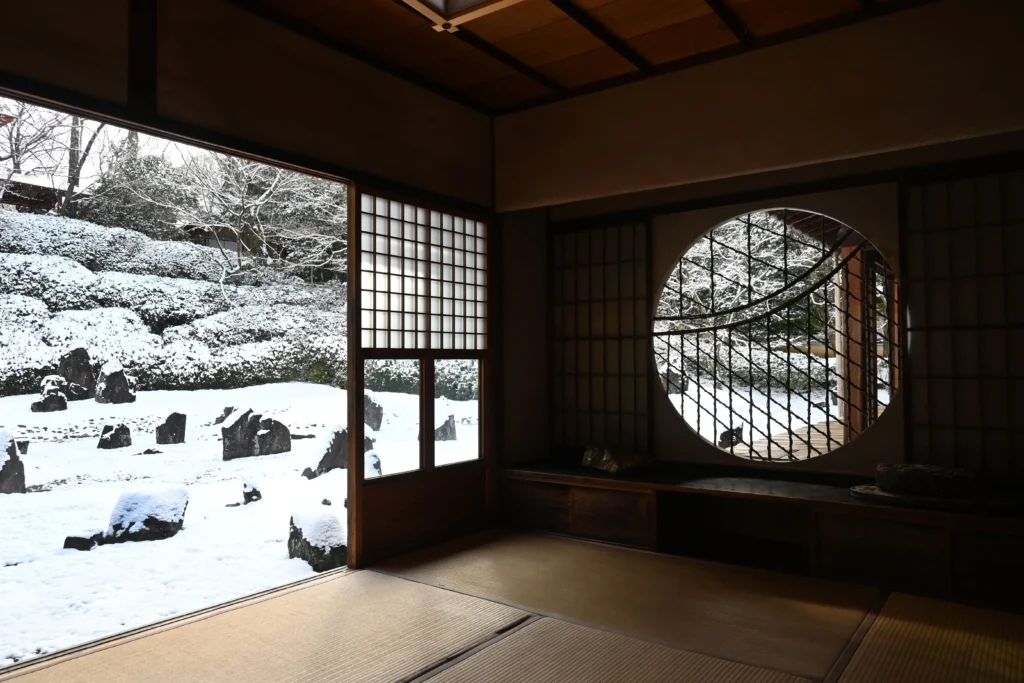
Winter (January–February): The ideal season for karesansui. Snow on raked gravel is one of Kyoto’s most transcendent sights. Few visitors. Cold but manageable.
Etiquette
Remove shoes where indicated—most temple interiors require it. Speak quietly. Karesansui gardens are typically viewed from a seated position on the veranda—sit down, be still, and give each garden at least ten minutes before moving on. Rushing through a Zen garden defeats the purpose of visiting one. Photography policies vary: Daisen-in prohibits photography of its main garden; most others allow it.
FAQ
Q: Which is the best Zen garden in Kyoto?
A: It depends on what you are looking for. Ryōan-ji is the most famous and the most philosophically radical—pure abstraction. Daisen-in offers the richest narrative depth in the smallest space. Tōfuku-ji shows how Zen garden design can be innovative and modern. For first-time visitors, Ryōan-ji is essential. For repeat visitors, Ryōgen-in’s intimacy and Tōfuku-ji’s boldness reward deeper exploration.
Q: How much time should I allow for visiting Zen gardens?
A: At minimum, 30–45 minutes per garden. Rushing defeats the purpose. A half-day at the Daitoku-ji complex (Daisen-in + Ryōgen-in) gives the deepest experience. A full day allows you to visit four or five gardens at a contemplative pace. Give each garden at least ten minutes of seated, silent viewing before moving on.
Q: Are the gardens accessible for visitors with mobility issues?
A: Most karesansui gardens are viewed from wooden verandas accessed by steps, which can be challenging. Ryōan-ji has improved accessibility in recent years. Tōfuku-ji’s Hōjō gardens are relatively accessible. Check individual temple websites or contact them directly for current accessibility information.
Q: Can I see the gardens being raked?
A: Monks typically rake the gravel early in the morning before visitors arrive. At Ryōan-ji, raking begins around 7:00 AM—well before the 8:00 opening. Occasionally you may witness maintenance during quieter periods, but it is not scheduled for public viewing.
Q: Are guided tours available?
A: Self-guided visits are the norm, and most gardens have some English signage. For deeper context, several English-speaking guides offer specialized Zen garden tours of Kyoto.
Sitting with Stone and Silence
There is a practice among Zen monks called shikan taza (只管打坐)—”just sitting.” No mantra, no visualization, no goal. Just sitting, with full awareness, in the present moment.
Comprehensive guide: How to Practice Zazen meditation at Home:Step-by-Step Guide for Beginners
Visiting a Kyoto Zen garden asks something similar of you. Just looking. Not analyzing, not photographing, not checking the next destination on your itinerary. Just looking at stone and gravel and the play of light across a surface that monks have raked fresh every morning for five hundred years.
The gardens do not explain themselves, and they do not need you to explain them. They ask only that you be present—fully, quietly present—for as long as you are willing to sit.
Comprehensive guide: Japanese Zen Garden Design: Principles, Symbolism, and How to Create Your Own
What you find in that silence belongs to you.