Shodō (書道, “the way of writing”) is the Japanese art of calligraphy, a meditative practice in which brush, ink, and paper become vehicles for expressing the calligrapher’s inner state. Rooted in Chinese calligraphic traditions brought to Japan alongside Buddhism in the 6th century, shodō evolved into a distinctly Japanese art form through the development of kana script and the influence of Zen aesthetics. Unlike Western calligraphy, which emphasizes uniformity and precision, shodō values the spontaneous, unrepeatable quality of each brushstroke—the speed, pressure, and breath of the artist captured permanently on paper. The ensō (円相), a circle drawn in a single brushstroke, is the most iconic expression of Zen calligraphy, representing enlightenment, emptiness, and the beauty of imperfection.

The Art of No Second Chance
Every form of writing allows revision. You can erase pencil, delete type, scratch out ink and start again. Japanese calligraphy permits none of this.
Shodō (書道)—literally “the way of writing”—is the Japanese art of brush calligraphy. The name places it among Japan’s dō (道) arts: disciplines where the practice itself is the path and the product is secondary to the process. Like kendō (the way of the sword) or sadō (the way of tea), shodō is not a skill to be mastered but a practice to be lived.
What makes shodō unique among the world’s calligraphic traditions is its relationship with Zen Buddhism. When a brush loaded with ink meets paper, there is no undo. The stroke records the exact speed, pressure, angle, and emotional state of the calligrapher at the moment of contact. Hesitation shows. Fear shows. Overthinking shows. The only way to produce beautiful calligraphy is to stop trying to produce beautiful calligraphy—to let the brush move from a mind that is present, relaxed, and empty of self-consciousness.
Comprehensive guide: Empty of self-consciousness.
This is why shodō has been practiced in Zen monasteries for centuries—not to produce art for display but to reveal the state of the practitioner’s mind. The brush does not lie. Every character is a portrait of the person who wrote it, at the precise moment they wrote it.
This guide explores the Zen philosophy behind Japanese calligraphy, the essential tools and techniques, and how to begin your own practice—whether at a desk in your home or at a workshop in Kyoto.
From China to Zen: A History in Brushstrokes
Chinese Roots, Japanese Spirit
Calligraphy arrived in Japan with Buddhism in the sixth and seventh centuries, carried by monks who brought Chinese sutras, writing systems, and the tools of brush and ink. For centuries, Japanese calligraphy closely followed Chinese models—the formal scripts of the Tang dynasty were the standard to emulate.
Comprehensive guide: Buddhism in the sixth and seventh centuries.
The transformation began in the Heian period (794–1185), when Japanese scribes developed kana (かな)—the flowing, cursive syllabaries that allowed the Japanese language to be written in its own voice rather than through Chinese characters alone. Kana calligraphy developed an aesthetic entirely distinct from its Chinese parent: softer, more fluid, with an emphasis on the expressive quality of the line itself rather than the structural precision of each character.
The Zen Brush
The deepest shift came with the arrival of Zen Buddhism in the Kamakura period (1185–1333). Zen monks did not approach calligraphy as scholars or artists. They approached it as practitioners—people trained in meditation who understood that the quality of any action reflects the quality of the mind performing it.
The great Zen calligraphers—Musō Soseki, Ikkyū Sōjun, Hakuin Ekaku—produced works that look nothing like the refined, perfectly balanced characters of court calligraphy. Their brushwork is wild, spontaneous, sometimes barely legible. A single character might fill an entire scroll, rendered in a single explosive stroke that captures an instant of insight.
This is bokuseki (墨跡, “ink traces”)—the calligraphic tradition of Zen masters, valued not for technical perfection but for the direct transmission of spiritual experience. A bokuseki scroll hanging in a tea room or temple alcove is not decoration. It is evidence of a mind in a state of awakened presence.
The Zen of the Stroke: Philosophy in Practice
Ichigo Ichie: One Stroke, One Moment
The tea ceremony principle of ichigo ichie (一期一会, “one time, one meeting”) applies with particular force to calligraphy. Each stroke happens once. It cannot be retouched, corrected, or repeated. The ink is either on the paper or it is not. The line either carries energy or it does not.
This irreversibility is what gives shodō its power as a Zen practice. In daily life, we habitually revise, reconsider, and redo. Calligraphy strips away this safety net and asks: can you act with full commitment, knowing there is no second chance? Can you accept whatever appears on the paper—including imperfection—as a true expression of this moment?
Comprehensive guide: Accept whatever appears—including imperfection.
Wabi Sabi : The Japanese Philosophy of Finding Beauty in Imperfection
Breath and Brush
Experienced calligraphers describe a direct connection between breathing and the brush. The stroke begins with an inhalation—the moment of gathering intention. The brush meets the paper on the exhalation—the moment of release. A long, slow exhalation produces a steady, flowing line. A sharp exhale produces a bold, decisive stroke. Holding the breath produces tension that shows immediately in the line.
This breath-brush connection is not metaphorical. It is physiological. The same nervous system regulation that meditation cultivates—calm breathing, relaxed shoulders, steady hands—directly produces better calligraphy. In this way, shodō becomes a biofeedback practice: the paper shows you, without flattery, whether your body and mind are settled or agitated.
Ma: The Space That Speaks
As in ikebana (生け花) and Zen garden design, the empty space in calligraphy is as important as the strokes themselves. The white paper surrounding and contained within each character is not unused space—it is ma (間), the meaningful emptiness that gives form its definition.
Related guide: ikebana (生け花) and Zen garden design.
Relate guide: Haiku: The Zen Art of Saying Everything in Seventeen Syllables
A character crammed into its space without room to breathe feels suffocating. The same character given generous margins feels expansive and alive. Learning to see and value the empty space—to resist the urge to fill every surface—is one of shodō’s most transferable lessons.
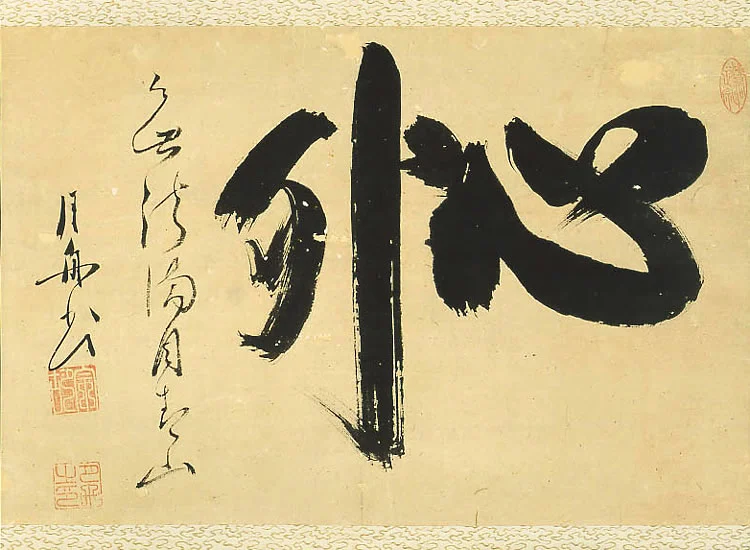
Source: Haginotera Temple – Treasure: Shingemuhou
Artist: Gesshu Soko (1618–1696)
A Zen ink rubbing (Bokuseki) by Gesshu Soko, the restorer of the Soto Zen sect and the 21st abbot of Daijo-ji Temple. The bold characters represent a fundamental Zen teaching that truth and the universe are found within one’s own heart and mind.
Essential Tools: The Four Treasures
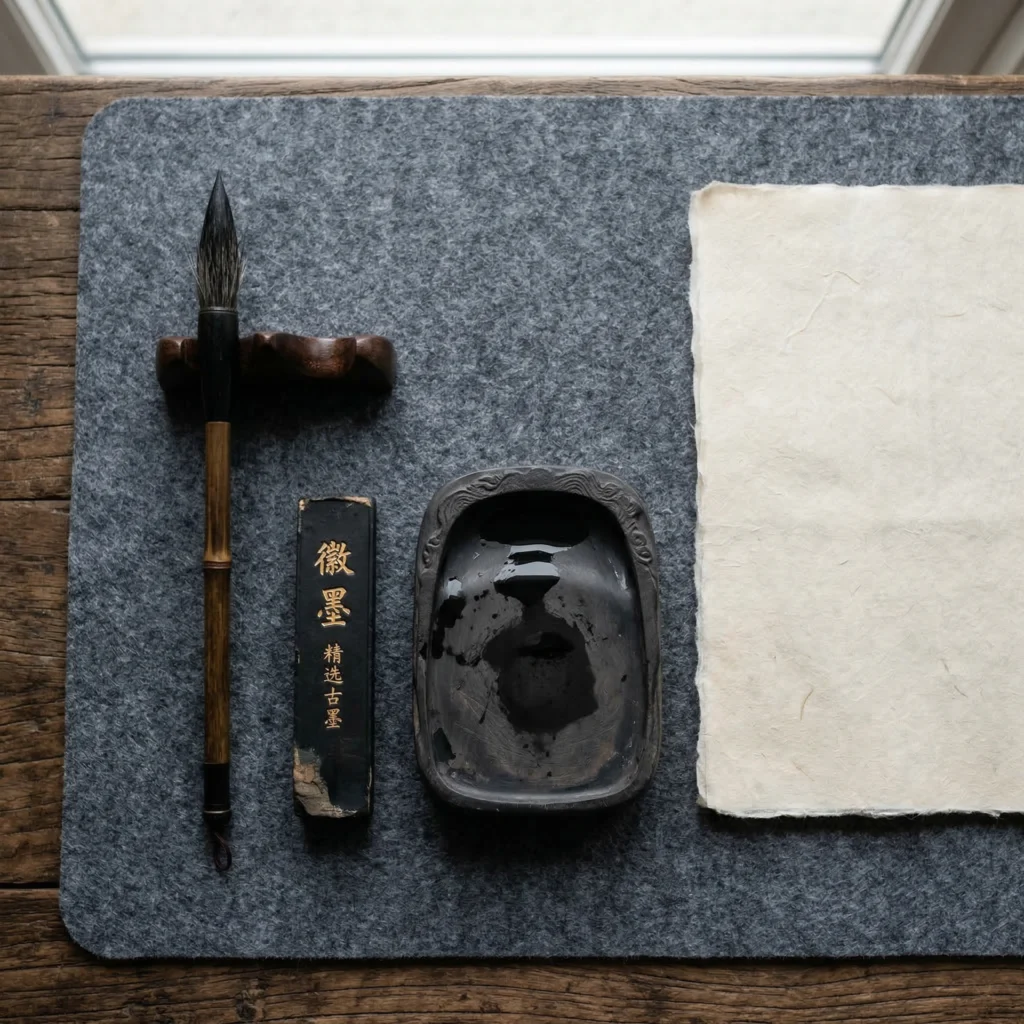
Japanese calligraphy uses the same core tools that have been used for over a thousand years. They are called bunbō shihō (文房四宝, “the four treasures of the study”):
Fude (筆) — The Brush
The calligraphy brush is the most important tool and the one that most rewards investment. Shodō brushes are made from animal hair—typically goat (soft, for flowing strokes), weasel or badger (firm, for sharp lines), or blends of both. The brush is held vertically, not at the angle used in Western writing. This vertical hold allows the tip to move in any direction with equal ease.
A beginner should start with a medium-sized, mixed-hair brush suitable for both practice and finished work. Avoid very cheap brushes—a poor brush fights the calligrapher rather than responding to their intention.
Sumi (墨) — The Ink
Traditional sumi ink comes in solid sticks that are ground on an inkstone with water. The grinding process is itself a meditative preparation—five to ten minutes of slow, circular motion that settles the mind before the brush touches paper. The density of the ink is controlled by the amount of water and time spent grinding: thick ink for bold, emphatic strokes; thin ink for subtle, transparent washes.
Bottled sumi ink (bokujū) is available for convenience and is perfectly acceptable for practice, though it lacks the subtle tonal range of freshly ground ink.
Suzuri (硯) — The Inkstone
A flat stone with a shallow well at one end, used for grinding the ink stick. Good inkstones are made from natural stone with a fine grain that efficiently breaks down the ink stick. The suzuri is also where you control the amount of ink on your brush—loading the brush from the well and adjusting the amount by pressing against the stone’s flat surface.
Hanshi (半紙) — The Paper
Shodō paper is thin, absorbent, and unforgiving—ink spreads immediately and cannot be lifted. Standard hanshi practice paper is inexpensive and available in packs of 100 sheets. For finished works, heavier gasenshi paper provides a more controlled surface with less bleeding.
Beginning Practice: Your First Strokes
Preparation as Practice
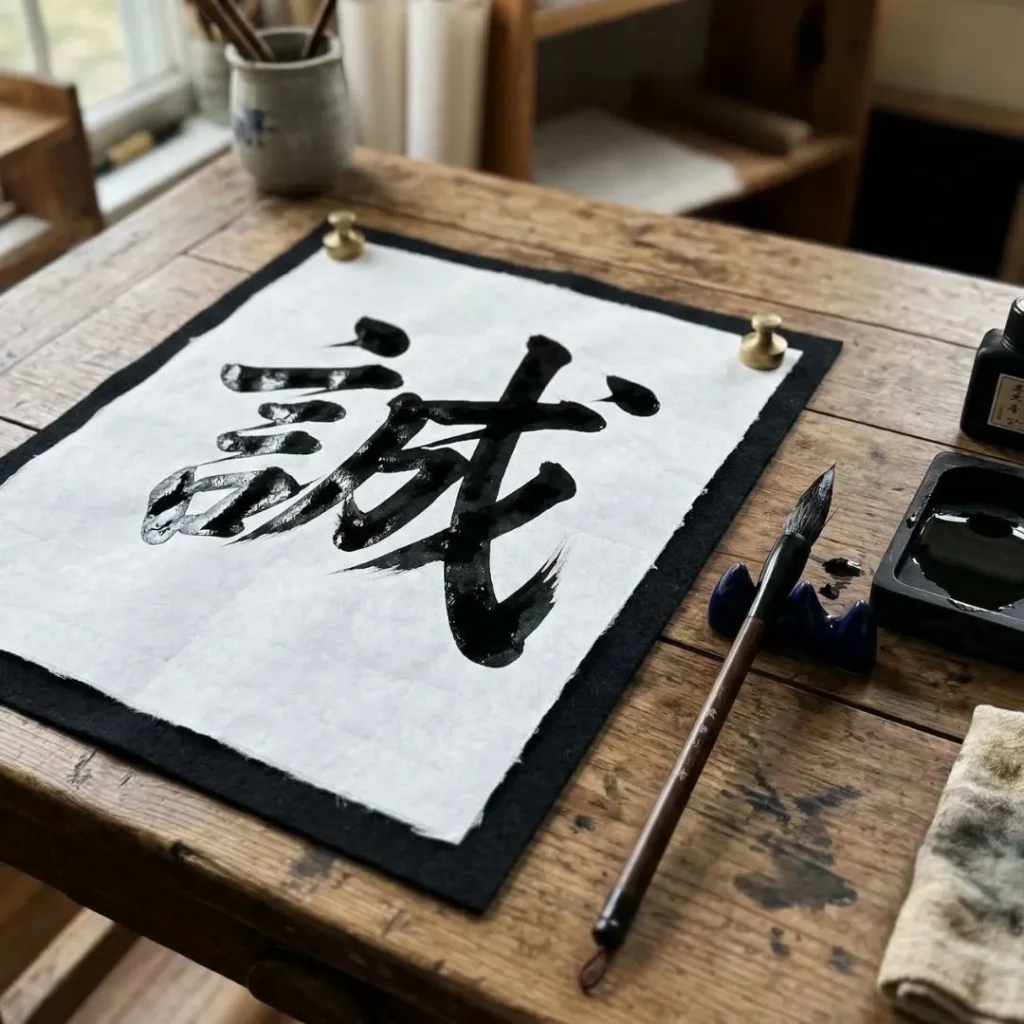
Before you write a single character, prepare. Grind your ink slowly if using a stick—circular motions, steady pressure, five to ten minutes. This is not wasted time. It is the transition from your daily mind to your calligraphy mind. Lay out your paper. Position your felt mat. Sit upright with your feet flat on the floor and your shoulders relaxed. Hold the brush vertically in your right hand, steadied lightly with the left if needed.
Take three slow breaths. Let the first breath release the tension in your shoulders. Let the second release the thought of what you are about to write. Let the third simply be a breath. Now you are ready.
The Basic Strokes
All Japanese characters—both kanji and kana—are built from a small set of fundamental strokes. Mastering these strokes is the foundation of all shodō practice.
Yokoga (横画) — Horizontal Stroke. The brush enters the paper with a slight press to the right, travels horizontally with even pressure, and ends with a controlled stop and lift. The line should be alive—not perfectly straight but carrying the subtle energy of a hand-drawn mark.
Tatega (縦画) — Vertical Stroke. Press down to enter, draw the brush straight down with steady pressure, and finish with either a sharp stop or a gradual taper. Vertical strokes are the spine of most characters—their quality determines the character’s balance.
Harai (払い) — Sweeping Stroke. A stroke that begins with firm pressure and ends by gradually lifting the brush as it sweeps to the left or right, creating a tapered finish. This is the most expressive stroke—the speed and confidence of the sweep reveals the calligrapher’s state of mind.
Ten (点) — Dot. A brief, decisive press of the brush. Despite its size, the dot is one of the most difficult strokes to execute well. It must feel intentional, not accidental—a full commitment of the brush to the paper, however briefly.
A First Character: 一 (Ichi — “One”)
The simplest kanji is also the most profound practice piece. 一 (ichi, “one”) is a single horizontal stroke—yet writing it well requires everything shodō teaches: breath control, arm steadiness, mental composure, and the courage to commit to a single, irreversible action.
Practice 一 fifty times. Not to achieve a perfect stroke, but to observe how each attempt differs—how your breath, your grip, your mental state all appear in the line. The variation between strokes is not failure. It is information. Each stroke is a mirror.
When 一 feels natural, move to 二 (ni, “two”) and 三 (san, “three”)—adding the challenge of spacing and proportion between parallel strokes. Then progress to simple characters like 大 (dai, “big”), 山 (yama, “mountain”), and 川 (kawa, “river”).
Experiencing Shodō in Japan
For visitors to Japan, calligraphy workshops offer an immersive introduction that no book or video can replicate. Working with a trained instructor—watching them demonstrate the brush grip, feeling the correct posture, receiving feedback on your first strokes—compresses months of self-study into a single session.
Kyoto
Kyoto’s deep connection to Zen Buddhism makes it a natural home for shodō. Several temples and cultural centers offer visitor workshops:
Shunkō-in Temple at Myōshin-ji. Known for English-language Zen experiences, Shunkō-in occasionally offers calligraphy sessions alongside meditation. The combination of zazen and shodō in a single visit captures the historical relationship between the two practices.
Camellia Garden Calligraphy Experience. A popular workshop in central Kyoto where visitors practice writing their name in kanji and create a small calligraphy piece to take home. Sessions run 60–90 minutes and require no prior experience.
Tokyo
Asakusa Calligraphy Workshops. Several studios near Sensō-ji temple offer drop-in shodō lessons. The Asakusa setting—traditional craft shops, temple atmosphere, and the energy of the old shitamachi district—adds authentic context.
Related guide: Myōshin-ji. 10 Must-Visit Zen Temples in Kyoto
FAQ
Q: What is Japanese calligraphy called?
A: Japanese calligraphy is called shodō (書道), which means “the way of writing.” The term places calligraphy among Japan’s traditional dō arts—disciplines understood as spiritual paths rather than mere skills. Shodō is practiced in schools from elementary level through adulthood, and advanced practitioners can earn teaching certifications through established calligraphy organizations.
Q: What is the difference between Japanese and Chinese calligraphy?
A: Both traditions share common roots and tools, but diverged over centuries. Chinese calligraphy places greater emphasis on structural precision and the historical evolution of script styles. Japanese calligraphy developed unique elements: the flowing kana syllabaries, the wild expressiveness of Zen bokuseki, and the dō (way/path) framework that treats calligraphy as a spiritual practice rather than a purely artistic one. Japanese calligraphy also tends toward greater spontaneity and values the expressive quality of the line itself.
Q: Do I need to know Japanese to practice shodō?
A: No. Many practitioners worldwide study shodō without speaking Japanese. The practice of basic strokes and simple characters requires understanding stroke order and brush technique, not language fluency. Many beginners start with single kanji whose meanings they appreciate—山 (mountain), 和 (harmony), 道 (way/path)—and find the practice deeply rewarding without broader language study.
Q: How long does it take to learn Japanese calligraphy?
A: You can produce satisfying work in your first session—shodō is accessible to absolute beginners. The basic strokes can be learned in an afternoon. Developing consistent quality and personal expression takes months to years of regular practice. In Japan, shodō is understood as a lifelong practice. The ranking system (kyū and dan levels) provides structured progression, but most practitioners describe the journey as more important than any certification.
Q: What Japanese calligraphy set should I buy?
A: A beginner set should include a medium-sized mixed-hair brush (fude), an ink stick (sumi) or bottled ink, an inkstone (suzuri), hanshi practice paper, and a felt writing mat (shitajiki). Complete sets are available for $25–50. Invest slightly more in the brush—it is the tool you will interact with most directly, and a quality brush responds to your intention in ways a cheap one cannot.
The Character Writes the Writer
There is a saying among shodō teachers: ji wa hito nari (字は人なり)—”the character is the person.” Your calligraphy does not just represent you. In the Zen understanding, it is you—the record of your breath, your posture, your courage, and your willingness to let the brush move without interference.
This is why shodō cannot be perfected by practice alone. Technical skill produces technically correct characters. But the calligraphy that stops people—the work that carries life, energy, ki (気)—comes from something beyond technique. It comes from a mind that has stopped worrying about the result and is simply present with the brush, the ink, and the paper.
Comprehensive guide: Simply present.
Wabi Sabi : The Japanese Philosophy of Finding Beauty in Imperfection
You do not need to write beautiful characters to practice shodō. You need to write honest ones. Grind your ink. Settle your breath. Pick up the brush. Make a single stroke and let it be exactly what it is.
That is enough. That is everything.
References
- Davey, H. E. (1999). Brush Meditation: A Japanese Way to Mind & Body Harmony. Stone Bridge Press.
- Suzuki, D. T. (1959). Zen and Japanese Culture. Princeton University Press.
- Nakata, Y. (1983). The Art of Japanese Calligraphy. Weatherhill/Heibonsha.
- Tanahashi, K. (2014). Heart of the Brush: The Splendor of East Asian Calligraphy. Shambhala.
- Addiss, S. (1989). The Art of Zen: Paintings and Calligraphy by Japanese Monks 1600–1925. Harry N. Abrams.