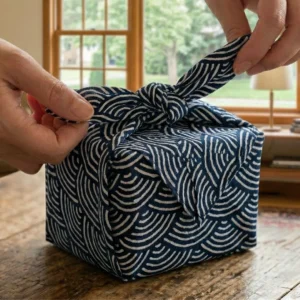
Sashiko (刺し子, “little stabs”) is a traditional Japanese form of decorative reinforcement stitching that originated in rural northern Japan during the Edo period. Born from necessity—farming families used simple running stitches to mend, strengthen, and insulate worn cotton garments—sashiko transformed functional repair into geometric art. The technique uses white cotton thread on indigo-dyed fabric in repeating patterns such as asanoha (hemp leaf), seigaiha (waves), and yabane (arrows), each carrying symbolic meaning. Closely related to boro (襤褸), the tradition of patchwork mending, sashiko shares the wabi-sabi philosophy that visible repair enhances rather than diminishes an object’s beauty. Today, sashiko has gained international recognition as both a textile art and a mindful, meditative craft.
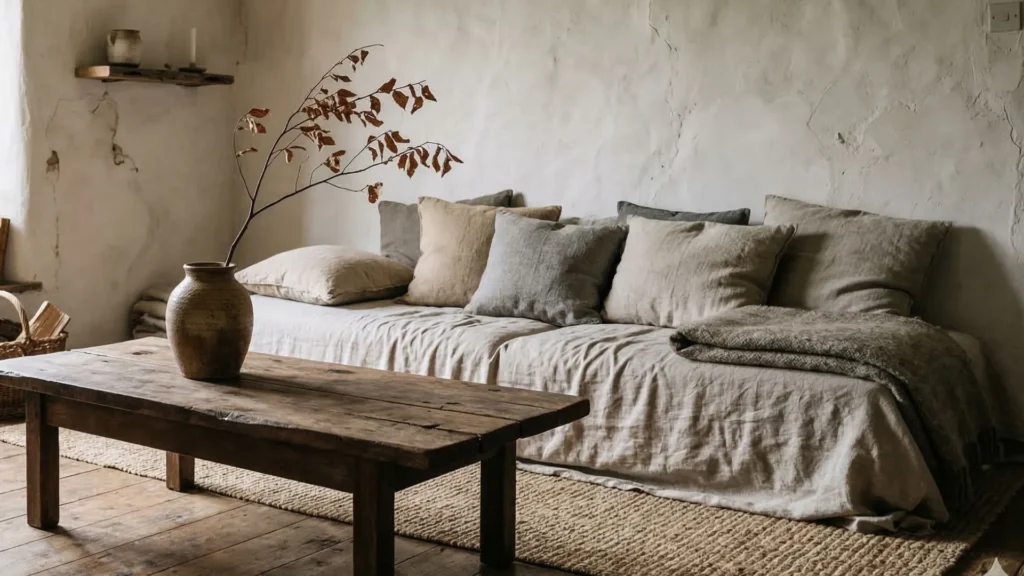
The Home That Breathes
Walk into a showroom or scroll through a design magazine, and you will encounter spaces engineered for perfection—flawless surfaces, precise symmetry, everything new, everything matching. They photograph beautifully. They are also, for most people, impossible to live in and exhausting to maintain.
Wabi-sabi interior design offers a fundamentally different proposition. Rooted in the Japanese philosophy of wabi-sabi (侘び寂び)—the aesthetic of finding beauty in imperfection, impermanence, and incompleteness—this approach to home design does not ask you to achieve a perfect space. It asks you to create an honest one.
Comprehensive guide: wabi-sabi (侘び寂び)—the aesthetic of finding beauty in imperfection
A wabi-sabi home welcomes the crack in the plaster, the patina on a brass handle, the unevenness of a hand-thrown bowl. It uses natural materials that age visibly—wood that darkens, linen that softens, stone that wears smooth. It values space and silence over accumulation and display. And perhaps most radically, it treats the home not as a finished product but as a living process—something that changes with the seasons, with use, and with time.
This guide walks through each room of the home, translating wabi-sabi philosophy into practical design choices you can make today—regardless of budget, location, or the current state of your space.
Principles Before Rooms
Before choosing furniture or paint colors, a wabi-sabi interior begins with three commitments:
1. Natural Materials Over Manufactured Surfaces
Wabi-sabi interiors favor materials that come from the earth and show their age honestly: wood, stone, clay, linen, cotton, wool, bamboo, iron. These materials develop character over time—the grain of a wooden table deepens, linen develops a softer drape, a cast-iron teapot builds a patina. Manufactured surfaces—high-gloss laminates, synthetic fabrics, chrome finishes—resist aging, which is precisely why they feel lifeless in a wabi-sabi context.
This does not mean your entire home must be handcrafted from reclaimed timber. It means choosing natural materials where you can, and accepting—even celebrating—the way they change with use.
2. Space Over Stuff
The most powerful element in a wabi-sabi interior is not any object. It is the empty space between objects. A room with three beautiful things and generous breathing room around each feels richer than a room filled with thirty beautiful things competing for attention.
This is the principle of ma (間)—the meaningful emptiness that gives form its power. In practical terms, it means fewer items, less clutter, and the discipline to leave surfaces clear. A single branch in a ceramic vase on an otherwise empty shelf communicates more than a shelf crowded with decorations.
3. Imperfection as Character
This is the hardest principle for most people, because modern design culture has trained us to see imperfection as failure. In wabi-sabi, imperfection is evidence of life. The scratch on a dining table records a meal. The chip on a bowl records a moment of carelessness that makes the bowl uniquely yours. The uneven surface of a hand-plastered wall proves that a human being, not a machine, shaped it.
The practice is not to damage things deliberately but to stop hiding the damage that living naturally produces. A home that shows its history is a home that has been lived in. That evidence of life is what makes it beautiful.
Related guide: The chip on a bowl.Kintsugi: The Art of Golden Repair
Room by Room: Wabi-Sabi in Practice
The Living Room: Where Stillness Lives
The living room is where wabi-sabi principles have their most visible impact, because it is the room where we spend the most waking time and the room visitors see first.
Walls. Consider raw plaster, limewash, or clay-based finishes instead of flat latex paint. These materials have subtle texture and tonal variation—they catch light differently throughout the day and develop a soft patina over years. If replastering is not practical, choose matte, warm-toned paint in earthy neutrals: warm grey, soft clay, aged white, stone.
Furniture. Low-profile, simple forms in natural wood. A coffee table with visible wood grain and no veneer. A sofa with linen or cotton slipcovers that wrinkle naturally. Avoid matching sets—wabi-sabi interiors are assembled over time, not purchased as a package. The mix of old and new, found and chosen, gives the room its personality.
Objects. Apply the ma principle ruthlessly. Choose three to five objects that you genuinely love—a hand-thrown ceramic bowl, a piece of driftwood, a single photograph in a simple frame—and give each enough space to be seen. Rotate these seasonally. Put the rest away or let them go.
Light. Natural light is the most important design element in any wabi-sabi space. Keep windows unobstructed or use light, translucent curtains that filter without blocking. In the evening, warm-toned lighting (2700K or below) from a few well-placed lamps creates the soft, shadow-rich atmosphere that wabi-sabi interiors thrive in.
The Bedroom: Where Simplicity Becomes Rest
The bedroom is perhaps the most natural room for wabi-sabi design, because its purpose—sleep—already demands simplicity, quiet, and the absence of stimulation.
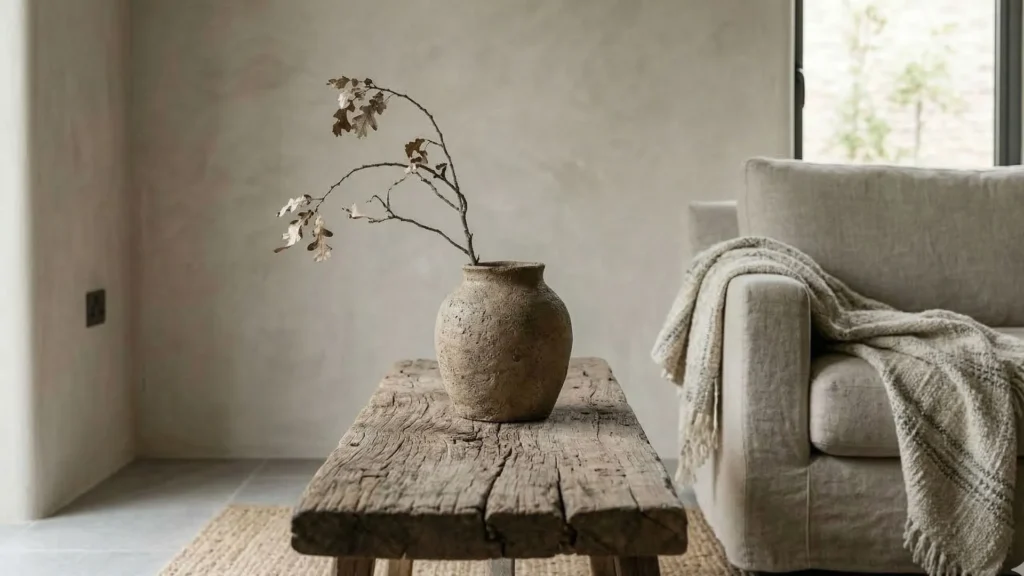
The Bed. Natural fiber bedding transforms the experience of sleep. Linen sheets, which start slightly rough and soften with every wash, are the wabi-sabi textile. Cotton and wool blankets in undyed or muted tones complete the palette. Avoid synthetic fabrics and bright whites—the goal is warmth, not clinical crispness.
Furniture. Minimalize relentlessly. A bed, a side table, a lamp. If possible, nothing else. Clothing storage belongs in a closet or behind a screen, not in a dresser competing with the bed for the room’s attention. A low bed frame in natural wood—or a futon on a tatami mat for the most traditional approach—keeps the visual weight close to the ground and the space above open.
Walls and Floor. Bare walls or a single piece of art. The bedroom wall does not need decoration—it needs to be a quiet surface that does not demand attention. For flooring, wood or tatami. If you have carpet, a natural-fiber rug (jute, sisal, wool) over the carpet changes the room’s character significantly.
The Ritual. Wabi-sabi is not only about objects but about how you inhabit a space. Making the bed each morning—slowly, deliberately, smoothing the linen with your hands—becomes a small act of care that sets the tone for the day. This is the domestic equivalent of a Zen monk raking the temple garden: a repetitive, mindful act that creates order and beauty from the simplest materials.
The Kitchen: Where Use Becomes Beauty
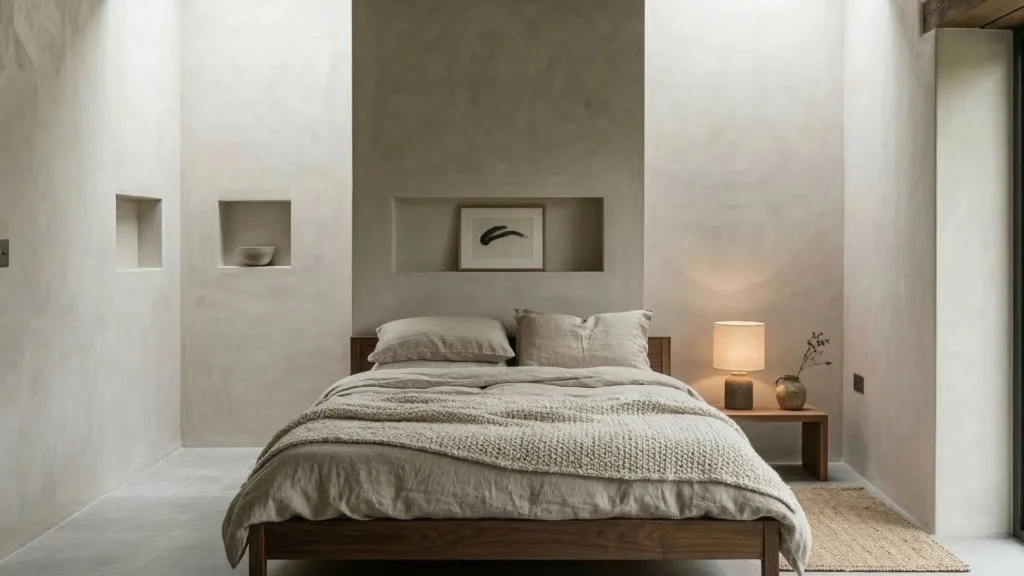
In most homes, the kitchen is the most heavily used and therefore the most visually cluttered space. Wabi-sabi kitchen design does not hide this use—it honors it.
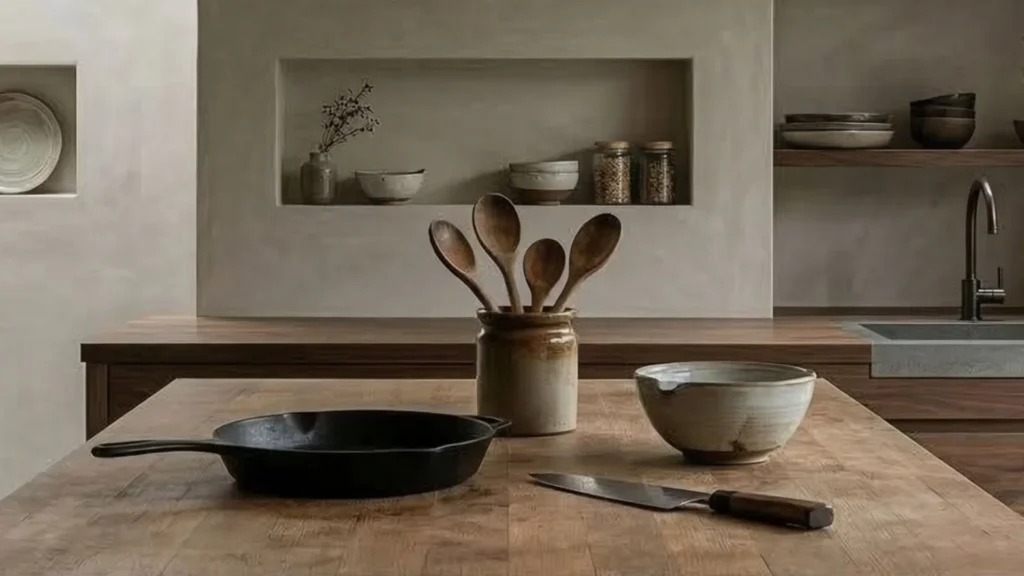
Tools on Display. Rather than storing everything behind cabinet doors, select your most-used tools—a well-seasoned cast-iron pan, a set of wooden spoons worn smooth by years of stirring, a knife with a handle darkened by use—and keep them visible. These objects are beautiful precisely because they have been used. Their wear is their decoration.
Ceramics. Replace uniform dinnerware with handmade ceramics. Plates and bowls that vary slightly in shape, glaze, and size—each made by a human hand—transform every meal into a tactile experience. A chipped bowl is not discarded but continues in service, its imperfection a mark of history.
Natural Surfaces. Butcher block or natural wood countertops develop character over time in ways that granite and quartz cannot. If natural wood counters are not practical, choose materials with visible texture—concrete, soapstone, or even well-maintained tile.
Open Shelving. Open shelves instead of upper cabinets create visual openness and encourage the ma principle—you can only display what the shelf holds, which forces thoughtful editing. Arrange bowls, jars, and vessels with space between them.
The Bathroom: Where Water Meets Stone
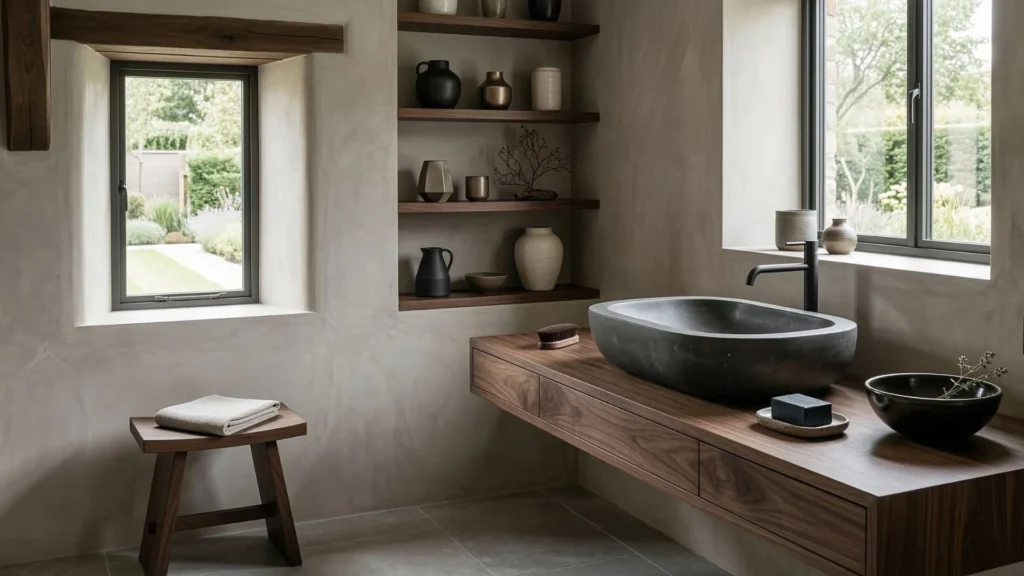
The Japanese relationship with bathing—communal baths, temple purification, the ritual of ofuro—makes the bathroom a natural space for wabi-sabi design. Water, stone, and wood are the elemental vocabulary.
Materials. Natural stone (slate, river rock, limestone) for floors or accent walls. Wood elements—a teak bath mat, a cedar soap dish, a bamboo shelf. These materials respond to moisture in ways that feel alive: stone darkens when wet, wood releases fragrance, surfaces develop the soft mineral deposits that signal a bathroom actually used for bathing.
Simplicity. Reduce products to essentials. A single bar of soap on a ceramic dish. One or two towels in natural linen or cotton. A wooden brush. The visual clutter of dozens of bottles and products contradicts the stillness that a wabi-sabi bathroom aims to create.
The Ofuro Principle. Even if you do not have a Japanese soaking tub, you can adopt its philosophy: bathing as a transition, a pause between the activity of the day and the stillness of the evening. Warm light, natural materials, and empty space support this shift.
Wabi-Sabi and Japandi: Understanding the Difference
If you have been exploring interior design trends, you have likely encountered Japandi—the fusion of Japanese and Scandinavian aesthetics that has become one of the most popular design movements of recent years. Japandi shares much with wabi-sabi—minimalism, natural materials, muted colors—but there are important differences.
Japandi is a style. It has recognizable visual markers: clean lines, light wood tones, functional furniture, hygge-influenced warmth. Japandi rooms are designed to look a certain way.
Wabi-sabi is a philosophy. It does not prescribe a visual style—it prescribes a relationship with imperfection, age, and natural process. A wabi-sabi room might look like a Japandi room, or it might look like a rustic farmhouse, or an artist’s studio, or a monk’s cell. The test is not “does it look right?” but “does it feel honest?”
Where Japandi tends toward polished minimalism—everything simple but everything in good condition—wabi-sabi actively embraces the worn, the weathered, and the unfinished. Japandi might replace an aging piece of furniture. Wabi-sabi might repair it with visible stitching, celebrate its scratches, or let it age further.
Both approaches are valid, and they overlap significantly. If Japandi appeals to you, you are already partway to wabi-sabi. The additional step is philosophical: learning to see beauty not in spite of imperfection but because of it.
Related guide: Japandi Style: Where Japanese Wabi-Sabi Meets Scandinavian Design
Getting Started: Three Changes Today
You do not need to renovate your home to begin living with wabi-sabi principles. Start with three changes:
1. Clear one surface completely. Choose a shelf, a countertop, or a table. Remove everything. Wipe it clean. Then place one object on it—something you find beautiful. Leave the rest of the surface empty. Notice how that single object, surrounded by space, becomes more visible, more meaningful, than it was when competing with everything else.
2. Replace one synthetic item with a natural one. Swap a plastic soap dispenser for a ceramic dish. Replace a polyester throw with a linen one. Trade a laminate cutting board for a wooden one. Each substitution introduces a material that will age and change—and that aging is not decay but evolution.
3. Stop hiding damage. The next time something chips, scratches, or wears—a bowl, a table, a piece of clothing—resist the impulse to replace or hide it. Ask instead: does this damage make the object less useful? If not, let it stay. You may find that a sashiko-mended sweater or a chipped ceramic mug becomes the object you reach for first, precisely because its imperfection makes it yours.
Related guide: Sashiko: The Japanese Art of Stitching, Mending, and Finding Beauty in Repair
FAQ
Q: What is wabi-sabi interior design?
A: Wabi-sabi interior design is an approach to home design rooted in the Japanese philosophy of wabi-sabi (侘び寂び)—finding beauty in imperfection, impermanence, and natural simplicity. It favors natural materials that age visibly (wood, stone, linen, clay), minimal furnishing with generous empty space, muted earth-toned colors, and an acceptance of wear and patina as signs of a life being lived. Rather than striving for a perfect, showroom appearance, wabi-sabi interiors aim to feel honest, calm, and deeply lived-in.
Q: What is the difference between wabi-sabi and Japandi?
A: Japandi is a style that blends Japanese and Scandinavian design aesthetics—clean lines, light wood, functional minimalism. Wabi-sabi is a philosophy that embraces imperfection, impermanence, and the beauty of natural aging. They share common ground in minimalism and natural materials, but wabi-sabi goes further: where Japandi favors polished simplicity, wabi-sabi actively celebrates the rough, worn, and unfinished. A Japandi room looks designed; a wabi-sabi room looks lived in.
Q: What colors are used in wabi-sabi interiors?
A: Wabi-sabi palettes are drawn from nature: warm greys, soft clay, aged white, sand, stone, charcoal, moss green, faded indigo. The key quality is mutedness—no bright or saturated colors. These tones provide a quiet background that allows natural materials and textures to become the focal point rather than color.
Q: Is wabi-sabi interior design expensive?
A: Not necessarily. Wabi-sabi is fundamentally about less, not more—fewer objects, simpler materials, less decoration. Many wabi-sabi design choices actually save money: keeping existing furniture instead of replacing it, choosing open shelving over custom cabinetry, selecting natural materials that improve with age rather than requiring replacement. The most expensive aspect is high-quality natural textiles and handmade ceramics, but these are one-time investments that last decades.
Q: How do I start with wabi-sabi interior design?
A: Begin with subtraction, not addition. Clear clutter from one room. Remove objects that serve neither function nor genuine beauty. Introduce one or two natural materials—a linen throw, a wooden bowl, a stone soap dish. Stop replacing items that show wear. Over time, your space will naturally evolve toward wabi-sabi as you develop the habit of choosing fewer, better, and more natural things.
The Home That Ages with You
There is a concept in Japanese architecture called tsukimi (月見)—moon viewing. Traditional Japanese homes were designed with verandas and openings specifically positioned to frame the moon at certain times of year. The house was not a sealed container against nature. It was a frame through which nature was invited in.
Related guide: The Philosophy of Zen Architecture: What Makes Temples Sacred
A wabi-sabi home works the same way. It does not resist time—it frames it. The morning light that moves across a plastered wall is part of the design. The wooden floor that darkens over decades is part of the design. The linen curtain that softens with each washing is part of the design.
Comprehensive guide: Wabi Sabi : The Japanese Philosophy of Finding Beauty in Imperfection
You do not create a wabi-sabi interior in a weekend. You begin it—and then you live in it, and it changes with you, and you change with it, and the home you have at the end of ten years is more beautiful than the home you had at the beginning, because it carries the evidence of those ten years in every surface, every worn edge, every sun-faded curtain.
That is not imperfection. That is life, made visible.
References
- Koren, L. (1994). Wabi-Sabi for Artists, Designers, Poets & Philosophers. Imperfect Publishing.
- Vervoordt, A. (2002). Wabi: Inspirations. Flammarion.
- Juniper, A. (2003). Wabi Sabi: The Japanese Art of Impermanence. Tuttle Publishing.
- Tanizaki, J. (1977/1933). In Praise of Shadows. Leete’s Island Books.
- Kempton, B. (2018). Wabi Sabi: Japanese Wisdom for a Perfectly Imperfect Life. Harper Design.
- Richie, D. (2007). A Tractate on Japanese Aesthetics. Stone Bridge Press.