Two hands clap and there is a sound. What is the sound of one hand?
Most people who hear this question for the first time do one of two things. They smile and dismiss it as a trick, or they start reasoning: maybe the answer is silence, maybe it is the air moving, maybe it is a metaphor for something. Both reactions miss what the question is for. In Zen, a question like this is not a puzzle waiting for a clever solution. It is a tool for exhausting the part of the mind that is always looking for one.
This is a koan (公案, also written kōan). In Zen Buddhism, a koan is a short story, dialogue, or question from the Zen tradition that a student holds in meditation until ordinary reasoning gives way and something more direct appears. Koans have been used this way for nearly a thousand years, and they remain at the center of Rinzai Zen training today.
This guide explains what a koan is, why koans have no correct answer, where they came from, how to approach five of the most famous ones, and how you can work with a koan yourself.
What Is a Koan?
The Japanese word kōan comes from the Chinese gong’an, which originally meant a “public case”: the record of a judgment in a government court. In the Song dynasty, the Chan (Zen) tradition borrowed the term for a new purpose. Its “cases” were records of encounters between teachers and students, and like legal precedents they were collected, cited, and used to test new students against the standard set by earlier masters. The fourteenth-century Chan teacher Zhongfeng Mingben explained the term in exactly this way.
A typical koan is very short. A monk asks a question; the teacher answers with a word, a gesture, or a sentence that does not seem to fit. Sometimes the koan is only a single phrase, such as “Mu.” The student’s task is not to interpret the story but to become the question—to hold it so completely that there is no gap left between the one asking and what is asked. For a concise reference definition, see the entry on koans in the Encyclopaedia Britannica.
A koan is often described in English as a “Zen riddle,” and the comparison is half right. Like a riddle, a koan stops the mind with something it cannot immediately process. Unlike a riddle, it has no hidden answer that, once found, makes the question disappear. A riddle is solved by thinking better. A koan is resolved, if at all, by seeing differently.
Why Koans Have No Answer
If a koan has no correct answer, why do Zen teachers bother with them? The short answer is that the mind we normally think with is exactly the mind Zen wants to see through.
Ordinary thinking works by dividing the world into categories: yes or no, self or other, sound or silence. This is enormously useful, but it also creates the sense of a separate self standing apart from experience, commenting on it. A koan is designed so that every category you reach for fails. Is the sound of one hand silence? Then you have answered with an idea about silence. Is it the sound of the air? Then you are still explaining. Each answer is another thought, and the koan simply waits.
The Chinese teacher Dahui Zonggao (1089–1163) described the result of this process as great doubt: a state in which the question fills the whole mind and every intellectual escape route has been closed. Dahui taught students to concentrate on a single key word of a koan, called the huatou (話頭, “head of the phrase”), and to keep returning to it in every activity until the doubt broke open. What breaks open is not an answer but a direct seeing—what Zen calls kenshō (見性), “seeing one’s own nature.”
This is why a Zen teacher judges a student’s response not by its content but by its quality. Two students might say exactly the same words; one may be reciting, while the other is speaking from what they have actually seen. In this sense a koan is less like a test question than like a mirror. It shows the teacher, and the student, where the student’s mind actually is.
The brushed ensō (円相) works on the same principle. Early Chan teachers sometimes answered a question by drawing a circle in the air instead of speaking. The circle, like a koan, is a reply that refuses to be paraphrased.
A Brief History of the Koan
From Encounters to Cases
The raw material of koans comes from the Tang dynasty (618–907), the golden age of Chinese Chan. Teachers such as Zhaozhou Congshen and Linji Yixuan were famous for spontaneous, often startling replies to students’ questions. Their disciples recorded these exchanges, and later generations collected them in histories such as the Jingde Record of the Transmission of the Lamp (景徳伝燈録), compiled in 1004.
The Great Collections
In the Song dynasty, teachers began to select the most powerful of these encounters, add commentary and verse, and use them systematically in training. Two collections became classics.
The Blue Cliff Record (碧巌録), compiled in 1125, builds on one hundred cases chosen by the poet-monk Xuedou Chongxian, with extensive commentary by Yuanwu Keqin. It is subtle, literary, and demanding. According to a later tradition, Yuanwu’s own student Dahui burned the printing blocks of the collection because students were treating its commentary as a substitute for practice—a story that captures Zen’s lasting suspicion of words, even its own.
The Gateless Barrier (無門関, Mumonkan in Japanese), compiled by the teacher Wumen Huikai in 1228, is shorter and sharper: forty-eight cases, each followed by a brief comment and a verse. Its first case, Zhaozhou’s “Mu,” is probably the most widely assigned koan in the world. For readers who want to meet these cases directly, Robert Aitken’s translation, The Gateless Barrier, includes his own commentary from decades of teaching.
Koans Come to Japan
Zen reached Japan in the Kamakura period (1185–1333), and with it came both great collections. The Rinzai school, which grew up in the great Zen temples of Kamakura and Kyoto, made koan training its central method. The Sōtō school, founded in Japan by Dōgen (1200–1253), took a different path. Dōgen knew the koan literature deeply and quoted it constantly, but he placed shikantaza, “just sitting,” at the heart of practice. Later, on the fringes of Rinzai Zen, the wandering komusō monks of the Fuke sect made the shakuhachi flute, rather than the koan, the center of their practice.
Dōgen also gave the word kōan a new meaning. In his essay Genjōkōan (現成公案, “The Koan of Actualizing Reality”), written in 1233 for a lay student, he suggested that the true koan is not an old story at all. It is life itself, appearing right now—this breath, this moment, this question of birth and death.
Hakuin and the Koan Curriculum
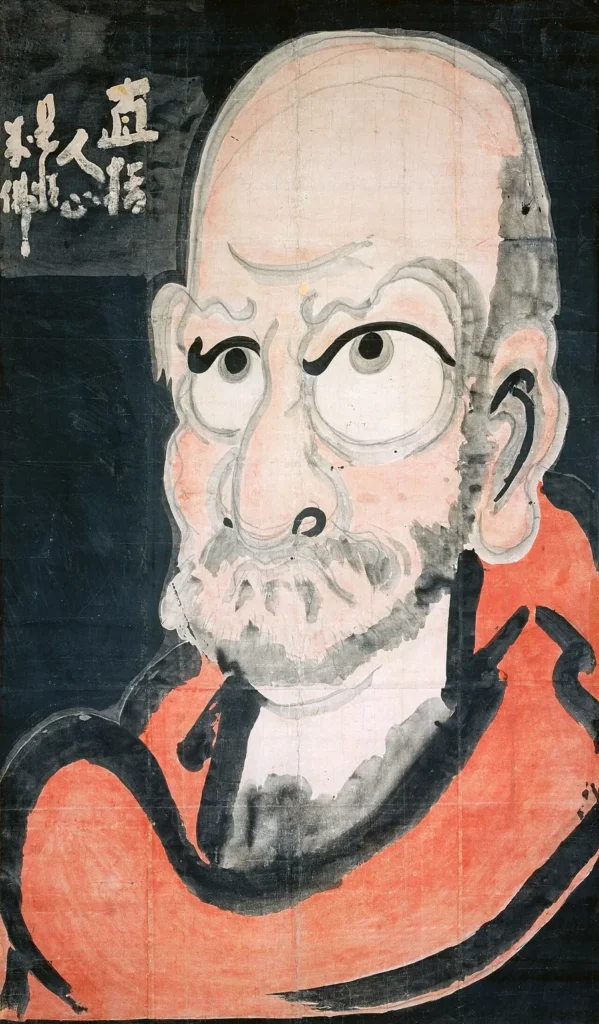
By the early eighteenth century, Rinzai Zen in Japan had lost much of its vitality. It was revived by Hakuin Ekaku (1686–1769), a fierce and tireless teacher who painted, wrote, and lectured for monks and lay people alike. Hakuin devised the koan of the sound of one hand as a new starting point for beginners, and his successors organized koans into a graded curriculum that students still work through in Rinzai monasteries today, moving from koans that open an initial insight to ones that refine and test it.
For a scholarly account of how koan literature developed in China and Japan, the essays collected in Steven Heine and Dale S. Wright’s The Kōan: Texts and Contexts in Zen Buddhism are a reliable starting point. Our list of the best Buddhist books suggests other places to begin.
Five Famous Koans, and How to Sit With Them
The koans below are retold in my own words from the classical sources. None of them comes with an answer, and none should. Instead, each is followed by a note on how a student might hold it.
1. Zhaozhou’s Dog (“Mu”)
A monk asked Zhaozhou whether a dog has Buddha nature. Zhaozhou answered, “Mu.” (Gateless Barrier, case 1)
Buddhist teaching holds that all beings have Buddha nature, so the expected answer is yes. Mu (無) means “no” or “nothing.” Interestingly, another record of Zhaozhou has him answering the same question with “yes.” The point is not doctrine. Students are usually told to drop the dog, the monk, and the doctrine, and to sit with “Mu” alone—breathing it, carrying it into every activity—until there is nothing left but Mu.
2. The Sound of One Hand
Two hands clap and there is a sound. What is the sound of one hand? (Hakuin)
This koan invites you to hear what cannot be heard by ordinary ears. Do not try to imagine a sound. Listen instead with your whole body to the question itself, and notice what happens to the one who is listening.
3. Your Original Face
The Sixth Patriarch, Huineng, told a pursuing monk: “Think neither good nor evil. At this very moment, what is your original face?” (Gateless Barrier, case 23)
In Japanese practice this koan is often phrased as “What was your original face before your parents were born?” It points to who you are before any label, role, or story. Hold the question without supplying a description; every description is another face put on.
4. Wash Your Bowl
A monk asked Zhaozhou for instruction. Zhaozhou asked, “Have you eaten your rice gruel?” “Yes.” “Then wash your bowl.” (Gateless Barrier, case 7)
This koan looks easy, which makes it hard. It suggests that awakening is not somewhere else, beyond ordinary life, but right in the next simple task. Work with it by doing exactly that: wash your bowl, completely, and see whether anything is missing.
5. Not the Wind, Not the Flag
Two monks were arguing about a temple flag. One said the flag was moving; the other said the wind was moving. Huineng said, “It is not the wind, and it is not the flag. It is your mind that moves.” (Gateless Barrier, case 29)
This koan turns attention from the world outside to the mind that perceives it. Sit with it by noticing, in any moment of agitation, what is actually moving.
How to Practice With a Koan
With a Teacher
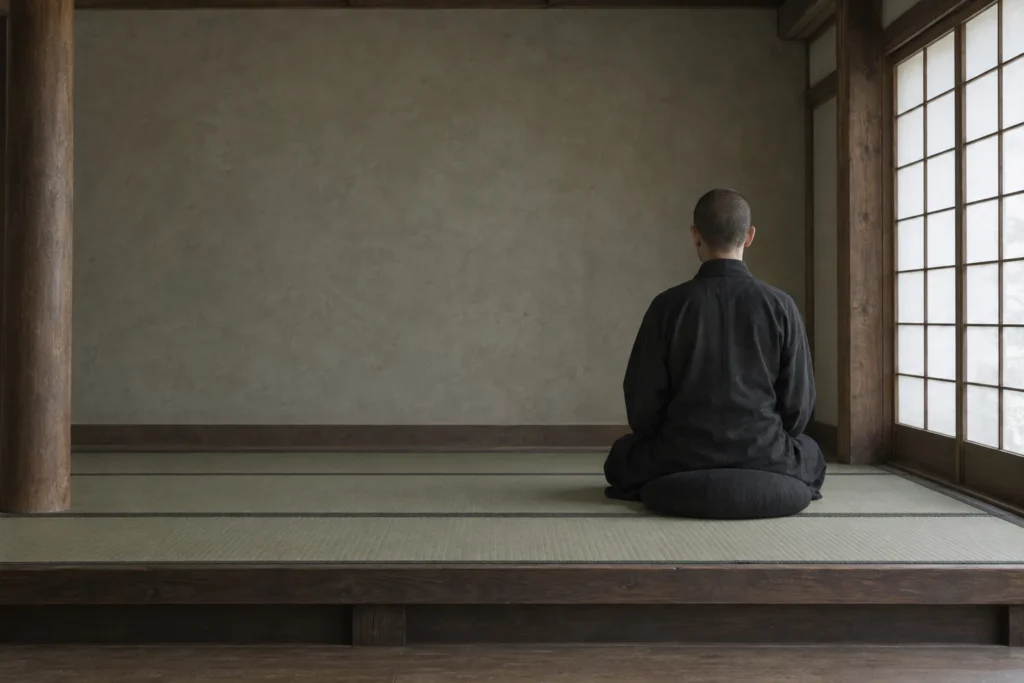
In traditional Rinzai training, a teacher assigns a koan and the student works with it during long periods of seated meditation. Several times a day, especially during intensive retreats called sesshin, the student goes alone to the teacher’s room for a brief private interview known as dokusan (独参) or sanzen (参禅). There the student presents a response—sometimes in words, sometimes in a gesture—and the teacher either accepts it or, far more often, rings a bell and sends the student back to sit.
This relationship is the heart of koan practice, because only someone who has passed through a koan can tell whether a student’s response comes from real insight or from cleverness. Some Rinzai monasteries and temples in Japan open their zazen sessions to visitors; our guide to Zen temples in Kyoto is a good starting point, and a temple stay lets you experience a monastery’s daily rhythm. A guided zazen session at a Kyoto Zen temple is the easiest first step for travelers.
Without a Teacher
Most Zen teachers would say that formal koan study requires a teacher, and that is worth taking seriously. Without someone to test your responses, it is easy to mistake a clever idea for insight. But you can still let a koan deepen your meditation.
Begin with a steady zazen (坐禅) practice, so that you can sit quietly for twenty or thirty minutes. Choose one koan, such as Mu or the sound of one hand, and keep it for weeks rather than days. At the start of each sitting, bring the koan to mind once, then let it rest in the breath instead of turning it over intellectually. When you notice yourself building theories, drop them and return to the bare question. A firm cushion makes long sitting much easier; a zafu and zabuton set is the simplest investment you can make in a home practice.
A few signs suggest you are working with a koan in a healthy way. You return to it without forcing, the way you return to the breath. You notice that you are a little less attached to your first interpretation of events. And when you feel you have “got it,” you hold that feeling loosely, because a sudden clever answer is usually one more idea. If the practice instead makes you anxious, obsessive, or proud, set the koan aside and simply sit. Zen has always valued steady, ordinary practice over dramatic breakthroughs.
Rinzai and Sōtō
If you join a Zen group, you will find that the two main Japanese schools approach koans differently. Rinzai centers its training on koan study with a teacher. Sōtō centers its training on shikantaza, just sitting, and few Sōtō practitioners work with koans in meditation, although they study and discuss the classic collections. Both schools aim at the same thing: seeing through the separate self. They simply open different doors.
Koans in Everyday Life
You do not need to live in a monastery to meet a koan. Life presents them constantly: a loss that cannot be explained, a decision with no right answer, a question about who you really are that no résumé can settle. Zen does not promise to solve these. It suggests a different way of holding them—with full attention, without rushing to an answer, until the question itself teaches you something.
That is what Dōgen meant by the koan of actualizing reality. The oldest koans were once someone’s real life, too: a monk with a question, a teacher with a bowl of rice gruel. The question is waiting in yours.
FAQ
Q: What is a koan in simple terms?
A: A koan (公案, also written kōan) is a short story, dialogue, or question from the Zen tradition that cannot be answered by logic. Zen students hold a koan in meditation until ordinary reasoning is exhausted and they see the matter directly. The word originally meant a “public case” in a Chinese court.
Q: Is there a right answer to a koan?
A: Not in the usual sense. A teacher does not check whether a student’s words match a fixed answer, but whether the response comes from real insight. Two students can say the same words and receive different judgments, because the teacher is assessing the student’s state of mind rather than the content.
Q: What is the most famous koan?
A: In the West, the most famous is probably Hakuin’s “What is the sound of one hand?” In Zen training, the most widely assigned is Zhaozhou’s “Mu,” the first case of the Gateless Barrier, in which Zhaozhou answers “Mu” when asked whether a dog has Buddha nature.
Q: What is the sound of one hand clapping?
A: It is a koan devised by the Japanese Rinzai master Hakuin Ekaku in the eighteenth century. It has no intellectual answer. It is meant to be held in meditation until the student stops trying to imagine a sound and experiences the question directly.
Q: Do Soto Zen practitioners use koans?
A: Rarely in meditation. The Sōtō school emphasizes shikantaza, or just sitting, while Rinzai centers its training on koan study with a teacher. Sōtō students still study the classic koan collections, and Dōgen, the founder of Japanese Sōtō Zen, wrote extensively about koans, including his essay Genjōkōan.
References
- Britannica Editors. (n.d.). Koan. In Encyclopaedia Britannica.
- Heine, S., & Wright, D. S. (Eds.). (2000). The kōan: Texts and contexts in Zen Buddhism. Oxford University Press.
- Wumen. (1991). The gateless barrier: The Wu-men kuan (Mumonkan) (R. Aitken, Trans.). North Point Press.