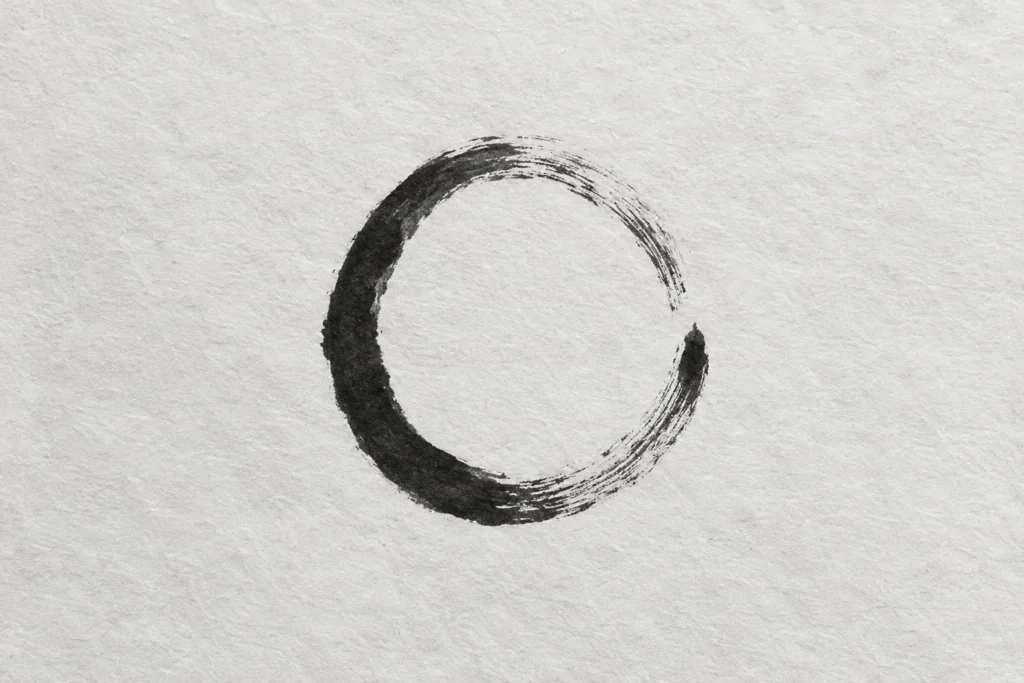
Load a brush with ink. Breathe in. On the out-breath, sweep a single circle across the paper and lift the brush. Whatever is left behind—thick or thin, round or lopsided, closed or open—cannot be corrected. It is simply what your hand and mind did in that moment.
This is the ensō (円相), also written enso: the circle that Zen teachers have used for more than a thousand years—first as a wordless teaching, later as a brushed painting—as a meditation and a portrait of the mind at work. To most people it looks like the simplest image imaginable. To the Zen tradition it is one of the most complete. Zen Buddhism has always distrusted words as a way of pointing at reality, and the ensō is what remains when the words are taken away.
This guide explains what the ensō means, where it came from, how the great Zen painters used it, why so many circles are left open, and how you can draw one yourself—not as an art exercise, but as a practice.
What Does Ensō Mean?
The word is made of two characters:
- 円 (en) — circle, round, whole
- 相 (sō) — form, aspect, appearance
Together they mean simply “the form of a circle.” The plainness is deliberate. Zen does not give the ensō one official meaning, and teachers have read it in several overlapping ways:
- Emptiness (空, kū). The open center recalls the Buddhist teaching of śūnyatā: nothing exists as a fixed, separate thing. The Heart Sutra, chanted daily in Zen temples, compresses this into a famous line: form is emptiness, emptiness is form. An ensō is both at once—a visible shape and an empty space.
- Wholeness and awakening. A circle has no beginning or end, no top or bottom. It points to the mind before it divides the world into subject and object, good and bad, mine and yours.
- The universe. Because it contains everything inside it and excludes nothing, the circle has long stood for the totality of existence.
- This moment. An ensō can only be drawn now. It cannot be rehearsed into perfection or revised afterward, so every circle records one unrepeatable instant.
That last meaning is what sets the ensō apart from other religious symbols. A cross or a lotus means the same thing whether it is carved, printed, or stitched. An ensō’s meaning lives in how it was made. A circle printed by a machine is just geometry; a circle brushed by a person in one breath is evidence of a state of mind.
Where the Ensō Came From
The ensō is often described as a Japanese invention, but its roots lie in Tang-dynasty China, in the Chan (Zen) schools of the eighth and ninth centuries.
Circles in Chinese Chan
An early Chan poem, the Xinxin Ming (信心銘, “Faith in Mind”), traditionally attributed to the Third Patriarch Sengcan, describes the Way as perfect like vast space—lacking nothing and holding nothing in excess. That image of a boundless, complete space is the seed of the circle.
The first teachers known to use circles directly in instruction belong to the lineage of the National Teacher Nanyang Huizhong (d. 775). According to Chan records, Huizhong used a set of ninety-seven circle-figures—written with the same characters, 円相—as teaching devices and passed them to his attendant Danyuan Yingzhen, who said they had come down from the Sixth Patriarch, Huineng. Danyuan later handed them to a young monk named Yangshan Huiji. In a story retold for centuries, Yangshan read the text once and burned it; when Danyuan scolded him, he rewrote all ninety-seven from memory.
Yangshan and his teacher Guishan Lingyou founded the Guiyang school (潙仰宗), which became known for answering questions by drawing circles in the air or on the ground. The Jingde Record of the Transmission of the Lamp (景徳伝燈録), compiled in 1004, preserves several of these wordless exchanges. In them, the circle is not a picture of an idea. It is a reply—an answer that refuses to be paraphrased. Exchanges like these became the raw material of the Zen koan.
The Circle Comes to Japan
Zen took root in Japan in the Kamakura period (1185–1333), and the Chan records and their circles came with it. But the ensō most people picture today—a single stroke of ink on paper, signed, inscribed, and hung in a tea room or home—flourished centuries later, in the Edo period (1603–1868). Zen monks of that era painted for lay people as well as for their disciples, and the brushed circle became one of their most direct ways of teaching people who might never sit in a meditation hall.
The Masters of the Circle
Three Rinzai monks of the Edo period did more than anyone to shape how the world sees the ensō today.
Hakuin Ekaku (1686–1769)
Hakuin revived the Rinzai school after a long decline, and he did it partly with a brush. In his later decades he produced a remarkable body of paintings and calligraphy—Bodhidharmas, folk figures, giant single characters, and circles—most of them inscribed with short, pointed teachings for the ordinary people who came to him. His brushwork is heavy, fast, and unpolished, the opposite of courtly elegance. Audrey Yoshiko Seo and Stephen Addiss, in their study of his art, show how directly these paintings served his teaching: they were meant to wake people up, not to decorate walls.
Tōrei Enji (1721–1792)
Hakuin’s leading disciple, Tōrei, is especially remembered for his ensō. His circles tend to be bold, swift strokes, often paired with brief inscriptions that turn the circle into a question the viewer has to answer. For Tōrei, the circle was not a finished statement but a koan held in ink.
Sengai Gibon (1750–1837)
If Hakuin made the ensō forceful, Sengai made it human. A monk of Shōfukuji in Hakata, on the southern island of Kyushu, Sengai painted with humor and warmth. One of his best-known circles, now in the Fukuoka Art Museum, carries an inscription that treats the circle as a rice cake: eat this, then have some tea. The joke is the teaching. The most profound symbol in Zen can also be the most ordinary thing on the table.
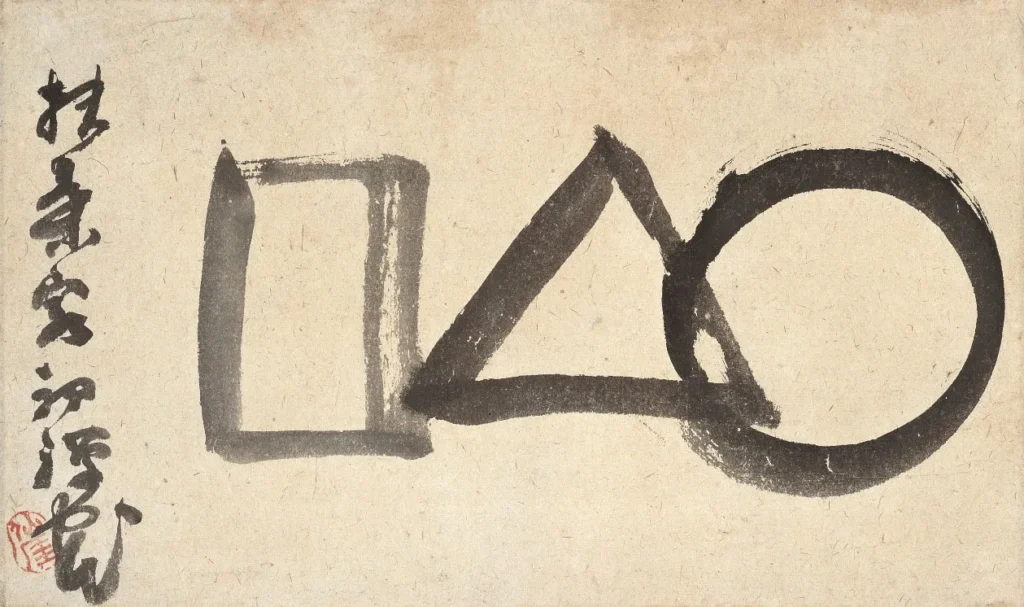
Sengai’s most famous work reduces existence to three shapes: a circle, a triangle, and a square (○△□). D. T. Suzuki, who introduced Sengai to Western readers, titled it “The Universe.” The painting belongs to the Idemitsu Museum of Arts in Tokyo, which holds one of the largest collections of Sengai’s work. The museum’s Tokyo galleries closed in December 2024 while their building is rebuilt, with construction planned through 2030. Its sister museum in Moji, Kitakyushu, continues to exhibit the collection.
To study the masters’ circles up close, Audrey Yoshiko Seo’s Ensō: Zen Circles of Enlightenment gathers dozens of examples, from Chinese sources to modern painters, with translations of their inscriptions.
Open or Closed? The Ensō and Wabi-Sabi
Look at enough ensō and you will notice that some circles close, with the end of the stroke meeting or overlapping its beginning, while others stop short and leave a gap.
A closed ensō suggests completeness: the full moon, the whole universe, a mind with nothing missing. An open ensō suggests something unfinished—movement, breath, a path still being walked. Both forms appear throughout the history of Zen painting, and neither is the “correct” one. Most painters draw the circle in a single stroke, though some historical examples were made in two; the choice belonged to the painter and the moment.
What matters is the attitude behind the gap. Many contemporary painters prefer the open circle because it refuses to pretend. A human hand cannot draw a perfect circle, and the effort to try brings in tension, self-consciousness, and ego—the very things Zen practice works to loosen. The gap admits this honestly. It also leaves room: for the viewer’s mind to complete the form, and for the painter’s practice to keep going.
This is the same sensibility that runs through wabi-sabi (侘び寂び), the Japanese aesthetic that finds beauty in the incomplete, the impermanent, and the imperfect. To a wabi-sabi eye, the slight wobble in a hand-thrown tea bowl is not a defect but a sign of life. In the same way, the dry streaks where the brush ran low, the uneven thickness, and the gap where the stroke ended are what make an ensō true.
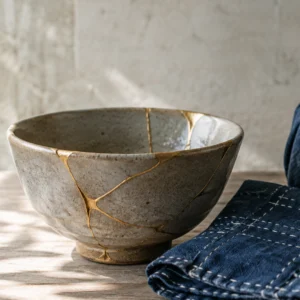
The craft of kintsugi (金継ぎ) carries the idea a step further: a broken bowl is mended with gold so that the break becomes the most visible part of its history. The ensō makes no attempt to hide where the hand hesitated, sped up, or let go. Its flaws are its biography.
How to Draw an Ensō
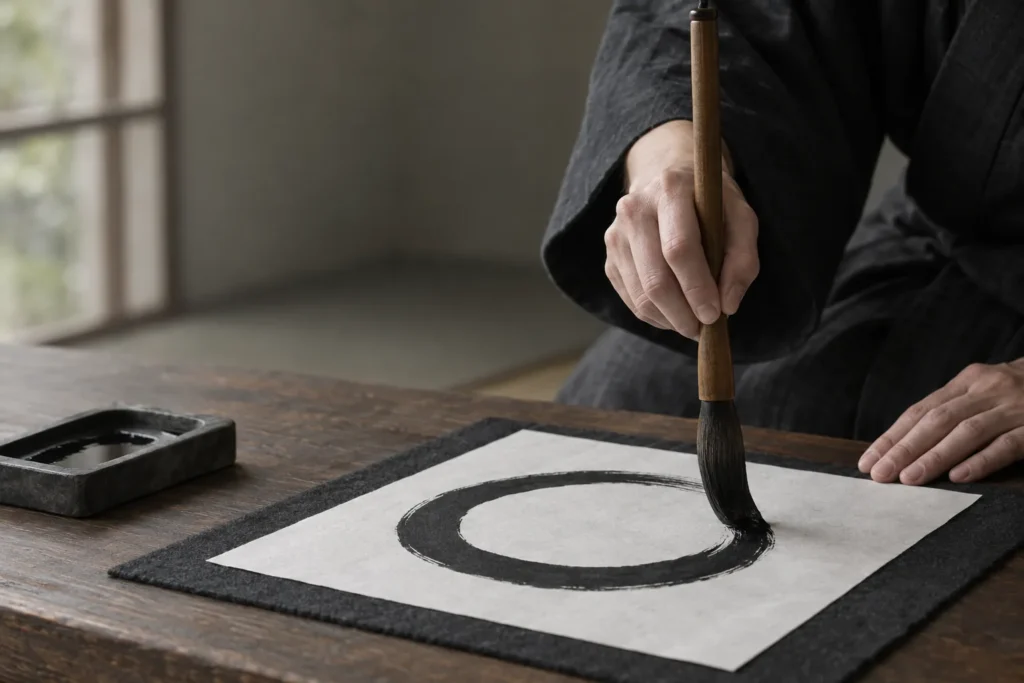
You do not need artistic training to draw an ensō. In some ways training gets in the way, because the goal is not a good-looking circle but an honest one. Here is a simple traditional approach.
Materials
- A brush (筆, fude). A medium or large calligraphy brush works best. A Japanese calligraphy (書道) set gives you everything in one box: brush, ink stick, inkstone, and paper.
- Ink (墨, sumi). Grinding an ink stick with water on an inkstone (硯, suzuri) takes a few minutes, and that time is part of the practice. Bottled ink is fine when you are short of time.
- Paper. Absorbent paper such as hanshi (半紙) shows every change in pressure and speed. Lay a felt underlay beneath it so the ink does not soak through to the table.
A beginner’s calligraphy set is the easiest way to start; you can always upgrade the brush later.
Before the Stroke
1. Sit upright. Kneel or sit at a low table with your back straight and shoulders relaxed—the same steady posture used in zazen (坐禅) meditation. Many people find it helps to sit quietly for a few minutes first.
2. Grind the ink slowly. Let the repetitive motion settle your attention. You are not preparing to perform; you are preparing to pay attention.
3. Load the brush fully, then hold it upright, with the handle vertical rather than slanted like a pen.
The Stroke
4. Breathe in. Let your gaze rest on the paper without planning the shape.
5. On the out-breath, draw the circle in one continuous movement, in whichever direction feels natural. Move from the shoulder, not just the fingers.
6. Lift the brush and stop. Do not go back over thin spots or close a gap you did not intend. The circle is finished when the brush leaves the paper.
After the Stroke
Look at what you made without grading it. Is the line heavy or light? Did it speed up near the end? Did you hesitate at the start? Then draw another. Some practitioners draw one circle every day and keep them as a journal of their mind over months; others throw each one away to practice letting go. Both approaches are faithful to the spirit of the ensō.
If you are traveling in Japan, a hands-on calligraphy class in Kyoto is the best way to learn brush handling from a teacher in person.
How to Read an Ensō
Once you have drawn a few circles yourself, you will start to see the masters’ circles differently. Every ensō is a record of movement, and it can be read almost like a seismograph:
- Wet, heavy strokes show a fully loaded brush and decisive energy.
- Dry, broken strokes (掠れ, kasure), where white paper shows through the ink, show the brush running out—and suggest passing time, fading, impermanence.
- Changes in width reveal shifts in pressure and speed, and with them the painter’s breathing.
- The start and the finish show the moment of commitment and the moment of release. Look for where the brush first pressed down and where it lifted away.
Just as important is what is not painted. The empty center and the blank paper around the circle are as much a part of the work as the ink. Japanese aesthetics call this kind of meaningful emptiness ma (間), and it is the same principle at work in a Zen rock garden, where raked gravel and open space give a handful of stones their weight. In both, what is left out does as much work as what is put in.
Read this way, every ensō is a self-portrait—not of the painter’s face, but of their mind at one moment.
Why the Ensō Endures
Today the ensō appears on meditation app icons, yoga studio logos, book covers, and tattoos. Some of this is a loss: a circle copied from a logo carries none of the breath that made the original. But its popularity also shows how directly the image speaks, even to people who know nothing of its history.
If you are drawn to the ensō—as something to hang on a wall, wear, or draw—knowing its Zen background turns it into a daily reminder rather than a decoration. The Japanese phrase ichigo ichie (一期一会), “one time, one meeting,” says that every encounter happens only once. The ensō says the same thing with a brush: this breath, this stroke, this circle will never happen again.
In a culture that prizes precision, the ensō offers a different standard. A computer can draw a perfect circle in an instant, and it means nothing. A person can draw an imperfect one in a single breath, and it holds everything that person was in that moment. Zen would say the second circle is the truer one—and that the empty space inside it has room for the whole world.
FAQ
Q: What does an enso circle symbolize?
A: The enso (円相, also written ensō) symbolizes several Zen ideas at once: emptiness, wholeness, awakening, and the universe. Above all, it records the painter’s state of mind at the moment it was drawn. Because it is brushed in a single, uncorrected motion, each circle is a unique expression of one moment of awareness.
Q: Why are some ensō circles open and others closed?
A: A closed ensō suggests completeness and unity, like the full moon. An open ensō suggests incompleteness, movement, and the acceptance that nothing is ever perfect—an idea close to wabi-sabi. Both appear throughout Zen painting, and neither is more correct. The choice belongs to the painter and the moment.
Q: Where did the ensō come from?
A: The circle as a teaching device began in Chinese Chan Buddhism in the eighth and ninth centuries, in the lineage of Nanyang Huizhong and later the Guiyang school of Guishan and Yangshan. The brushed ensō as a work of art flourished in Japan during the Edo period, through Zen monks such as Hakuin, Tōrei, and Sengai.
Q: Can anyone draw an ensō?
A: Yes. No artistic training is needed, and technical polish is not the goal. All you need is a brush, ink, and absorbent paper. Sit upright, breathe, and draw the circle in one movement without correcting it. A wobbly circle drawn with full attention is closer to the spirit of the ensō than a smooth one drawn while thinking about something else.
Q: Is an ensō tattoo disrespectful?
A: Generally not. The ensō is not a devotional image in the way a Buddha statue is, and Zen teachers have long shared it freely with lay people. Many people choose it as a reminder of presence and of accepting imperfection. Learning what it means—and, ideally, using a circle brushed by hand rather than copied from a font—keeps that reminder meaningful.
References
- Seo, A. Y. (2007). Ensō: Zen circles of enlightenment. Weatherhill.
- Seo, A. Y., & Addiss, S. (2010). The sound of one hand: Paintings and calligraphy by Zen master Hakuin. Shambhala.
- Suzuki, D. T. (1971). Sengai, the Zen master (E. van Hoboken, Ed.). Faber and Faber.