Some truths are felt before they are understood. In Japanese aesthetics, this feeling has a name.
Yūgen (幽玄), also written yugen, is the Japanese aesthetic sense of a beauty too deep to be fully seen or named.
There is a moment, watching fog roll across a mountain valley, when language fails. The scene is beautiful — but the word “beautiful” misses something. What moves you isn’t the landscape itself but what it conceals: the suggestion of depths beyond sight, the awareness that what you’re witnessing extends far past what your eyes can reach.
In Japanese, this experience has been refined into one of the culture’s most sophisticated aesthetic concepts: yūgen (幽玄).
Unlike wabi-sabi (侘び寂び), which finds beauty in imperfection, or mono no aware (もののあはれ), which celebrates the bittersweet awareness of impermanence, yūgen points to something more elusive: the profound beauty of what lies just beyond understanding.
What Does Yūgen Mean?
The characters that compose yūgen reveal its essence:
- 幽 (yū): dim, deep, mysterious, secluded
- 玄 (gen): dark, profound, subtle
Together, they suggest a beauty that is felt rather than seen — an emotional response to depth, mystery, and the unknowable. In his 1921 introduction to The Nō Plays of Japan, Arthur Waley rendered Zeami’s gateways to yūgen this way: “To watch the sun sink behind a flower-clad hill, to wander on and on in a huge forest with no thought of return…”
Yūgen is not darkness itself but the beauty that emerges from darkness — the way moonlight is more evocative than sunlight precisely because of what it leaves in shadow.
Yūgen in Everyday Language
In modern Japanese, yūgen (幽玄) is used less frequently than wabi-sabi or mono no aware. When it does appear, it typically describes:
- An atmosphere of profound mystery in art or nature
- The quality of suggesting more than what is directly expressed
- Experiences that evoke a sense of the universe’s depth
The word carries an inherent paradox: to fully explain yūgen would be to destroy it. Its power lives in the space between expression and silence.
Origins of Yūgen: From Chinese Philosophy to Japanese Aesthetics
Yūgen’s roots extend into Chinese Daoist philosophy. The character gen (玄) appears at the close of the Tao Te Ching’s first chapter: “mystery upon mystery — the gateway to all wonders” (玄之又玄,衆妙之門). This philosophical embrace of mystery and the ineffable traveled to Japan alongside Buddhism during the 6th and 7th centuries. For a scholarly overview of how the concept developed, see the Stanford Encyclopedia of Philosophy’s entry on Japanese aesthetics.
However, yūgen as a distinctly Japanese aesthetic concept crystallized through two transformative figures:
Fujiwara no Shunzei (1114–1204)
The great waka poet Fujiwara no Shunzei elevated yūgen from a philosophical concept to a poetic ideal. For Shunzei, the finest poetry didn’t describe emotions directly — it evoked them through images that resonated beyond their literal meaning. An autumn evening, a solitary crane, rain falling on an empty temple — these weren’t mere scenery but vehicles for suggesting emotional depths that explicit language could never reach.
Zeami Motokiyo (1363–1443)
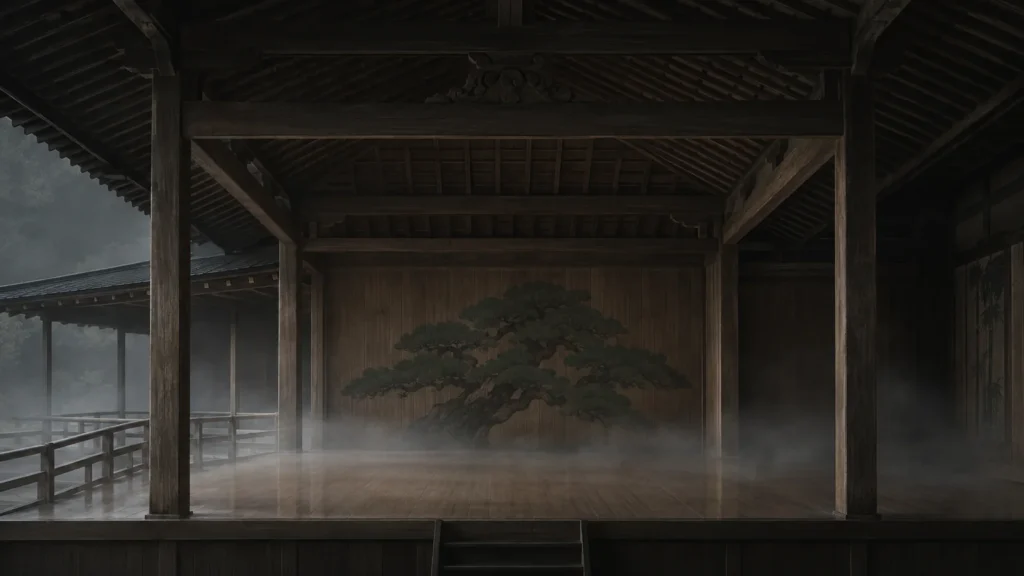
It was Zeami, the legendary Noh theater (能) master, who gave yūgen its most complete artistic articulation. In his treatise Fūshikaden (風姿花伝, “The Transmission of the Flower of Acting”), Zeami positioned yūgen as the highest ideal of Noh performance.
For Zeami, yūgen in Noh was achieved not through dramatic action but through restraint — the slow turning of a masked face, a single gesture held in stillness, the pregnant pause between words. He compared it to “a white bird with a flower in its beak”: grace that carries meaning beyond what the eye perceives.
Zeami’s concept of hana (花, “flower”) — the ephemeral, unrepeatable quality of a perfect performance — was inseparable from yūgen. The most profound moments on stage were those where the audience sensed something vast moving beneath the surface of a simple gesture.
Yūgen in Art and Literature
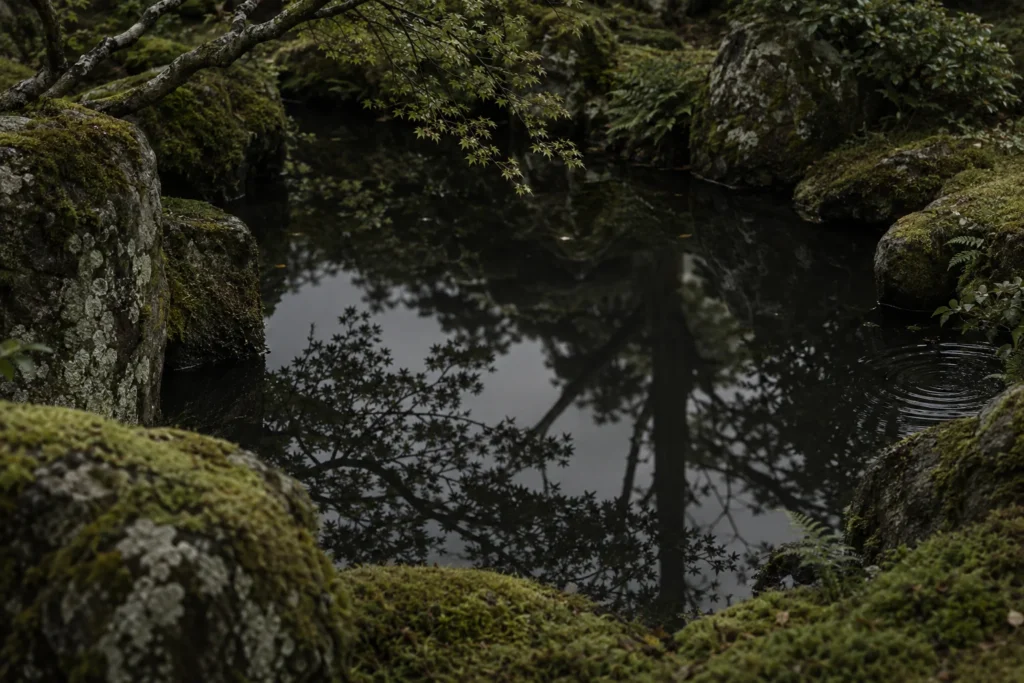
Yūgen permeates Japanese artistic traditions far beyond Noh theater, though it manifests differently in each form.
Yūgen in Poetry
Japanese poetry has long served as yūgen’s most natural medium. The haiku tradition, with its radical brevity, achieves yūgen by leaving vast spaces for the reader’s imagination. Matsuo Bashō (1644–1694) was particularly attuned to yūgen’s quality of evoking infinity through suggestion.
Bashō’s most celebrated works don’t describe — they open doorways. A frog’s splash doesn’t just break silence; it reveals the silence that was always there. The genius lies not in the seventeen syllables that are written but in the universe of feeling they leave unwritten.
Yūgen in Visual Arts
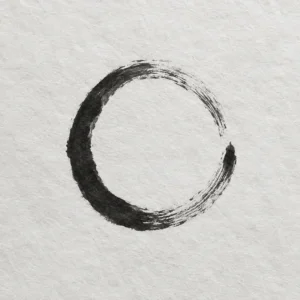
In ink painting (sumi-e), yūgen appears in the unpainted portions of the paper — the blank spaces that represent mist, distance, or the unknown. A mountain half-hidden by clouds carries more emotional weight than one fully rendered, because the viewer’s imagination completes what the painter has deliberately withheld. The same principle lives in the ensō (円相), the Zen circle brushed in a single stroke, whose empty center is as much a part of the work as the ink.
Yūgen in Music
Traditional Japanese music — particularly the shakuhachi (bamboo flute) — embodies yūgen through the spaces between notes. The concept of ma (間, “negative space”) in Japanese music creates an acoustic equivalent of the mist-shrouded mountain: what is absent resonates as powerfully as what is present.
Yūgen and Zen Buddhism
Yūgen shares deep philosophical ground with Zen Buddhism, though the two developed along parallel rather than identical paths. Both recognize that the most profound truths resist direct expression. Zen’s famous paradox — “The finger pointing at the moon is not the moon” — captures the same epistemological humility that yūgen embodies aesthetically. Zen koans push the same insight further, with questions that reasoning cannot answer.
Several Zen principles illuminate yūgen’s philosophical foundations:
Non-duality (不二, funi): Yūgen dissolves the boundary between observer and observed. In a moment of yūgen, you don’t stand apart from the misty landscape analyzing its beauty — you are absorbed into it.
Emptiness (空, kū): Just as Zen teaches that form and emptiness are inseparable, yūgen reveals that beauty and mystery are not separate qualities but aspects of a single experience.
Direct experience (直指, jikishi): Yūgen, like Zen insight, cannot be transmitted through explanation. It must be experienced directly — which is precisely why the concept has always resisted clear definition.
The Japanese Aesthetics Triangle: Yūgen, Wabi-Sabi, and Mono no Aware
Understanding yūgen becomes richer when placed alongside Japan’s other major aesthetic concepts:
| Aesthetic | Core Quality | Emotional Tone | Finds Beauty In… |
|---|---|---|---|
| Yūgen (幽玄) | Profound mystery | Awe, wonder | What is hidden or suggested |
| Wabi-Sabi (侘び寂び) | Imperfect beauty | Acceptance, peace | What is weathered or incomplete |
| Mono no Aware (もののあはれ) | Pathos of things | Gentle sadness | What is passing or ephemeral |
These three concepts are not competing philosophies but complementary lenses for perceiving beauty in the world:
- Watching cherry blossoms fall is mono no aware — the poignant awareness of their transience
- The gnarled branch that remains after the blossoms have fallen is wabi-sabi — beauty in imperfection and age
- The feeling that the falling petals connect you to something vast and unknowable — the cycle of seasons, the passage of all things, the mystery of existence itself — that is yūgen
Together, they form what might be called the Japanese aesthetic trinity: three ways of being moved by the world that Western languages struggle to separate from the single word “beauty.”
Experiencing Yūgen Today
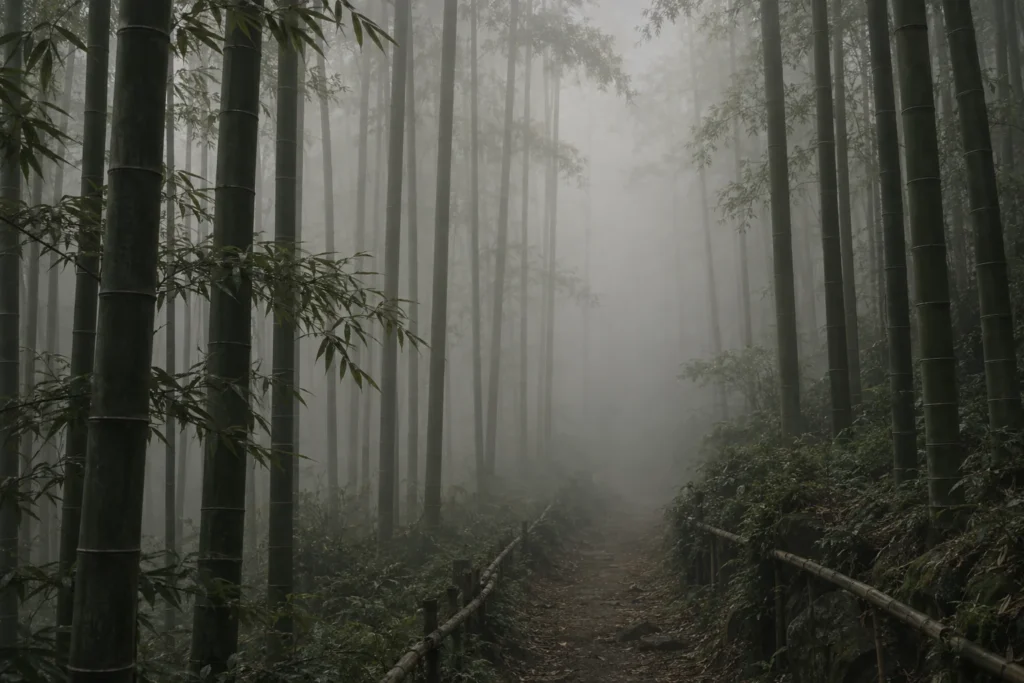
Yūgen is not confined to medieval poetry or Noh stages. It remains accessible to anyone willing to slow down and attend to the world’s hidden depths. Here are pathways to encountering yūgen in contemporary life:
In Nature
The natural world offers the most direct access to yūgen. Seek out moments of atmospheric mystery:
- Dawn mist rising from a lake or forest — the way familiar landscapes become strange and infinite
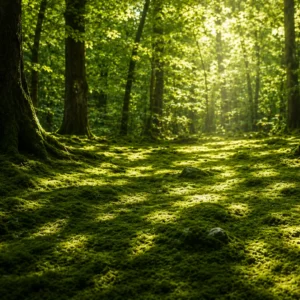
- Komorebi (木漏れ日) — sunlight filtering through leaves, creating patterns that shift between revelation and concealment
- The night sky far from city lights — the visceral awareness of depths beyond comprehension
- Ocean horizons at dusk — where sea, sky, and light merge into indistinguishable unity
In Art and Culture
- Attend a Noh performance and notice the moments between movements — the stillness that speaks
- Visit temples and shrines at twilight, when shadows transform stone and wood into something timeless
- Listen to shakuhachi music and follow not the notes but the silences between them
- Read classical Japanese poetry slowly, allowing each image to expand beyond its literal meaning
In Daily Practice
Yūgen can also be cultivated as a mode of attention — a way of remaining open to the mystery that permeates ordinary experience:
- Contemplative walking: Move slowly through a familiar place at an unfamiliar time — your neighborhood at dawn, a park at dusk — and notice how changed light reveals hidden dimensions
- Listening practice: Sit quietly and attend to sounds you normally filter out. The layers of sound — distant traffic, wind, birdsong, your own breathing — reveal an acoustic depth that mirrors yūgen’s visual quality
- Twilight meditation: The liminal moments between day and night naturally evoke yūgen’s quality of in-betweenness. Use these transitions as meditation anchors
Why Yūgen Matters in a Transparent World
We live in an age that prizes transparency, explanation, and the elimination of mystery. Information is expected to be clear, complete, and immediately accessible. Yūgen offers a counterpoint: the recognition that not everything valuable can or should be fully revealed.
This isn’t an argument for obscurity or mystification. Rather, yūgen reminds us that the deepest experiences — love, grief, creative inspiration, spiritual insight — always exceed our ability to articulate them. The gap between experience and expression isn’t a failure of language; it’s a feature of reality that yūgen teaches us to appreciate rather than resist.
In this sense, yūgen may be more relevant now than ever. As we navigate a world saturated with information and explanation, the capacity to sit with mystery — to find beauty in what we cannot fully understand — becomes not just an aesthetic preference but a form of wisdom.
FAQ
Q: What does yugen mean in English?
A: Yūgen (幽玄) combines two characters meaning “dim/mysterious” (幽) and “profound/dark” (玄). It describes the aesthetic experience of profound, mysterious beauty — the feeling evoked by things that suggest depths beyond what can be directly perceived or expressed. Originally rooted in Chinese Daoist philosophy, it became a central concept in Japanese aesthetics through Noh theater and classical poetry.
Q: How is yūgen different from wabi-sabi?
A: While both are core Japanese aesthetic concepts, they point to different dimensions of beauty. Wabi-sabi finds beauty in imperfection, impermanence, and incompleteness — a cracked tea bowl, a weathered wooden fence. Yūgen finds beauty in mystery and depth — the feeling evoked by mist-covered mountains or the spaces between notes in music. Wabi-sabi is about accepting what is visible; yūgen is about sensing what lies beyond visibility.
Q: Can you experience yūgen in daily life?
A: Yes. While yūgen was historically associated with Noh theater and classical poetry, it can be experienced through nature (dawn mist, stargazing, forest walks), art (traditional Japanese music, ink painting), and contemplative practices (twilight meditation, slow walking in unfamiliar light). The key is cultivating receptivity to moments of atmospheric mystery and depth.
Q: What is the connection between yūgen and Zen Buddhism?
A: Yūgen and Zen Buddhism share a recognition that the most profound truths resist direct expression. Zen’s emphasis on non-duality, emptiness, and direct experience aligns with yūgen’s aesthetic of suggestion over statement. Both traditions value what cannot be captured in words — Zen through paradox and meditation, yūgen through art and aesthetic experience.
Q: Who is Zeami and why is he important to yūgen?
A: Zeami Motokiyo (1363–1443) was a Noh theater performer and theorist who gave yūgen its most complete artistic articulation. In his treatise Fūshikaden, he positioned yūgen as the highest aesthetic ideal of Noh performance, achieved through restraint, suggestion, and the beauty of movements that hint at emotional depths beneath a calm surface.
References
- Parkes, G., & Loughnane, A. (2023). Japanese aesthetics. In E. N. Zalta & U. Nodelman (Eds.), The Stanford encyclopedia of philosophy. Stanford University.
- Waley, A. (1922). The Nō plays of Japan. A. A. Knopf.
- Zeami. (1984). On the art of the Nō drama: The major treatises of Zeami (J. T. Rimer & M. Yamazaki, Trans.). Princeton University Press.