The Art of Almost Nothing
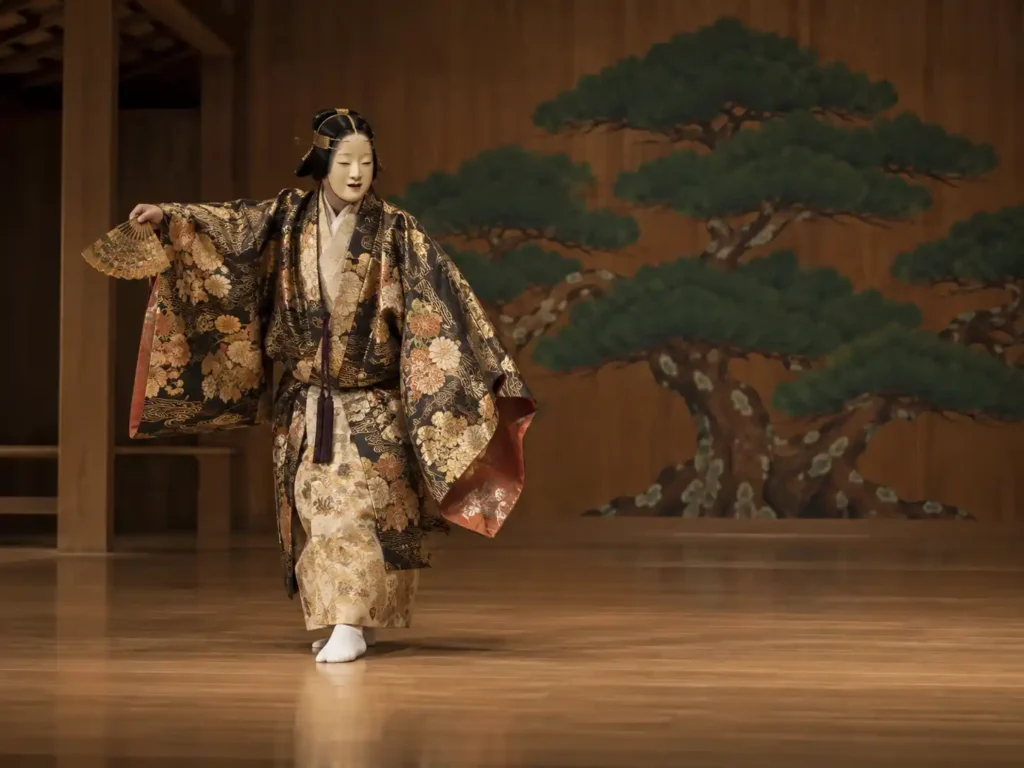
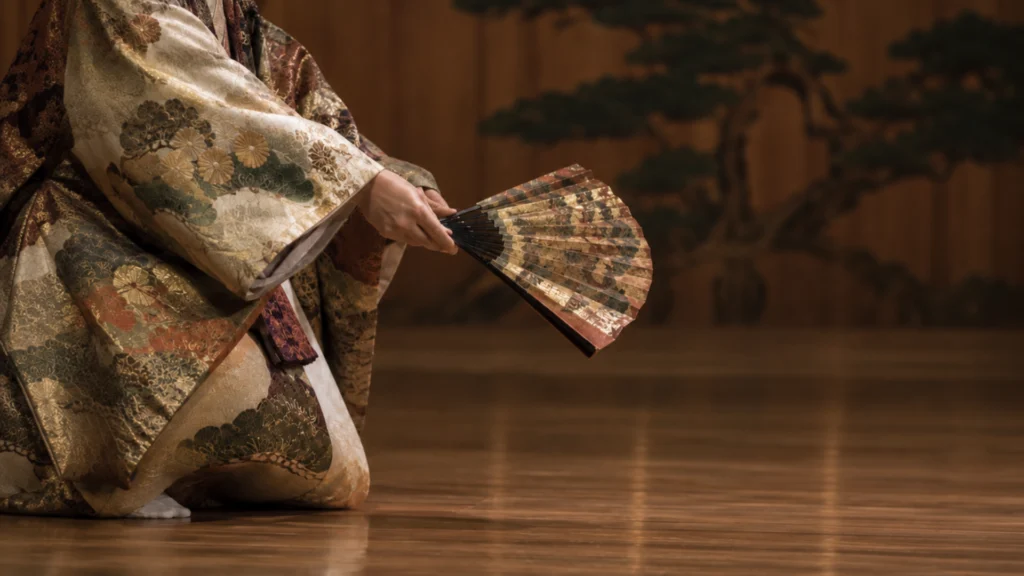
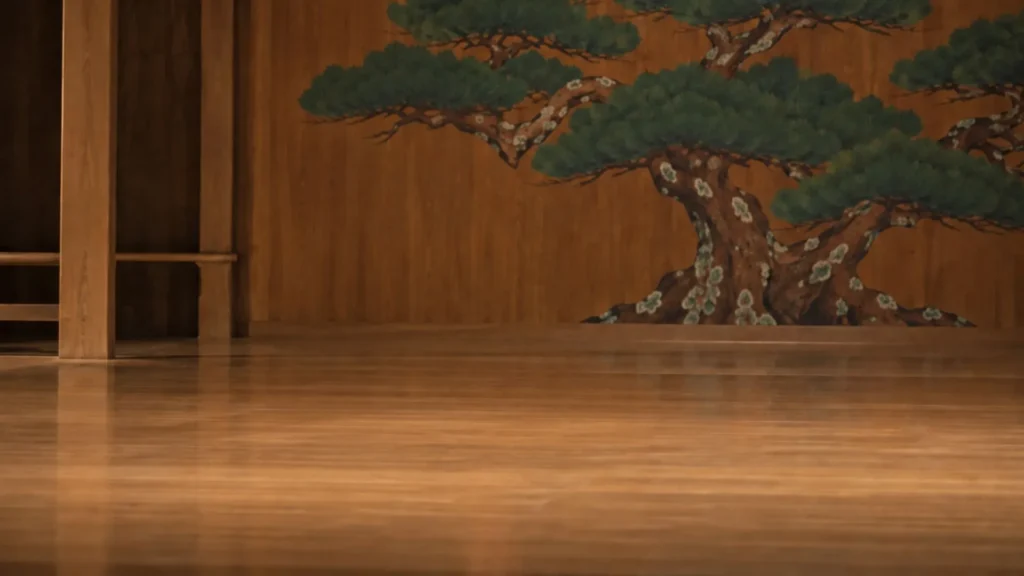
The noh stage is nearly empty. There is no set, no scenery, no lighting change. The backdrop is a single painting of a pine tree on a wooden wall—the same pine tree, on every noh stage in Japan, unchanged for over six hundred years. The floor is bare cypress, polished to a deep glow by centuries of sliding feet. There are no curtains, no wings, no hidden mechanisms.
Into this emptiness, a figure enters. The figure wears a mask—a small, carved wooden face that covers the performer’s own. The mask does not move. It cannot smile, frown, or weep. And yet, as the figure tilts it a few degrees toward the light, the mask appears to smile. A few degrees downward, and it grieves. The expression changes without the face changing. The audience sees emotion that does not exist on the surface of the mask—because the emotion is not in the mask. It is in the space between the mask and the viewer’s mind.
This is noh (能)—Japan’s oldest surviving theater form, a performing art that has been practiced continuously for more than 650 years. It is, by any measure, one of the most radical artistic propositions in world culture: the less you show, the more the audience sees.
What Is Noh?
Noh is a form of musical drama that combines poetry, dance, music, and mask-work into performances that typically last thirty to ninety minutes. It originated in the fourteenth century under the patronage of the Ashikaga shoguns and the direct influence of Zen Buddhism, and it has been performed in essentially the same form ever since.
A noh performance consists of a shite (主手, principal actor)—usually masked—accompanied by a chorus of eight singers, a small instrumental ensemble of flute and drums, and sometimes a secondary actor (waki). The stories are drawn from Japanese mythology, Buddhist scripture, classical literature, and the spirit world. The pace is extraordinarily slow by Western standards—a single step can take thirty seconds, a single gesture an entire minute.
Noh and Kabuki: The Essential Difference
Visitors to Japan often confuse noh with kabuki—the other great Japanese theater form. The difference is fundamental and illuminating.
Kabuki is theater of addition. It adds makeup, elaborate sets, trapdoors, revolving stages, dramatic lighting, and exaggerated gestures. Kabuki wants you to see everything. It is spectacular, visceral, and immediately accessible.
Noh is theater of subtraction. It removes set, removes scenery, removes facial expression, removes rapid movement, removes naturalistic acting. Noh wants you to see through what is shown to what is not shown. It is austere, contemplative, and requires the audience to participate in creating the experience.
Kabuki fills the stage. Noh empties it. And in the emptiness, something appears that no amount of spectacle can produce: the audience’s own imagination, activated by the discipline of what the performer chooses not to show.
Zeami and the Zen of Performance
The Man Who Made Noh an Art
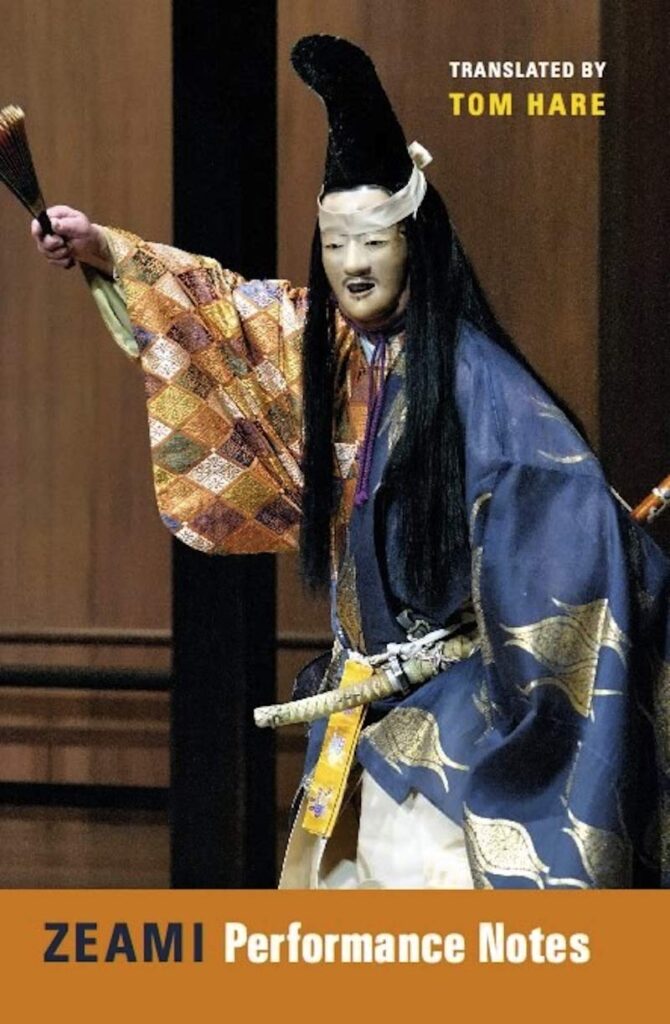
Zeami Motokiyo (世阿弥元清, c. 1363–c. 1443) is the figure who transformed noh from a popular entertainment into one of the most philosophically sophisticated art forms in human history. An actor, playwright, and theorist, Zeami wrote over fifty noh plays and a series of treatises on performance that remain among the most profound writings on art ever produced.
Zeami’s father, Kan’ami, was already a successful noh performer when the young Zeami caught the attention of the shogun Ashikaga Yoshimitsu. Under the shogun’s patronage, Zeami had access to the highest levels of aristocratic culture—and, crucially, to the Zen monks who served as intellectual advisors to the Ashikaga court.
The influence of Zen on Zeami’s thinking was transformative. His treatises—particularly Fūshikaden (風姿花伝, “The Transmission of the Flower of Acting Style”) and Kakyō (花鏡, “A Mirror Held to the Flower”)—use Zen concepts not as metaphors but as operating principles for performance. The result is a theory of art that is simultaneously a theory of consciousness.
The Flower: What Cannot Be Shown
Zeami’s central concept is hana (花)—the “flower.” Hana is not beauty, not skill, not emotional power, though it may involve all of these. Hana is the moment when something happens in the audience’s consciousness—a shift, a recognition, a feeling that arises not from what the performer is doing but from the quality of attention with which it is done.
Zeami’s most famous teaching is hisureba hana (秘すれば花)—”what is hidden is the flower.” The power of a noh performance lies not in what is displayed but in what is withheld. The actor who shows grief directly—weeping, wailing, collapsing—produces spectacle. The actor who holds grief inside, letting only the faintest trace escape through the tilt of a mask and the tempo of a step, produces hana—a flower that blooms in the viewer’s mind rather than on the stage.
This is Zen applied to performance. The Zen master does not explain enlightenment—explanation would destroy it. The noh actor does not perform emotion—performance would flatten it. Both trust that the truth, if approached with sufficient discipline and restraint, will transmit itself directly, without the mediation of explicit statement.
Yūgen: The Beauty of Depth
Zeami used the term yūgen (幽玄)—”mysterious depth”—to describe the highest quality a noh performance could achieve. Yūgen is not vagueness or obscurity. It is the sense that what you are witnessing has a depth that extends beyond what is visible—that behind the mask, beneath the slow movement, within the silence between drum beats, something vast and unnameable is present.
Yūgen in noh is the theatrical equivalent of mono no aware—the bittersweet awareness of beauty that cannot be held. Many noh plays concern ghosts—warriors who died in battle, women who died of longing, poets who wander the spirit world unable to let go of the beauty they experienced in life. These ghost-figures appear on stage not to frighten but to move—to transmit the ache of impermanence through a form so controlled that the emotion, when it finally reaches the audience, arrives with the force of something long suppressed.
Related guide: Mono no Aware: The Japanese Philosophy of Bittersweet Beauty.
The Masks: Empty Faces That Hold Everything
Why the Face Is Blank
Noh masks (nōmen or omote, 面) are among the most extraordinary objects in Japanese art. Carved from a single block of Japanese cypress, painted with layers of natural pigment, and typically five to seven hundred years old, the great masks are considered national treasures.
The most striking quality of a noh mask is what it lacks: expression. A noh mask does not smile, frown, or grimace. Its face is neutral—poised at a point between emotions, belonging to none. In Western theater, the mask traditionally amplifies expression (think of the exaggerated comedy and tragedy masks of Greek theater). In noh, the mask eliminates expression—and in doing so, creates the conditions for something far more powerful.
When a masked noh actor tilts the face slightly upward—a movement called terasu (照らす, to illuminate)—the mask catches light from above, and its features appear to brighten into something approaching joy. When the actor tilts the face slightly downward—kumorasu (曇らす, to cloud over)—shadow falls across the features, and the same face appears to grieve. The mask has not changed. The carving is identical. But the emotion the audience perceives shifts completely.
This is the noh mask’s genius: by showing no expression, it becomes a surface onto which the audience projects its own emotional response. The grief you see in the mask is your grief. The joy is yours. The mask is a mirror—and what it reflects is not the character’s inner life but your own.
Types of Noh Masks
The noh repertoire includes over two hundred named mask types, each associated with specific character categories:
Okina (翁) — The Old Man. The most sacred mask, used only in ritual performances. The okina’s face is creased with age and split by a wide smile. It represents divine blessing and the continuity of tradition.
Ko-omote (小面) — The Young Woman. The most iconic noh mask—a pale, serene female face of extraordinary beauty and ambiguity. The ko-omote is used for roles of young women, celestial beings, and spirits. Its famous half-smile, half-sadness is the essence of yūgen.
Hannya (般若) — The Demon Woman. A woman consumed by jealousy and rage, her face twisted into horns and a snarling mouth. The hannya is terrifying—and also heartbreaking, because it represents the face of love turned to suffering. The name comes from hannya (般若, prajñā)—Buddhist wisdom—suggesting that even in demonic rage, the seed of enlightenment remains.
Chūjō (中将) — The Warrior Ghost. A young warrior’s face, beautiful and haunted. Used for the ghosts of fallen samurai who return to the world unable to release their attachment to honor and glory—figures trapped between life and death by the force of their own emotions.
The Mask Is Not Worn—It Is Met
In Japanese, a noh performer does not “put on” a mask. The verb is tsukeru (つける)—to attach, to meet. The performer meets the mask. The encounter is treated with reverence: the mask is held carefully, gazed at, and placed on the face in a private moment before the performance. The mask is not a disguise. It is a personality—an entity with its own history, its own presence, its own demands.
Many masks are centuries old—carved by master carvers whose names are recorded and revered. A performer wearing a 500-year-old mask is not merely playing a character. The performer is entering a relationship with an object that has been the vessel for that character hundreds of times before, in hundreds of different performances, across half a millennium.
The Stage: Emptiness as Design
The Architecture of Nothing
The noh stage (butai, 舞台) is a masterpiece of architectural restraint. Approximately six meters square, it is made of polished cypress wood and is open on three sides to the audience. There is no proscenium arch, no curtain, no fly tower—nothing that separates the performer’s space from the audience’s space except the performer’s discipline.
The backdrop—a single painted pine tree on a wooden wall (kagami-ita, 鏡板)—never changes. It is always the same pine, whether the play is set in a battlefield, a mountain temple, a moonlit garden, or the spirit world. The pine tree is not a set piece. It is a constant—a reminder that beneath every story, every emotion, every transformation, the unchanging natural world continues.
The Hashigakari: Bridge Between Worlds
The most distinctive architectural element of the noh theater is the hashigakari (橋掛かり)—a narrow, roofed walkway that connects the backstage area to the main stage. The hashigakari is not a practical corridor. It is a symbolic bridge between the spirit world and the human world—and the shite’s entrance along this bridge, moving with glacial slowness, is often the most powerful moment in a noh performance.
The length of the hashigakari—typically ten to thirteen meters—gives the audience time to watch the character materialize. The figure appears at the far end, mask and robes already visible, and approaches the stage over several minutes. The audience watches the approach the way you might watch someone emerge from fog—gradually, with increasing clarity, with the growing awareness that what is arriving carries weight.
Experiencing Noh Today
Where to See Noh
Noh is performed regularly throughout Japan at dedicated noh theaters (nōgakudō, 能楽堂):
Tokyo. The National Noh Theatre in Shibuya is the most accessible venue for visitors, with regular performances and occasional English-language program notes. Kanze Noh Theatre in Ginza and Cerulean Tower Noh Theatre in Shibuya offer additional programming.
Kyoto. Kongo Noh Theatre is one of the oldest active noh theaters in Japan, home to the Kongo school. Performances are held monthly. Several temples, including Nishi Honganji, host outdoor torchlight noh (takigi nō, 薪能) in spring and autumn—among the most atmospheric ways to experience noh.
Related guide: 10 Must-Visit Zen Temples in Kyoto: Complete Visitor Guide.
How to Watch Noh as a First-Timer
Noh’s extreme slowness and formal language can challenge first-time viewers. These guidelines help:
Choose the right play. For beginners, plays with dramatic action—particularly warrior plays (shura-mono, 修羅物) and demon plays (kiri-mono, 切能物)—are more immediately engaging than the contemplative woman plays (kazura-mono, 鬘物). Ask the theater for a recommendation.
Read the synopsis beforehand. Noh texts are written in archaic Japanese that even native speakers find difficult. Read the story before you go so that you can follow the narrative without needing to understand every word. Most theaters provide program notes in Japanese, and major venues occasionally offer English summaries.
Do not watch. Listen. Close your eyes for a full minute during the performance and listen to the drum patterns, the flute, the chorus. Noh is as much a musical experience as a visual one. The rhythm of the drums—irregular, unpredictable, leaving long silences between strikes—creates a temporal experience unlike any Western music.
Let go of comprehension. You do not need to understand noh to experience it. Zeami designed noh to communicate below the level of verbal understanding—through rhythm, movement, mask, and the quality of silence between sounds. The feeling that arises in you during a noh performance is not a side effect of comprehension. It is the point.
FAQ
Q: What is noh theater?
A: Noh (能) is a form of Japanese musical drama that originated in the fourteenth century and has been performed continuously for over 650 years, making it one of the world’s oldest surviving theater traditions. It combines poetry, dance, music, and mask-work in performances characterized by extreme slowness, minimal staging, and the use of carved wooden masks. Noh was developed under the direct influence of Zen Buddhism and reflects Zen principles of reduction, direct transmission, and the power of emptiness.
Q: What is the difference between noh and kabuki?
A: Noh and kabuki are often confused but are fundamentally different in philosophy and style. Noh is theater of subtraction—bare stage, minimal props, masked performers, glacial pace. It emerged from Zen Buddhist culture in the fourteenth century and aims at contemplative depth. Kabuki is theater of addition—elaborate sets, colorful costumes, dynamic action, exaggerated expression. It emerged from popular entertainment in the seventeenth century and aims at spectacular impact. Noh asks the audience to participate in creating meaning; kabuki delivers meaning directly.
Q: What are noh masks made of?
A: Traditional noh masks (omote) are carved from a single block of Japanese cypress (hinoki), then painted with multiple layers of natural pigment including crusite (ground seashell), gofun (胡粉), and mineral pigments. The carving process takes weeks to months. Great masks are handed down through noh families and schools for centuries—some performing masks in active use today were carved in the fifteenth or sixteenth century. The masks are considered sacred objects and are treated with formal reverence before and after each performance.
Q: How many noh masks are there?
A: The noh repertoire includes over two hundred named mask types, organized into categories: old men (jō), women (onna), warriors (otoko), spirits and gods (shin), and demons (ki). Each mask type has a specific name and is associated with particular roles and plays. The most famous include the ko-omote (young woman), the hannya (demon woman), and the okina (sacred old man). A noh school’s mask collection, accumulated over centuries, is among its most prized possessions.
Q: What noh play should I see first?
A: For first-time viewers, warrior plays (shura-mono) offer the most immediate impact—particularly Atsumori (the ghost of a young warrior killed in the Genpei War) and Tsunemasa (a warrior-poet’s ghost who returns to play the lute). For the quintessential noh experience of yūgen, Izutsu (a woman’s ghost who relives a childhood love beside an old well) is widely considered the most beautiful play in the repertoire—though its extreme subtlety rewards viewers who have already developed some familiarity with the form.
The Silence Between Drum Beats
Noh has survived for 650 years not by adapting to the times but by refusing to. The plays performed today are the same plays performed in the fifteenth century. The masks are carved by the same methods. The stage is built to the same dimensions. The drum patterns have not gained a beat. The pace has not quickened.
In a world that values novelty, speed, and constant reinvention, noh’s refusal to change appears at first like stubbornness or irrelevance. But sit through a performance—even one you do not understand, in a language you do not speak—and you may discover that the refusal is something else. It is a statement. It says: the things that matter most about being human do not change. Love, loss, rage, longing, the ache of beauty, the weight of time—these are the same today as they were six centuries ago. Noh does not need to update its stories because the stories are still true.
Zeami understood this. His art was not designed to entertain an audience but to awaken something in them—something that was already there, sleeping beneath the noise of daily life. The empty stage, the motionless mask, the silence between drum beats—these are not deficiencies. They are invitations. They say: we have removed everything that might distract you. What remains is you—your attention, your feeling, your willingness to be moved by something you cannot explain.
This is Zen, made visible. Not on a cushion. Not in a garden. On a bare wooden stage, in the tilt of a 500-year-old mask, in the space between two sounds.
The curtain is always open. The pine tree is always waiting. Noh asks nothing of you except that you sit, watch, and let the flower bloom.
References
- Zeami. (2008). Performance Notes. Translated by Tom Hare. Columbia University Press.
- Komparu, K. (1983). The Noh Theater: Principles and Perspectives. Weatherhill/Tankosha.
- Keene, D. (1966). Nō and Bunraku: Two Forms of Japanese Theatre. Columbia University Press.
- Tyler, R. (1992). Japanese Nō Dramas. Penguin Classics.
- Suzuki, D. T. (1959). Zen and Japanese Culture. Princeton University Press.
- Ortolani, B. (1990). The Japanese Theatre: From Shamanistic Ritual to Contemporary Pluralism. Princeton University Press.