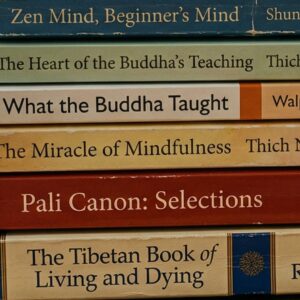

The Stack on Your Nightstand
There is a stack of books on your nightstand. Or your desk. Or the floor beside the chair where you read. Some have been there for weeks. Some for months. One—the one at the bottom, the one you bought with a surge of certainty that this was the book you needed—has been there so long that you have forgotten what made you buy it.
You have not read them. You may not read them this month, or this season, or this year. And somewhere beneath the pleasure of owning them, there is a thin layer of guilt. You should have read them by now. You should stop buying books until you finish the ones you have. The stack is a record of good intentions unfulfilled—a monument to your inability to keep up with your own curiosity.
Or so the Western mind tells you.
The Japanese mind tells you something different. It tells you that your stack of unread books has a name—tsundoku (積ん読)—and that name is not a criticism. It is a recognition. A recognition that the desire to read is itself a form of devotion, that a pile of unread books is a library of possibility, and that the relationship between a person and their books does not begin when the cover is opened. It begins the moment the book is chosen.
What Tsundoku Means
Tsundoku (pronounced tsoon-doh-koo) is a compound of two verbs:
積む (tsumu) — to pile up, to stack, to accumulate. The same verb used for stacking boxes, building stone walls, and accumulating experience. It carries no negative connotation—piling up can be diligent, careful, deliberate.
読む (doku/yomu) — to read. In the compound, the reading form doku is used, creating a wordplay: tsundoku sounds like tsunde-oku (積んでおく), meaning “to pile up and leave for later.” The word itself contains its own punchline—reading that has been piled up and left.
The term emerged in Japan’s Meiji era (1868–1912), a period of explosive intellectual curiosity when Western books flooded into the country for the first time. Students and scholars, overwhelmed by the sudden availability of knowledge, bought far more than they could read. The word was coined with a self-aware smile—the recognition that intellectual appetite often outpaces intellectual digestion.
What makes tsundoku distinctive is its tone. It is not a diagnosis of a problem. It is a name for a condition that readers share—a condition that is simultaneously ridiculous, endearing, and quietly admirable. The person who practices tsundoku cares about books. They care enough to acquire them, to bring them home, to give them a place on the shelf. That the reading has not happened yet does not diminish the caring. It simply means the relationship is still in its early stages.
The Western Guilt vs the Japanese Acceptance
The Productivity Trap
Western culture has a complicated relationship with unfinished things. An unread book feels like a task left incomplete—an item on a to-do list that refuses to be checked off. In a culture that values productivity, measurable progress, and the efficient use of time, a pile of books you have not read looks like evidence of waste. You spent money. You spent shelf space. You received nothing in return.
This framing turns books into transactions. You pay (money, time) and you should receive (knowledge, entertainment, self-improvement). An unread book is a failed transaction—money paid, value not received.
Tsundoku rejects this framing entirely. A book is not a transaction. It is a relationship—and like all relationships, it unfolds on its own schedule. Some books are read the week they are bought. Some wait years. Some are never read at all but serve their purpose simply by being present—a reminder on the shelf that a certain subject exists, that a certain question is worth asking, that a certain author has something to say when you are ready to listen.
Mottainai and the Unread Book
There is an apparent contradiction between tsundoku and mottainai (もったいない)—the Japanese ethic of not wasting. If you buy a book and do not read it, is that not waste?
The answer, in the Japanese view, is no—because mottainai is about respecting the value of things, not about extracting maximum utility from them. A book sitting unread on a shelf is not being wasted. It is being kept. It is not in a landfill. It is not forgotten. It occupies a place in your home and, however faintly, in your awareness. The waste would be discarding it—throwing away the possibility it represents. Keeping it, even unread, is an act of respect.
Related guide: Mottainai: The Japanese Philosophy That Sees Dignity in Every Object
This is the same principle that makes kintsugi repair a broken bowl rather than discard it—the recognition that an object’s value is not limited to its current function. The bowl’s value includes its history and its future. The book’s value includes the reading that has not yet happened.
Tsundoku and the Zen of Not-Yet
Beginner’s Mind and the Unread Shelf
In Zen Buddhism, shoshin (初心)—beginner’s mind—is the quality of approaching every experience as if for the first time, without the burden of preconception or the arrogance of expertise. Shunryu Suzuki’s famous teaching—”In the beginner’s mind there are many possibilities, but in the expert’s mind there are few”—is one of the most quoted lines in Western Buddhism.
Comprehensive guide: What Is Zen Buddhism?
An unread book is beginner’s mind in physical form. It sits on your shelf as pure possibility—a question you have not yet asked, an argument you have not yet heard, a world you have not yet entered. The moment you read it, the possibilities collapse into a single experience. The book becomes what it is. Before that moment, it is what it might be—and “might be” contains more than “is.”
This is not a rationalization for laziness. It is a genuine philosophical observation. The unread books on your shelf represent the frontier of your ignorance—the boundary between what you know and what you do not know. That boundary is the most intellectually alive place you can inhabit. Knowing that it exists, seeing it every day in the form of a stack of unread spines, is itself a practice—a daily reminder that the world is larger than your current understanding of it.
The Book That Finds You
There is a version of ichigo ichie—the principle of the unrepeatable encounter—that applies to books. You did not buy that book randomly. Something about the title, the cover, the recommendation, the moment in your life when you encountered it, made you reach for it. That impulse was not rational. It was not a calculated decision based on reviews and syllabi. It was recognition—a quiet sense that this book contained something you needed.
Related guide: Ichigo Ichie Meaning: “One Time, One Meeting” — Origins & Practice
That the reading has not happened yet does not invalidate the recognition. The book may be waiting for you to arrive at the version of yourself that is ready for it. You at twenty-five may buy a book that you at thirty-five finally reads—and when you read it, you understand why you bought it a decade ago. Your past self knew something your present self had not yet learned. The book was patient. It waited.
Related guide: Koi no Yokan: The Japanese Feeling of Knowing Love Is Coming
The Anti-Library
The Italian novelist and semiotician Umberto Eco owned a personal library of approximately thirty thousand volumes. When visitors expressed amazement at the collection, Eco would note that the value of his library lay not in the books he had read but in the ones he had not. The unread books were the important ones—they represented everything he did not yet know, the vast territory of his ignorance made visible and organized on shelves.
Nassim Nicholas Taleb, in The Black Swan, formalized Eco’s insight as the concept of the “anti-library”—a collection whose value increases with the number of unread books it contains. A library of books you have already read is a record of the past. An anti-library—a collection of books you have not read—is a map of the future. It shows you where you could go, what you could learn, who you could become.
Tsundoku is the Japanese name for what Eco practiced intuitively and Taleb described analytically. The word has existed since the nineteenth century—a century before Eco’s library and Taleb’s theory. Once again, the Japanese language arrived first: it noticed the experience, gave it a name, and in naming it, made it available to be practiced deliberately rather than experienced accidentally.

How to Practice Tsundoku (Without Guilt)
1. Buy for Resonance, Not for Schedule
The next time you are in a bookshop or browsing online, notice why you reach for a particular book. Is it because a review told you it was important? Or is it because something in the title, the cover, the first paragraph, produced a small vibration of recognition—a sense that this book and you have unfinished business?
Buy the books that produce the vibration. Do not worry about when you will read them. The when will take care of itself.
2. Give Your Unread Books a Place
Do not hide your tsundoku in a closet or stack them behind the books you have already read. Give them a visible shelf, a dedicated stack, a place where you see them every day. The unread pile is not a source of shame. It is a landscape of possibility—and like any landscape, it works best when you can see it.
3. Revisit the Pile
Once or twice a year, sit in front of your unread books. Do not plan to read any of them. Just look. Pick up each one. Read the first page. Put it back. Some books will feel alive in your hands—they are ready, or you are. Some will feel neutral—not yet. Some will feel finished—the curiosity that made you buy them has been satisfied by other means, and you can let them go.
This is the tsundoku equivalent of tending a garden. Not every seed germinates. Not every book gets read. The practice is not reading everything—it is maintaining a relationship with the possibility that reading represents.
4. Pass Along What You Have Outgrown
When a book no longer calls to you—when the question it promised to answer has been answered by experience, by another book, by the passage of time—let it go. Give it to someone who might need it. Wrap it in furoshiki and present it as a gift. The book’s journey does not end with you.
Related guide: Furoshiki: The Japanese Art of Wrapping and the Philosophy of One Cloth
5. Read What Calls You
And when a book finally calls—when you pick it up from the pile and the first page pulls you in and the world outside goes quiet—read it. Read it slowly. Read it the way you drink matcha—with attention, with presence, with the awareness that this encounter between your mind and these words is happening for the first and only time.
Related guide: Matcha Ceremony: How to Make Japanese Matcha as a Daily Zen Practice
FAQ
Q: What does tsundoku mean?
A: Tsundoku (積ん読) is a Japanese word meaning the habit of acquiring books and letting them pile up unread. It combines tsumu (積む, to pile up) and doku (読, to read), with a wordplay on tsunde-oku (積んでおく, to pile up and leave). The term emerged in Japan’s Meiji era (late 19th century) and carries an affectionate, self-aware tone—it is not a criticism but a name for a condition that book lovers universally share.
Q: How do you pronounce tsundoku?
A: Tsundoku is pronounced tsoon-doh-koo. The “tsu” is a single syllable—the “t” and “s” are blended, similar to the “ts” in “cats.” “Doh” rhymes with “go.” “Koo” rhymes with “too.” Three syllables, evenly stressed.
Q: Does tsundoku contradict KonMari?
A: Not necessarily. Marie Kondo’s method asks whether an object “sparks joy.” For many readers, unread books spark a particular kind of joy—the joy of anticipation, of possibility, of future discovery. Kondo herself has said that books you intend to read eventually can stay if they genuinely bring you happiness. Tsundoku and KonMari conflict only if the books produce guilt rather than possibility. If looking at your unread stack fills you with pleasure, the books are doing their job. If it fills you with dread, some can be released.
Q: How many unread books is too many?
A: There is no number. Umberto Eco had thirty thousand books and considered the unread ones the most important. The question is not how many books you own but how you relate to them. If your unread books feel like a living collection of curiosity—a map of where your mind might go—you have the right number. If they feel like a burden, you have too many. The practice is awareness, not arithmetic.
Q: Does tsundoku apply to e-books?
A: Technically yes—a digital library full of unread purchases is tsundoku in electronic form. But the experience is different. Physical books occupy space. They are visible. They remind you of their presence every time you walk past the shelf. A digital book, buried in a device, does not announce itself the same way. The physicality of tsundoku—the pile, the weight, the visible spines—is part of its meaning. Screens hide their contents. Shelves display theirs.
The Pile Is the Practice

Your unread books are not a failure of discipline. They are not evidence that you lack time, focus, or commitment. They are evidence of something far more important: you are still curious. You still believe that a book you have not yet read might change how you think. You still walk into bookshops and feel the pull of a spine, a title, a first sentence that speaks to something you did not know you were looking for.
That pull—that reaching—is not the problem. It is the most human thing about you. The day you stop buying books you do not have time to read is the day you have decided that your current understanding of the world is sufficient. Tsundoku says: it is not. There is more. There is always more.
The pile on your nightstand is not a to-do list. It is a love letter—from your past self to your future self, written in titles and spines and the faint scent of paper. Each book says: I thought you might need this someday. And someday, for each of them, you will.
Until then, let them pile. The Japanese have a word for what you are doing, and it is not a word for failure.
It is a word for a reader who has not yet finished beginning.
References
- Taleb, N. N. (2007). The Black Swan: The Impact of the Highly Improbable. Random House.
- Suzuki, S. (1970). Zen Mind, Beginner’s Mind. Weatherhill.
- Manguel, A. (2008). The Library at Night. Yale University Press.
- Eco, U. (2009). The Infinity of Lists. Rizzoli.
- Kondo, M. (2014). The Life-Changing Magic of Tidying Up. Ten Speed Press.
- Lomas, T. (2016). “Towards a positive cross-cultural lexicography.” The Journal of Positive Psychology, 11(5), 546-558.