Raku pottery (楽焼, raku-yaki) is a Japanese ceramic tradition created in the 16th century specifically for the Zen tea ceremony. Born from the collaboration between tea master Sen no Rikyū and tile maker Chōjirō in 1580s Kyoto, raku ware is hand-formed without a potter’s wheel using a technique called tezukune (手捏ね), fired at extreme temperatures, and deliberately shaped to be asymmetric and irregular. The Raku family has maintained an unbroken sixteen-generation lineage in Kyoto, making each bowl by hand in a process unchanged since its founding. Rooted in the wabi-sabi aesthetic of finding beauty in imperfection, raku tea bowls are designed not to be admired from a distance but to be held—their irregular surfaces demanding the kind of present-moment attention that is itself a form of Zen practice.
The Most Expensive Imperfection in the World
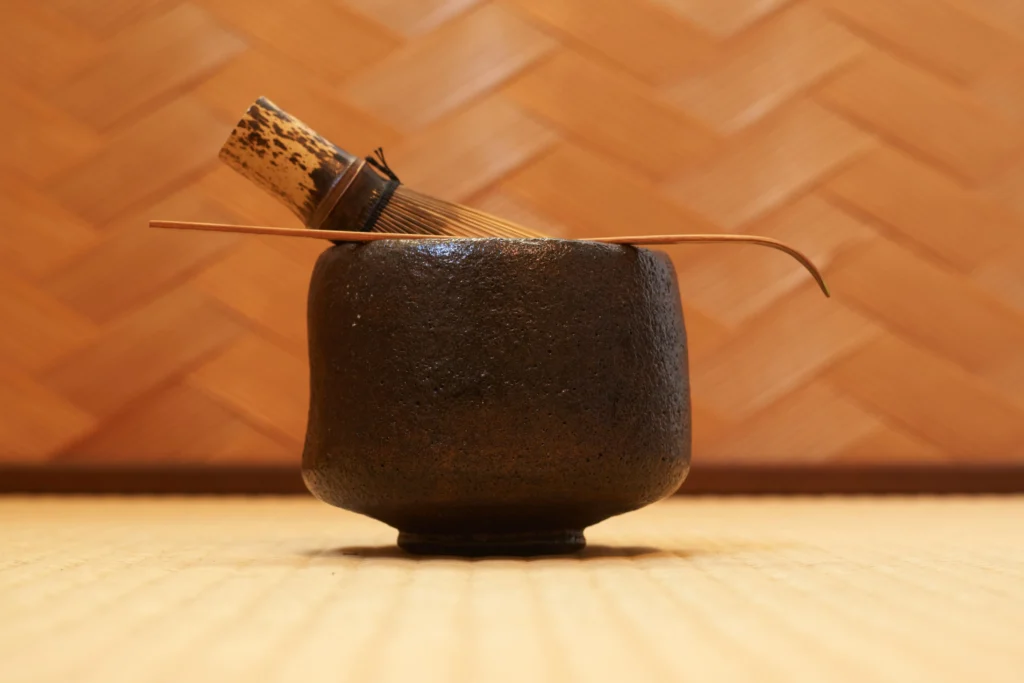
In 2016, a small tea bowl sold at auction for approximately $1.2 million. It was not painted by a famous artist. It was not decorated with gold or precious stones. It was a simple, dark, slightly lopsided vessel—hand-formed without a potter’s wheel, glazed in plain black, and small enough to fit in two cupped hands.
It was a raku tea bowl. And its value lies not in what it has but in what it lacks.
Raku pottery (raku-yaki, 楽焼) is the ceramic tradition born from the Japanese tea ceremony—created in the sixteenth century at the request of Sen no Rikyū, the tea master who believed that the most profound beauty is found not in perfection but in its deliberate absence. Where Chinese and Korean ceramics pursued symmetry, smoothness, and technical virtuosity, Rikyū asked for the opposite: a bowl that was rough, uneven, and shaped not by a spinning wheel but by the pressure of human hands.
That request produced one of the most influential ceramic traditions in world history—and one of the purest expressions of Zen philosophy in physical form.
Related guide: Tea Ceremony: History, Philosophy & How to Experience It
This guide explores the origins of raku pottery, the Zen philosophy that shaped it, the firing process that gives it its character, and why a tradition born in a sixteenth-century tea room continues to influence ceramics worldwide.
Rikyū and Chōjirō: The Birth of Raku
The Tea Master’s Request
In the 1580s, Sen no Rikyū was transforming the Japanese tea ceremony. He rejected the elaborate Chinese tea wares (karamono) favored by the aristocracy and sought vessels that embodied his philosophy of wabi-cha—tea practiced in the spirit of rustic simplicity, humility, and direct experience.
Rikyū found his potter in Chōjirō (長次郎, died 1589), a tile maker in Kyoto. The request was radical: create tea bowls without using a potter’s wheel. Shape them entirely by hand. Make them small enough to hold intimately, rough enough to feel honest, and dark enough to let the green of the matcha speak without competition from the vessel.
Chōjirō’s response was a series of bowls that broke every convention of fine ceramics. They were asymmetrical. Their walls were uneven. Their surfaces were matte and unpretentious. They looked, to the untrained eye, like the work of a beginner—and that was precisely the point.
The Seal of Raku
The name “raku” (楽, meaning “enjoyment” or “ease”) was bestowed on Chōjirō’s successors by the warlord Toyotomi Hideyoshi, who gave the family a gold seal bearing the character. The Raku family has continued to make tea bowls in Kyoto for sixteen generations—an unbroken lineage spanning over four hundred years. The current head, Raku Kichizaemon XVI, still works in the same tradition, shaping each bowl by hand without a wheel.
This continuity is itself a statement. In a world where ceramics have been industrialized, mechanized, and mass-produced, the Raku family continues to make one bowl at a time, by hand, in a process that has not fundamentally changed since Chōjirō first pressed clay between his palms at Rikyū’s request.
The Zen of Imperfection
Why the Bowl Is Not Round
A raku tea bowl is not round because Rikyū understood something about attention: symmetry is invisible. A perfectly round, perfectly smooth bowl disappears in the hand—the mind registers it as “bowl” and moves on. An irregular bowl—one with a slight lean, an uneven lip, a thumbprint pressed into the clay—demands to be noticed. The hand adjusts its grip. The eye follows the rim. The mind, for a moment, pays attention to the vessel instead of taking it for granted.
This is wabi-sabi at its most functional. The imperfection is not a failure of craftsmanship. It is the deliberate creation of conditions that make the user present with the object. The tea tastes different from a raku bowl because you are paying attention to the act of drinking—and the bowl’s irregularity is what invited that attention.
Comprehensive guide: Wabi Sabi : The Japanese Philosophy of Finding Beauty in Imperfection
Tezukune: The Hand as Tool
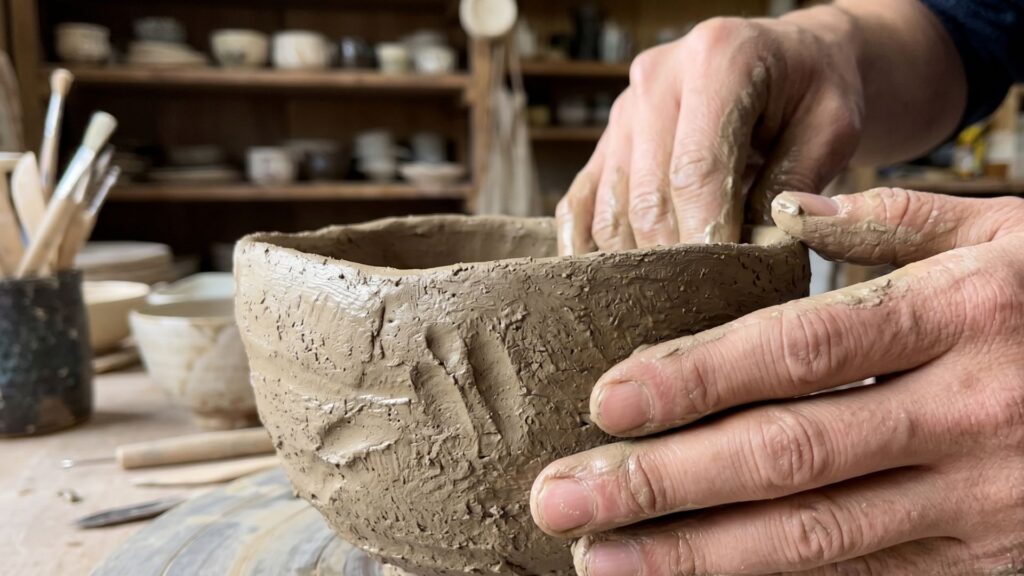
The technique that defines raku pottery is tezukune (手捏ね)—forming the bowl entirely by hand, without a potter’s wheel. The potter begins with a ball of clay, hollows it with the thumbs, and builds up the walls by pinching, pressing, and rotating the clay in the palms.
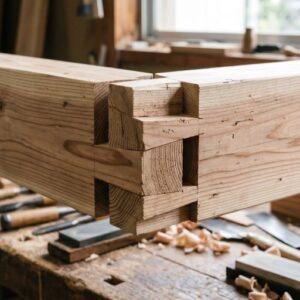
The result is a bowl that records every decision the potter made—every press of the thumb, every adjustment of the wall thickness, every moment when the clay responded to the hand’s pressure in an unexpected way. The bowl becomes a record of the conversation between maker and material—the same dialogue that Japanese woodworking achieves between carpenter and wood.
Related guide: Japanese Woodworking: The Zen Philosophy of Building Without Nails
This is why no two raku bowls are alike, and why collectors value specific bowls by specific makers. Each bowl is literally one of a kind—not because the potter intended uniqueness, but because the hand-forming process makes repetition impossible.
How Raku Is Made: The Traditional Process
Preparing the Clay
Traditional raku clay must withstand thermal shock—the stress of being moved rapidly between extreme temperatures. Raku potters use a coarse, open-bodied clay that contains enough grog (ground fired clay) or sand to absorb expansion and contraction without cracking. The clay is wedged by hand to remove air bubbles, then formed using the tezukune method.
After forming, the bowl is dried slowly—sometimes for weeks—then bisque-fired at a low temperature to harden it enough to accept glaze.
Glazing
Traditional Japanese raku uses two primary glazes:
Black raku (kuro-raku, 黒楽): The bowl is glazed and placed directly into a preheated kiln at approximately 1,200°C. The extreme heat melts the glaze quickly, and the bowl is removed with tongs while still glowing. The rapid cooling produces a dense, matte black surface—sometimes with subtle variations where the glaze pooled or thinned.
Red raku (aka-raku, 赤楽): The bowl is fired at a lower temperature and cooled more slowly, producing warm red-brown tones from the iron in the clay and glaze. Red raku surfaces tend to be softer and more varied than black—each firing produces slightly different colors depending on the clay, the kiln atmosphere, and the cooling rate.
The Firing
The raku firing process is uniquely direct. Unlike most ceramics—which are loaded into a cold kiln, heated gradually over many hours, and cooled slowly inside the kiln—raku bowls are placed into a kiln that is already at full temperature. The potter watches through the kiln opening as the glaze melts, then removes the bowl at the precise moment when the surface reaches the desired state.
This requires judgment that cannot be taught from a book. The potter reads the color of the glaze, the texture of the surface, and the behavior of the heat—making a decision in seconds that determines the bowl’s final character. Too early, and the glaze is underdeveloped. Too late, and it loses its subtlety. The firing is a moment of absolute attention—a practice that mirrors the concentrated awareness of zazen.
Black and Red: The Two Faces of Raku
Kuro-Raku (黒楽): Darkness as Depth
Black raku is the tradition most closely associated with Rikyū’s aesthetic. The dense, light-absorbing surface of a kuro-raku bowl creates a visual silence—the eye has nothing to cling to except the form itself and the thin bright line of green matcha inside. In the dim light of a tea room, a black raku bowl seems to absorb the space around it, becoming a void that focuses attention inward.
Chōjirō’s black raku bowls—several of which survive in Japanese museum collections—are considered among the most important objects in Japanese art history. They are not beautiful in any conventional sense. They are powerful. They create presence.
Aka-Raku (赤楽): Warmth as Welcome
Red raku, developed slightly later than black, offers a warmer, more approachable character. The red-brown surfaces show more variation—patches of darker iron spotting, areas where the clay body shows through the glaze, subtle orange tones where the fire touched the surface directly.
Where black raku commands attention through absence, red raku invites it through warmth. Many tea practitioners choose red raku bowls for less formal gatherings—the warmth of the color creates an atmosphere of ease that complements the wabi spirit of humble hospitality.
Western Raku: A Different Fire
In the 1960s, the American ceramicist Paul Soldner developed a technique he called “raku”—inspired by the Japanese tradition but fundamentally different in method and philosophy.
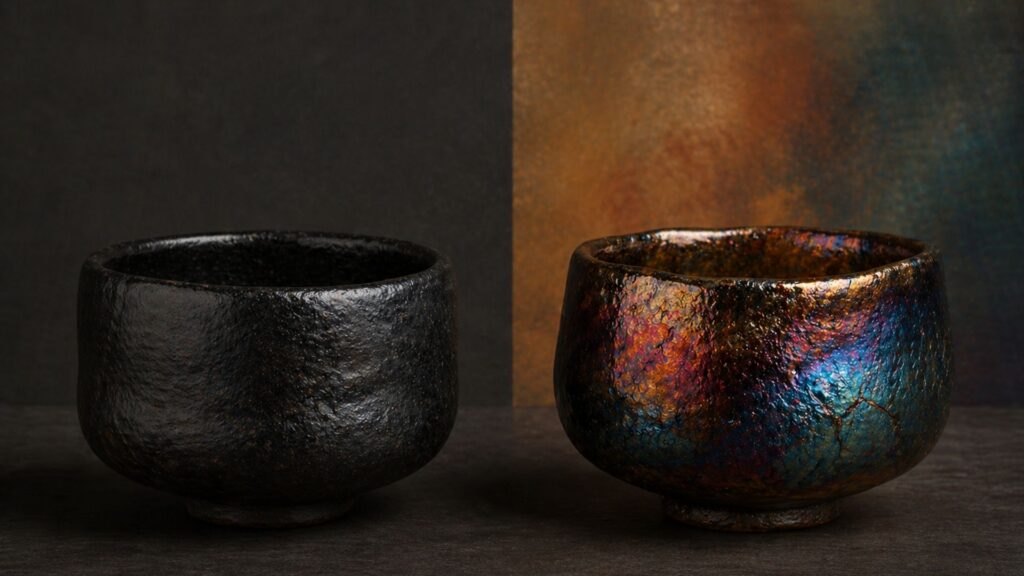
Western raku involves removing the glazed pot from the kiln at peak temperature and placing it into a container of combustible material—sawdust, newspaper, leaves. The material ignites, and the container is sealed. The reduction atmosphere and rapid cooling produce dramatic, unpredictable effects: metallic lusters, iridescent surfaces, crackle patterns stained by carbon, and the distinctive horsehair patterns created by laying strands of horsehair onto the hot surface.
The results are visually spectacular—and entirely different from traditional Japanese raku. Where Japanese raku seeks quiet restraint, Western raku celebrates drama. Where Japanese raku is made for the hand and the tea room, Western raku is often made for the eye and the gallery. Where the Japanese potter seeks control within simplicity, the Western potter seeks beauty within chaos.
Neither tradition is “more authentic” than the other—they are different responses to the same fundamental question: what happens when you bring fire and clay together with intention? But understanding the difference matters, because the word “raku” in English almost always refers to the Western technique. The Japanese tradition—the one born in Rikyū’s tea room—remains far less known in the English-speaking world, and far more profound in its philosophical implications.
Raku and Kintsugi: The Circle of Imperfection
There is a moment in the life of a raku tea bowl that completes its philosophical arc. The bowl, shaped by hand to be deliberately imperfect, is used for years or decades in the tea ceremony. One day, it breaks—dropped, knocked from a shelf, cracked by thermal stress. In most cultures, this would be the end of the object’s life.
In Japan, it is the beginning of a new chapter.
Related guide: Kintsugi: The Art of Golden Repair and Finding Beauty in Broken Things
The broken raku bowl is repaired with kintsugi—lacquer mixed with gold, applied along the cracks so that the repair becomes visible, even celebrated. The bowl that was already imperfect becomes more so. The golden lines of repair add a history that the potter never intended—a record of accident, loss, and the decision to mend rather than discard.
A kintsugi-repaired raku bowl is, in a sense, the ultimate wabi-sabi object. It was shaped imperfectly on purpose. It was broken by chance. It was repaired with care. Each layer of its history—making, breaking, mending—adds depth without adding pretension. The bowl does not try to be beautiful. It simply carries the evidence of having been used, valued, and loved enough to save.
FAQ
Q: What is raku pottery?
A: Raku pottery (raku-yaki, 楽焼) is a Japanese ceramic tradition created in the sixteenth century for the tea ceremony. Its defining characteristics are hand-forming without a potter’s wheel (tezukune), low-temperature firing, and a deliberate embrace of irregularity and imperfection rooted in Zen Buddhist aesthetics. The term “raku” in English also refers to a Western ceramic technique developed in the 1960s, which uses post-firing reduction to produce dramatic surface effects—a related but philosophically distinct tradition.
Q: Why are raku tea bowls imperfect on purpose?
A: Raku’s founder, Sen no Rikyū, believed that perfect symmetry makes objects invisible—the mind categorizes them and stops paying attention. An irregular bowl requires the hand to adjust, the eye to explore, and the mind to engage. The imperfection is a tool for creating presence—it makes the act of drinking tea a conscious experience rather than an automatic one. This philosophy is rooted in wabi-sabi, the Japanese aesthetic that finds beauty in impermanence, incompleteness, and the natural character of materials.
Q: What is the difference between Japanese raku and Western raku?
A: Japanese raku is hand-formed, quietly glazed (typically black or red), and made specifically for the tea ceremony. Its aesthetic is restraint, subtlety, and warmth in the hand. Western raku, developed by Paul Soldner in the 1960s, uses post-firing reduction with combustible materials to produce dramatic metallic lusters, crackle patterns, and horsehair effects. Both are legitimate ceramic traditions, but they differ fundamentally in philosophy: Japanese raku seeks beauty through simplicity; Western raku seeks beauty through unpredictability.
Q: Can I buy authentic Japanese raku tea bowls?
A: Bowls by the Raku family (the direct lineage from Chōjirō) are extremely rare and expensive—museum-level pieces. However, many skilled Japanese potters produce traditional-style raku tea bowls that are accessible to tea practitioners. Look for bowls described as tezukune (hand-formed) in kuro-raku or aka-raku styles from Kyoto-based potters. Specialty Japanese ceramics retailers and auction houses are the most reliable sources. For everyday use, high-quality raku-style bowls are available through Japanese craft dealers.
Q: Is raku pottery food safe?
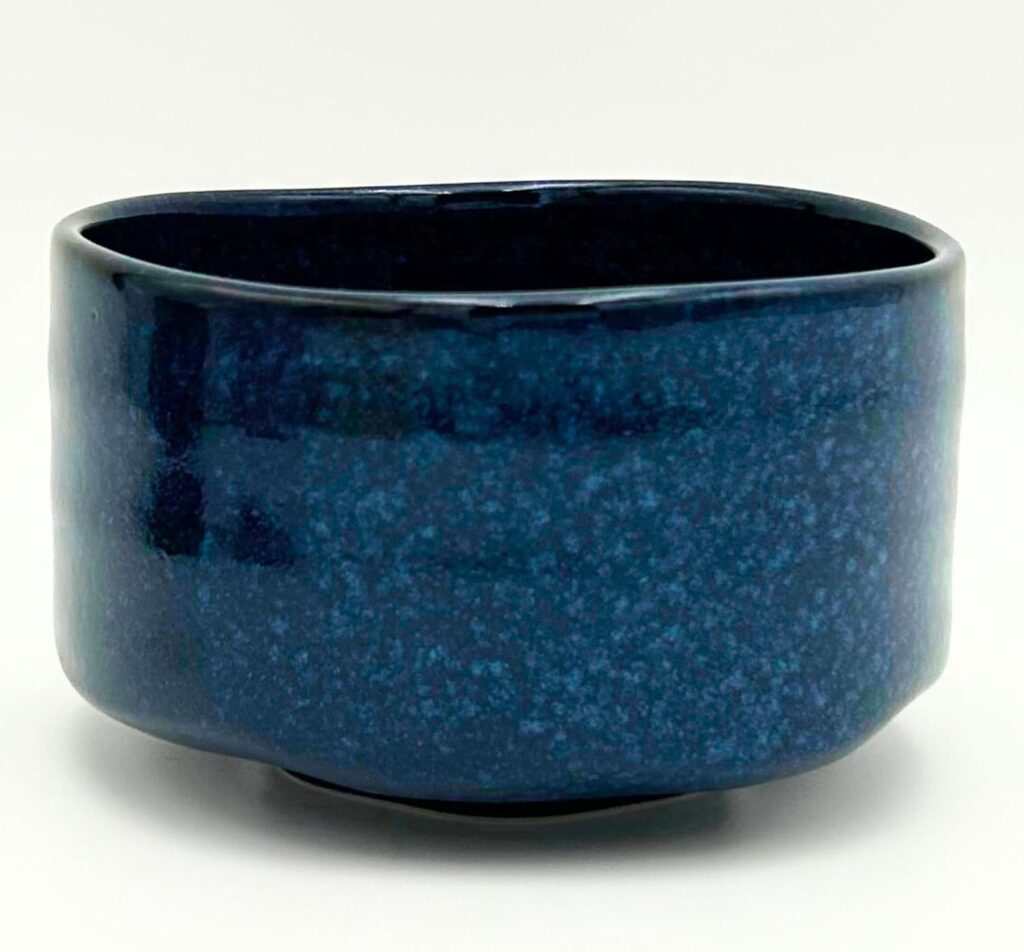
A: Traditional Japanese raku tea bowls are used for matcha and are considered safe for that purpose—the brief contact time between tea and vessel is minimal. However, raku pottery (both Japanese and Western) is generally not recommended for food storage, cooking, or use with acidic foods, as the low-firing temperature produces a porous body that can absorb liquids. Western raku pieces with metallic glazes should be treated as decorative objects, not functional tableware.
The Bowl That Gets Out of the Way
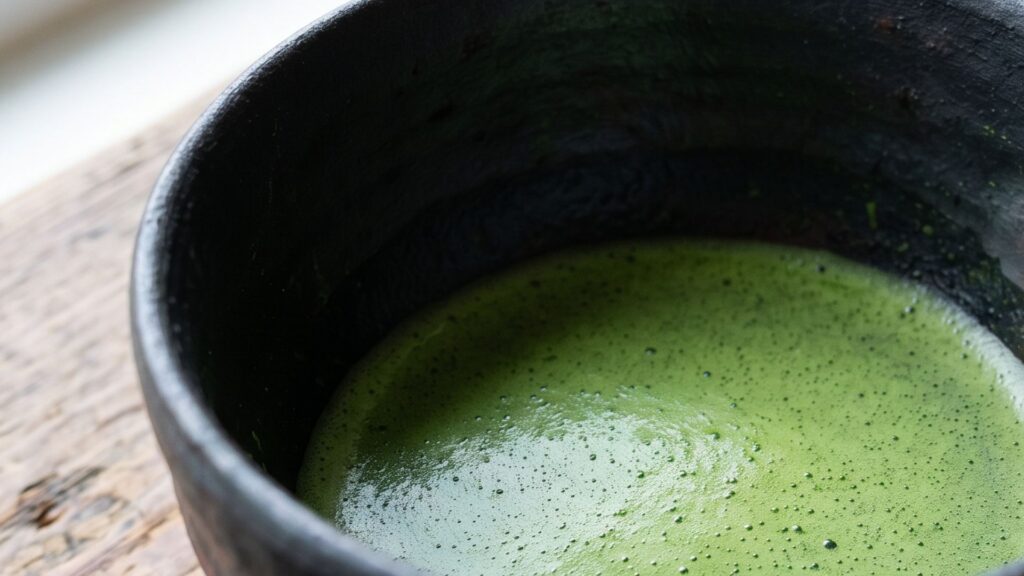
When Rikyū asked Chōjirō to make a tea bowl without a wheel, he was not asking for a new style of ceramics. He was asking for a vessel that would get out of the way.
The ornate Chinese tea bowls that Rikyū rejected were beautiful, but their beauty competed with the experience they were meant to serve. The gold, the intricate painting, the technical perfection—all demanded attention that should have belonged to the tea, the guest, and the present moment. Rikyū wanted a bowl that would hold tea and hold attention, but hold nothing else. No decoration to admire. No technique to praise. No perfection to aspire to. Just clay, shaped by a hand, darkened by fire, and warm against the palms.
Related guide: Ichigo Ichie: The Japanese Art of Living in the Unrepeatable Moment
Related guide: Mono no Aware: The Japanese Philosophy of Bittersweet Beauty
Four hundred years later, the raku bowl still does what Rikyū intended. It sits in the hand with a weight that says I am here. Its rough surface says feel me. Its irregular rim says look carefully. And its darkness says the tea is what matters—not me.
Comprehensive guide: Wabi Sabi : The Japanese Philosophy of Finding Beauty in Imperfection
This is the deepest teaching of raku pottery: the most profound beauty is the kind that serves something larger than itself.
References
- Raku, K. XVI. (2015). Raku: A Legacy of Japanese Tea Ceramics. Seigensha Art Publishing.
- Cardozo, S., & Hirano, M. (2004). The Art of Raku Pottery. Kodansha International.
- Cort, L. A. (1992). Seto and Mino Ceramics. Smithsonian Institution.
- Okakura, K. (1906). The Book of Tea. Putnam’s Sons.
- Bernard, R. (2005). The Unknown Craftsman: A Japanese Insight into Beauty (translation of Yanagi Sōetsu). Kodansha International.
- Suzuki, D. T. (1959). Zen and Japanese Culture. Princeton University Press.