The Word You Hear Every Day in Japan
In a Japanese household, few words are spoken more frequently than mottainai. A child leaves rice in the bowl—mottainai. Water runs from an unattended tap—mottainai. A shirt with years of wear left in it is headed for the trash—mottainai.
The word is spoken reflexively, almost unconsciously, the way English speakers say “excuse me” or “thank you.” But unlike those social lubricants, mottainai carries philosophical weight. It is not a polite convention. It is a worldview—one that has shaped Japanese material culture for centuries and produced some of the most beautiful art forms in the world.
English translations typically land on “wasteful” or “what a waste.” Both are wrong—or rather, both are so incomplete that they obscure what mottainai actually means. “Wasteful” describes a behavior. Mottainai describes a relationship—the relationship between a person and an object, and the recognition that the object has a value that extends beyond its utility. To say mottainai is not to say “you are being wasteful.” It is to say “this thing deserves better than what you are doing with it.”
That distinction—between criticizing behavior and honoring the object—is where mottainai departs from Western environmentalism and enters the territory of philosophy.
What Mottainai Means
Mottainai (pronounced moht-tai-nai) is written 勿体無い, though it is more commonly written in hiragana as もったいない.
The kanji reveal the word’s depth:
勿体 (mottai) — the intrinsic dignity or essence of a thing. Mottai is the inherent worth that an object possesses simply by existing—not its market value, not its usefulness, but the fact that it is made of materials that came from somewhere, was shaped by someone’s labor, and carries the accumulated energy of everything that went into its creation.
無い (nai) — without, lacking, absent.
Mottainai, then, means “the intrinsic dignity is not being honored”—a state in which something’s essential value is being disregarded, wasted, or treated as though it does not exist.
This is fundamentally different from “wasteful.” Wasteful is about efficiency—you are not getting enough value from the resource. Mottainai is about respect—the resource has a dignity that your behavior is failing to acknowledge. The correction is not “be more efficient.” The correction is “see what this thing actually is.”
Buddhist Roots: The Dignity of All Things
Dependent Origination
Mottainai’s philosophical foundation lies in the Buddhist concept of engi (縁起)—dependent origination. This teaching holds that nothing exists independently. Every object is a convergence of causes and conditions—a temporary gathering of materials, labor, energy, and intention that will eventually dissolve and reconverge into something else.
Comprehensive guide: What Is Zen Buddhism?
A grain of rice is not just a grain of rice. It is sunlight converted to energy by a plant. It is water drawn from a river. It is soil built over centuries from decaying organic matter. It is the labor of a farmer who planted, tended, and harvested the crop. It is the effort of everyone who transported, sold, cooked, and served it. To waste a grain of rice is not merely to waste a grain of rice. It is to waste everything that converged to produce it.
This is what the Zen meal chant gokan no ge (五観の偈, Five Reflections) expresses when monks recite before eating: “Let us reflect on how this food came to us—the work, the sacrifice, the conditions that made it possible.” The chant does not say “be grateful.” It says “be aware”—aware of the web of causes that produced what is in front of you.
Mottainai is this awareness applied to everything, not just food. Every object is a convergence. Every object carries the trace of what made it. To discard it carelessly is to disregard that history—to treat the convergence as though it never happened.
Mottainai in the Temple
In Zen monasteries, mottainai is not a concept. It is an operational principle. Monks use every part of a vegetable in their cooking. They mend their robes until the original fabric is barely visible beneath the patches. They sweep their rooms with brooms worn down to the last bristle. Nothing is discarded until it has given everything it can give—and even then, it is often repurposed rather than thrown away.
This is not asceticism. It is attention. The monk who mends a robe for the tenth time is not suffering through deprivation. The monk is practicing a form of respect—acknowledging that the fabric, the thread, and the labor that produced them have value that outlasts any single tear.
Three Arts of Mottainai
The most remarkable expression of mottainai is not in what Japan discards but in what Japan makes from the refusal to discard. Three art forms—each covered in depth elsewhere on this site—embody mottainai so completely that they have become internationally recognized symbols of the philosophy.
Kintsugi: When a Bowl Breaks, Make It More Beautiful
A ceramic bowl breaks. In most cultures, this is the end of the object’s story. In Japan, it can be the beginning of a new chapter.
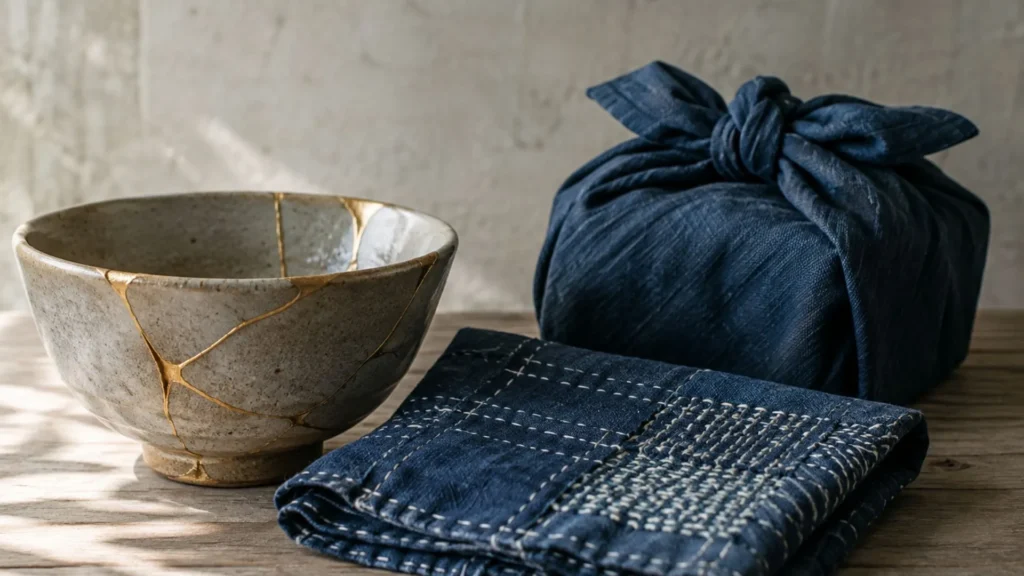
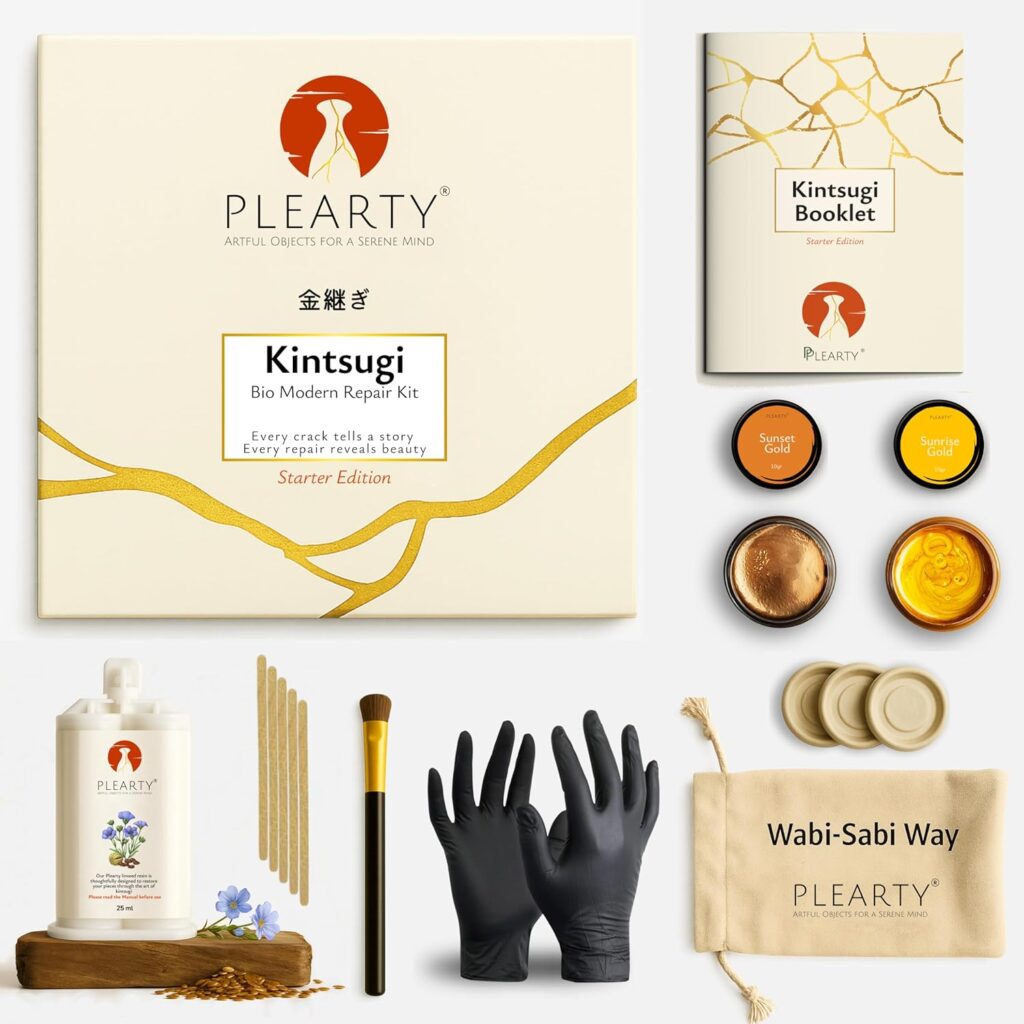
Kintsugi (金継ぎ, golden joinery) is the art of repairing broken ceramics with lacquer mixed with powdered gold. The repair does not hide the damage. It illuminates it—the golden seams become visible lines that trace the object’s history of breaking and mending. The repaired bowl is not restored to its original condition. It is transformed into something new—an object whose beauty includes its wounds.
Related guide: Kintsugi: The Art of Golden Repair and Finding Beauty in Broken Things
The mottainai in kintsugi is double. First: the bowl is not discarded when it breaks—its material value and its history are preserved. Second: the repair itself becomes beautiful—the act of mending is elevated from maintenance to art. Kintsugi says: this bowl’s story did not end when it cracked. The crack is a new line in the story, and the gold makes that line worth reading.
Sashiko: When Fabric Tears, Stitch It Stronger
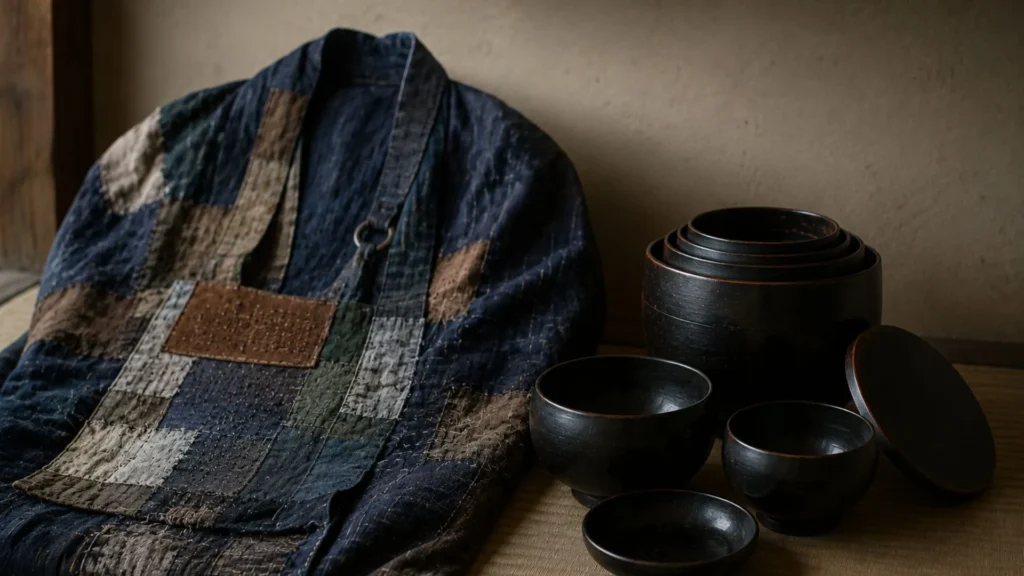
Sashiko (刺し子, “little stabs”) is the Japanese art of reinforcing and decorating textiles with running stitch patterns. Originating in rural Japan where fabric was scarce, sashiko transformed the act of mending into a geometric art form—stitching patterns of asanoha (hemp leaf), nowaki (wind-blown grass), and uroko (fish scales) across worn fabric, making the mended textile stronger and more beautiful than the original.
Related guide: Sashiko: The Japanese Art of Stitching, Mending, and Finding Beauty in Repair
Where kintsugi uses gold, sashiko uses thread. Where kintsugi is singular (each repair is unique to the break), sashiko is systematic (patterns repeat across the fabric). But both express the same mottainai principle: the object’s life does not end at the point of damage. It continues—and the continuation can be more beautiful than the beginning.
Furoshiki: When You Could Throw It Away, Wrap Something Instead
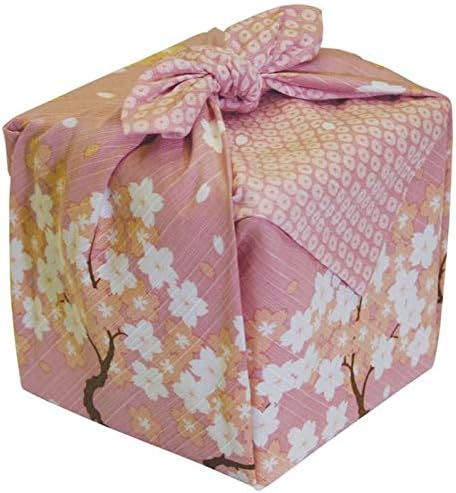
Furoshiki (風呂敷) is the Japanese practice of wrapping and carrying objects in a single square of cloth—reusable, infinitely adaptable, and entirely waste-free. Where wrapping paper is used once and discarded, a furoshiki cloth is used, washed, reused, given a different shape, and used again for years or decades.
Related guide: Furoshiki: The Japanese Art of Wrapping and the Philosophy of One Cloth
Furoshiki’s mottainai is the mottainai of refusal—the refusal to accept that wrapping must be disposable. A single furoshiki cloth replaces thousands of sheets of wrapping paper over its lifetime. It does not do this through sacrifice or inconvenience. It does this through elegance—the wrapping is more beautiful than paper, the knot more satisfying than tape, and the cloth itself becomes a gift within the gift.
The Trilogy Together
| Art | What breaks/wears | What mottainai does | What beauty results |
|---|---|---|---|
| Kintsugi | A ceramic bowl cracks | Repairs with gold | Golden seams that honor the history |
| Sashiko | A textile tears | Reinforces with patterned stitching | Geometric beauty stronger than the original |
| Furoshiki | Nothing breaks—wrapping paper would be created and wasted | Replaces disposable with reusable | Elegant cloth wrapping that outlasts thousands of paper alternatives |
These three arts are not separate traditions that happen to share a value. They are three expressions of a single philosophical conviction: the life of an object does not end at the point where a different culture would discard it. That point is not an ending. It is a threshold—and what lies beyond the threshold, if you bring care and attention to the crossing, is often more beautiful than what came before.
Mottainai Beyond Ecology
More Than Sustainability
Western media has largely framed mottainai as an environmental concept—Japan’s answer to the sustainability movement, a premodern anticipation of reduce-reuse-recycle. This framing is not wrong, but it is dangerously incomplete. It reduces a philosophy of respect to a strategy of resource management.
Mottainai is not about saving the planet. It is about seeing the world clearly—recognizing the convergence of effort, material, and time in every object, every experience, every relationship. When this recognition is present, sustainability follows naturally. You do not waste what you respect. But the goal is the respect, not the sustainability. The sustainability is a side effect.
Mottainai of Time
Time is the most irreversible mottainai. An hour spent in distraction cannot be recovered. An evening with a friend that you spent looking at your phone cannot be relived. The Japanese sensitivity to seasonal beauty—cherry blossoms that bloom for ten days, autumn leaves that peak for two weeks—is itself a form of temporal mottainai: the awareness that this moment of beauty will not return, and that failing to notice it is a waste more profound than any physical waste.
Related guide: Ichigo Ichie Meaning: “One Time, One Meeting” — Origins & Practice
Mottainai of Potential
There is a mottainai of unused talent, unexplored curiosity, unlived possibility. The book that sits unread on your shelf is mottainai—not because you wasted money, but because the encounter between your mind and those ideas has not yet happened, and it could be transformative. The skill you have not practiced, the conversation you have not started, the place you have not visited—each is a form of mottainai, a potential that exists but is not being honored.
This is mottainai at its most existential. It is not about objects at all. It is about the recognition that existence itself is a convergence of conditions so improbable that wasting any part of it—any hour, any ability, any relationship—is a failure of awareness.
Mottainai in Daily Practice
1. The Meal
In Zen monasteries, monks eat using ōryōki (応量器)—a set of nesting bowls that they clean by pouring hot water into the largest bowl, swirling it to collect every remaining particle of food, and drinking the rinse water. Nothing is left. Nothing is wasted. The meal ends with bowls so clean they require no washing.
You do not need ōryōki to practice this. Cook what you will eat. Eat what you cook. Use vegetable scraps for stock. Compost what remains. The practice is not deprivation—it is completion. The meal is not finished when you are full. It is finished when everything on the plate has been honored.
2. The Object
When something breaks—a button falls off a shirt, a handle loosens on a mug, a seam splits on a bag—pause before discarding it. Ask: can this be repaired? The repair need not be invisible. A visible mend, like sashiko, adds character. A replaced button in a contrasting color tells a story. The practice is not about saving money. It is about extending respect to the object by extending its life.
3. The Words
The most immediate way to practice mottainai is linguistic. Before meals, say itadakimasu (いただきます)—”I humbly receive.” After meals, say gochisōsama (ごちそうさま)—”it has been a feast.” These are not merely polite expressions. They are mottainai in verbal form—the acknowledgment that what you have received was not owed to you and that the labor and material that produced it deserve recognition.
Even if you say these words in English—”I receive this with gratitude” and “thank you for this meal”—the practice works. The words create a pause, and the pause creates awareness. That awareness is mottainai.
FAQ
Q: What does mottainai mean?
A: Mottainai (もったいない / 勿体無い) is a Japanese word expressing the sense that an object’s intrinsic dignity is not being respected—typically because it is being wasted, discarded, or used carelessly. It is often translated as “wasteful,” but this misses the word’s depth. Mottainai is not about efficiency. It is about respect—the recognition that every object carries the trace of the materials, labor, and conditions that created it, and that discarding it carelessly dishonors that history.
Q: Is mottainai the same as sustainability?
A: Mottainai and sustainability share common ground—both oppose waste. But they differ in motivation. Sustainability is typically framed as resource management: reduce waste to protect the environment. Mottainai is framed as respect: honor the intrinsic value of what exists. When you practice mottainai, sustainable behavior follows naturally—but the driving force is reverence for objects and experiences, not environmental strategy. Mottainai predates the sustainability movement by centuries.
Q: How is mottainai connected to Buddhism?
A: Mottainai is rooted in the Buddhist concept of engi (縁起, dependent origination)—the teaching that everything exists as a temporary convergence of causes and conditions. A grain of rice is sunlight, water, soil, and human labor made edible. To waste it is to disregard everything that converged to create it. In Zen monasteries, mottainai is a daily practice—monks use every part of every vegetable, mend every garment, and clean their eating bowls by drinking the rinse water.
Q: How does mottainai relate to KonMari?
A: Marie Kondo’s method asks whether an object “sparks joy” and suggests discarding what does not. Mottainai asks a different question: does this object still have life in it? Mottainai would not discard a functional but joyless object—it would repair it, repurpose it, or give it to someone who needs it. The two approaches are complementary rather than contradictory: KonMari clarifies what you value, and mottainai ensures that what you release is honored rather than simply thrown away.
Q: How can I start practicing mottainai today?
A: Three immediate actions: first, repair one broken object instead of replacing it. Second, finish the food on your plate—or serve yourself less. Third, replace one disposable item in your life with a reusable alternative (a furoshiki cloth for gift wrapping, a ceramic cup for takeaway coffee, a cloth napkin for paper). The practice is not about perfection—it is about attention. Each small act of mottainai trains the awareness that everything you touch has a history and a dignity.
What Every Object Carries
Every object you own was, at some point, part of the earth. The wooden table was a tree. The ceramic mug was clay. The cotton shirt was a plant growing in a field. The book was a forest. Something was taken from the world to make each of these things, and someone’s labor shaped it into the form you now hold.
Mottainai is the awareness of this history—not as an abstract fact but as a felt reality. When you hold a bowl and know, even faintly, that it was once earth and water and fire, you hold it differently. You set it down more carefully. You wash it with more attention. And when it breaks, you do not reach for the trash. You reach for gold.
Comprehensive guide: Wabi Sabi : The Japanese Philosophy of Finding Beauty in Imperfection
This is what mottainai teaches, beneath all the environmental implications and the cultural history: everything you touch was made from something, by someone, for some purpose. That convergence—of material and labor and intention—is not trivial. It is, in the Buddhist sense, miraculous. And the appropriate response to a miracle, however small, is not carelessness.
It is care.
References
- Sasaki, F. (2017). Goodbye, Things: The New Japanese Minimalism. W. W. Norton.
- Koren, L. (1994). Wabi-Sabi for Artists, Designers, Poets & Philosophers. Imperfect Publishing.
- Suzuki, D. T. (1959). Zen and Japanese Culture. Princeton University Press.
- Maathai, W. (2010). Replenishing the Earth: Spiritual Values for Healing Ourselves and the World. Doubleday.
- Ministry of the Environment, Japan. (2005). Mottainai: The 3R + Respect Campaign. Government of Japan.
- Juniper, A. (2003). Wabi Sabi: The Japanese Art of Impermanence. Tuttle Publishing.