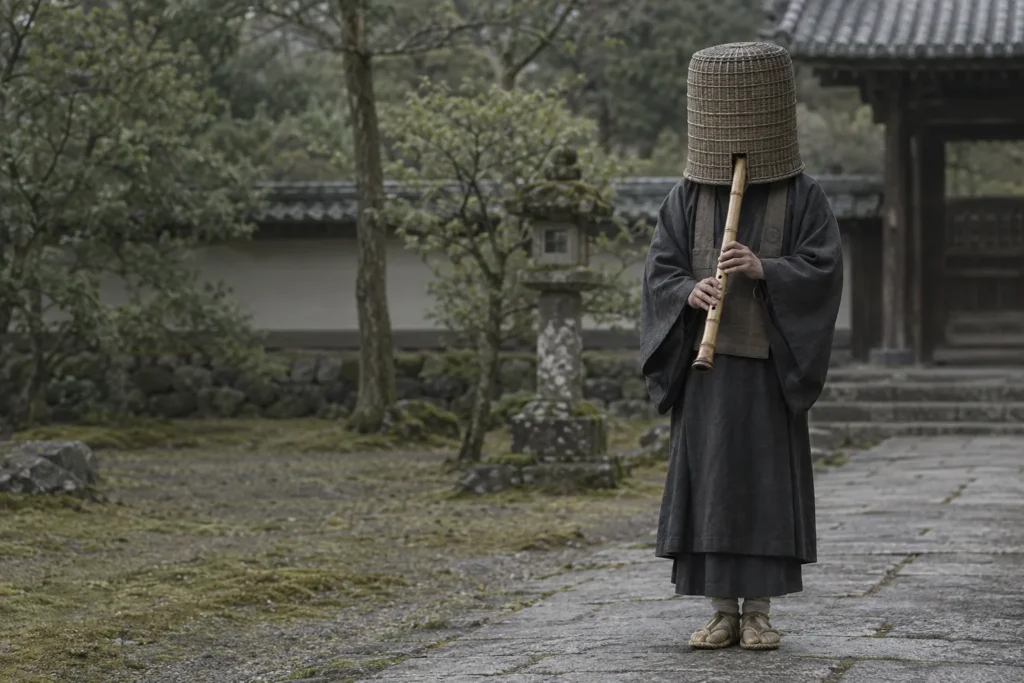
Picture a street in Edo-period Japan. A figure walks slowly toward you, his entire head hidden inside a deep basket woven from reeds. You cannot see his face. You can only hear what he carries: a long bamboo flute, and a single, breathy tone that seems to rise out of the ground and fade into the air.
He is a komusō (虚無僧), a “monk of emptiness,” and the instrument is the shakuhachi (尺八). For these wandering monks, the flute was not an instrument for entertainment. It was a way of meditating with the breath, and every sound they played was meant to be a complete act of practice.
The shakuhachi is a Japanese end-blown bamboo flute with four finger holes on the front and one on the back, traditionally cut from the root end of a bamboo stalk. It is known for its breathy, expressive tone, and for its long association with Zen, where playing it was called suizen (吹禅), “blowing Zen.”
This guide explains what the shakuhachi is, why it became a tool of Zen practice, where it came from, how to listen to its classical solo music, and how to choose a first instrument if you want to play.
What Is a Shakuhachi?
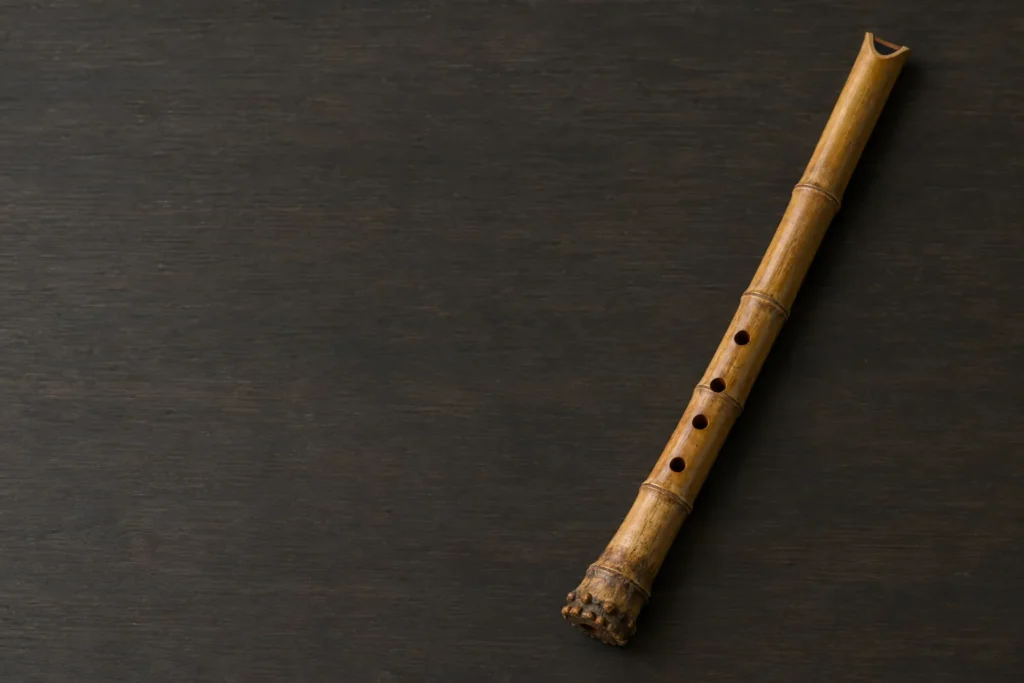
The name describes the instrument’s size. A shaku (尺) is an old Japanese unit of length, close to a foot, and hachi (八) means eight, short for eight sun (寸), or eight tenths of a shaku. One shaku eight sun comes to about 54.5 centimeters, roughly 21.5 inches, and that is the standard length of the instrument today. Longer and shorter flutes exist as well; each change of about one sun shifts the pitch by roughly a semitone.
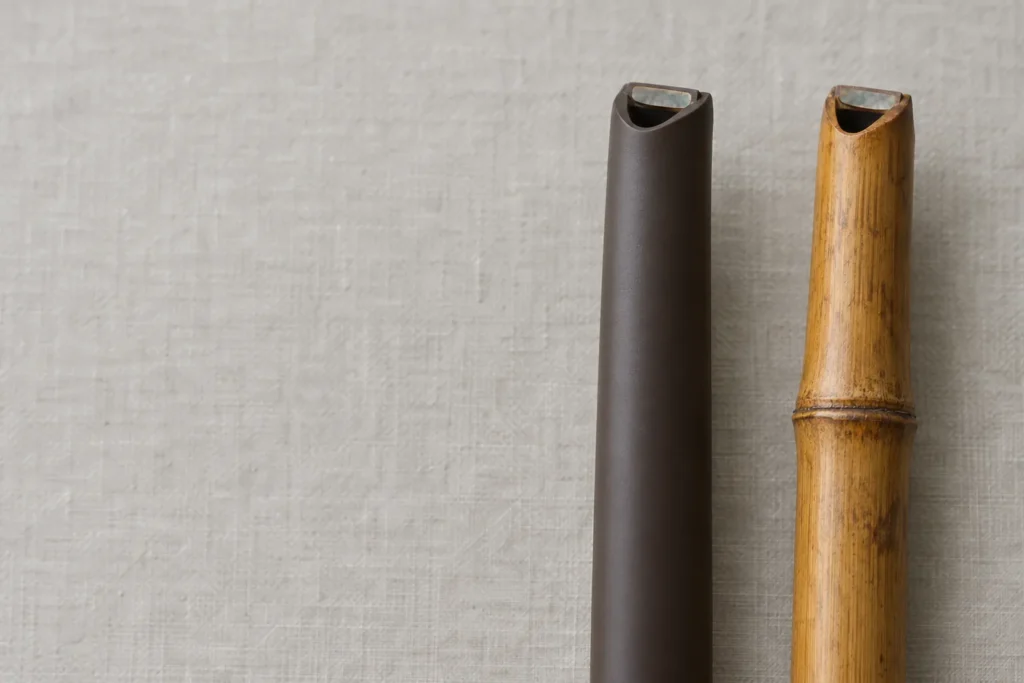
At first glance the shakuhachi looks almost primitive: a single piece of bamboo with five holes. The secret lies at the top. Instead of a reed or a whistle-like mouthpiece, the player blows across a sharp, angled edge called the utaguchi (歌口, “song mouth”). There is nothing to fix the airstream in place, so every aspect of the sound—its pitch, color, volume, and the amount of breath noise—depends on the angle of the player’s lips and head.
This is what gives the shakuhachi its range of expression. By dropping the chin, a technique called meri (メリ), the player lowers a note and darkens it; by raising the chin, called kari (カリ), the note rises and brightens. A good player can bend a single tone through shades that Western flutes rarely attempt, and can let the rush of breath itself become part of the music. Beginners often struggle for weeks just to produce a steady sound, which is one reason the shakuhachi has a reputation as a demanding instrument.
Breath as Practice: Suizen
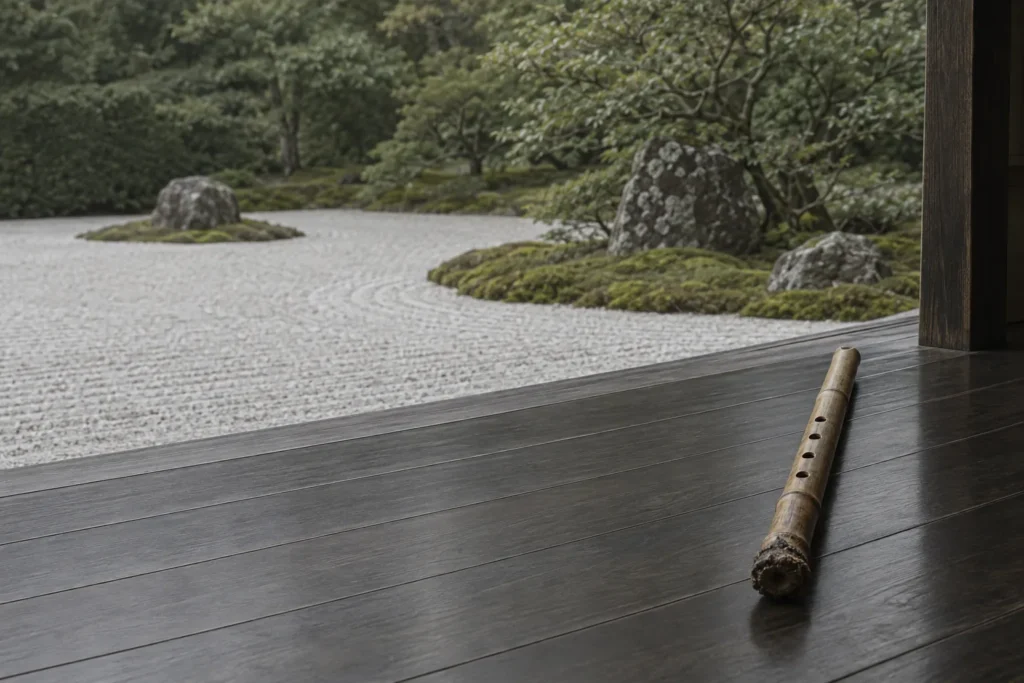
Why would a flute become a form of Zen practice? The answer lies in the breath.
In zazen (坐禅), the breath is the anchor of attention: you sit still and return, again and again, to the simple fact of breathing in and breathing out. The shakuhachi turns that same breath into sound. Each long tone lasts exactly as long as one exhalation, and when the breath ends, the tone ends. The player cannot hide distraction. If the mind wanders, the sound wavers; if the body is tense, the tone becomes thin. In this sense the flute works like a mirror, much as zazen does, showing the player the state of their own mind in real time.
The komusō called this practice suizen, “blowing Zen,” and they expressed its ideal in a phrase often linked to the tradition: ichion jōbutsu (一音成仏), “attaining buddhahood in a single sound.” The point is not to play beautiful melodies. It is to put one’s whole being into one tone, so completely that there is no separation between the player, the breath, and the sound.
Equally important is what happens between the tones. Classical shakuhachi music is full of pauses, each one as long as an in-breath. Japanese aesthetics calls this kind of meaningful interval ma (間). It is the same principle that gives a few stones their weight in a Zen garden. Listening to the silence between shakuhachi notes, many people feel the quality the Japanese call yūgen (幽玄): a depth that is felt more than heard.
A Brief History of the Shakuhachi
From the Chinese Court to Nara
End-blown bamboo flutes reached Japan from China around the end of the seventh century, together with the court music known as gagaku. Several of these early instruments survive in the Shōsōin, the eighth-century imperial treasure house in Nara. They differ from the modern shakuhachi: they have six finger holes rather than five and are made from thinner bamboo. For several centuries they were used in court ensembles, and then they gradually fell out of use.
By the fifteenth and sixteenth centuries, a shorter flute called the hitoyogiri was played by wandering monks and entertainers, and appears in stories about figures such as the eccentric Zen master Ikkyū (1394–1481). It was in the hands of wandering mendicants, rather than courtiers, that the bamboo flute began its association with Zen.
The Fuke Sect and the Komusō
The tradition most people associate with the shakuhachi took shape in the Edo period (1603–1868), around groups of mendicant monks who played the flute as they begged for alms. Many were former samurai who had lost their masters in the wars of the late sixteenth and early seventeenth centuries. They came to be called komusō, and their temples formed what later became known as the Fuke sect (普化宗), loosely affiliated with Rinzai Zen.
The sect told a striking story about its own origins. It traced itself to Puhua (Fuke in Japanese), an eccentric Chinese Chan monk of the ninth century who was said to wander the streets ringing a bell. According to the same tradition, the Japanese monk Shinchi Kakushin (1207–1298), who studied in China, brought this lineage and its music back to Japan. Kakushin is still honored with shakuhachi performances at Kōkoku-ji in Wakayama, the temple he later headed. Modern historians, however, treat the story as legend: it appears in a sect history written in the late eighteenth century, and Kakushin’s own records do not mention the flute.
The komusō’s privileges were equally colorful. The shogunate allowed them to travel freely between checkpoints, and they alone had the right to play the shakuhachi while collecting alms. Their most famous charter, dated 1614, is now considered a later forgery, but the authorities treated it as genuine for generations. The woven basket hat, called a tengai (天蓋), hid each monk’s identity—a symbol of the dissolved ego, and, critics noted, a convenient disguise for spies and fugitives.
Unlike the Rinzai monks who sat with a koan in the meditation hall, the komusō made the street their meditation hall and the flute their practice. Over two centuries they developed a large body of solo pieces, known as honkyoku (本曲), “original music,” which they regarded not as compositions but as religious exercises.
Abolition and Revival
The Meiji government, set on modernizing Japan and reducing the power of Buddhist institutions, abolished the Fuke sect in 1871. For a short time, playing the shakuhachi for religious purposes was banned outright.
The music survived through teachers who reorganized it as a secular art. The Kinko school, descended from the eighteenth-century player Kurosawa Kinko (1710–1771), who had collected honkyoku from Fuke temples across Japan, preserved much of the classical repertoire. In 1896 Nakao Tozan founded the Tozan school in Osaka, composing new music and placing the shakuhachi in ensembles with the koto and shamisen. Today Tozan and Kinko are the two largest schools, while groups often called Myōan lineages continue the older temple pieces. In the twentieth century the shakuhachi traveled abroad, and it is now taught and played on every continent.
Honkyoku: How to Listen
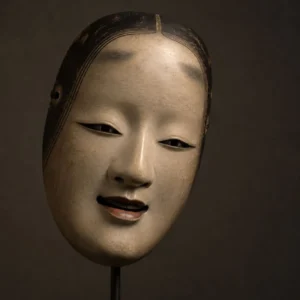
The core repertoire of the shakuhachi is honkyoku, the solo pieces handed down from the komusō. To a first-time listener they can sound slow or even formless. They are better heard the way you would watch a Noh theater (能) performance: not as a melody to follow, but as a sequence of single gestures, each complete in itself.
When you listen, try paying attention to three things:
- The breath. Notice the breath noise at the start of a tone and the way the sound swells and fades. In honkyoku the breath is not a flaw to be hidden; it is part of the music.
- The bends. Listen for meri and kari, the slow lowering and raising of pitch within a single note, and the sharp grace notes that colour a phrase.
- The silence. Pay as much attention to the pauses as to the sounds. Like a haiku, a honkyoku phrase says a little and leaves a great deal unsaid.
Three Pieces to Start With
- Kyorei (虚鈴, “Empty Bell”). One of the oldest and most sacred pieces, said to recall the bell that Puhua rang through the streets. It is slow and austere, and many players treat it as a meditation rather than a performance.
- Shika no Tōne (鹿の遠音, “Distant Cry of the Deer”). Often played as a duet, with two flutes answering each other like deer calling across autumn mountains. It is a good first piece because the call-and-response structure is easy to follow.
- Tsuru no Sugomori (鶴の巣籠, “Nesting Cranes”). A more pictorial piece, using fluttering techniques that evoke the movement of cranes. It shows how much variety a single bamboo flute can produce.
Recordings of all three are widely available. For a personal introduction to the instrument and its music, Christopher Yohmei Blasdel’s The Single Tone recounts his years of study in Japan with the master Yamaguchi Gorō and explains the ideas behind the music in plain language.
Where to Hear It
The most memorable way to hear honkyoku is at one of the temples that keep the komusō tradition alive. Myōan-ji, a small temple within the grounds of Tōfuku-ji in Kyoto and the former head temple of the Fuke sect, continues to transmit the old temple pieces, and komusō performances are offered at temples such as Kōkoku-ji in Wakayama on special occasions. If you are visiting the city’s Zen temples in Kyoto, a short hands-on shakuhachi session is a memorable way to feel how hard it is to make that first sound.
Choosing Your First Shakuhachi
Length
Start with the standard 1.8 (one shaku eight sun) flute. Almost all teaching materials are written for it, and its finger holes are spaced comfortably for most adult hands. Longer flutes, such as the 2.4, have a deeper, darker voice but stretch the fingers and demand more air.
Material and Price
Shakuhachi are made from three main materials:
- Bamboo. The traditional material. Each flute is made by hand from a single stalk, so no two are alike, and good bamboo flutes are expensive; instruments by respected makers can cost thousands of dollars.
- Wood. Turned wooden flutes are more stable than bamboo and usually cost less, though their tone is somewhat different.
- Resin or plastic. Molded from a precise design, these are inexpensive, durable, and consistent in pitch. They are the most practical choice while you learn whether the instrument suits you, and many experienced players keep one for travel.
Bamboo flutes also come in two styles. A jiari (地有り) flute has its bore lined and shaped with a paste called ji, giving reliable pitch and a strong tone; it is the standard for ensemble playing. A jinashi (地無し) flute keeps the natural bore of the bamboo, with a rawer, more variable sound favored by some honkyoku players. For a beginner, the difference matters less than simply having an instrument that makes a sound reliably. An affordable resin flute in the standard 1.8 length is the easiest way to start.
Caring for Your Flute
Bamboo is a living material, and it reacts to its surroundings. The most common cause of damage is a crack caused by rapid changes in temperature or humidity, so a few simple habits go a long way. In cold weather, warm the flute in your hands for a minute before playing, so that warm breath does not hit cold bamboo. After playing, pull a soft cloth swab through the bore to remove moisture, and let the flute dry at room temperature rather than next to a heater. Store it in a cloth bag or case, away from direct sunlight, air conditioning vents, and car interiors on hot days. Wooden flutes need similar care, while resin flutes need little more than an occasional wipe, which is another reason they make a good first instrument. Treating the flute this way is also part of the tradition: the komusō regarded the instrument not as a tool but as a companion in practice.
Learning to Play
The shakuhachi rewards patience. Expect to spend your first sessions just finding a clear tone: cover the holes, rest the edge of the utaguchi against your chin, and adjust the angle of your lips and the instrument until the breath turns into sound. Short daily practice is far more effective than occasional long sessions.
Many players learn their first notes from books and online videos, but a teacher makes a great difference, especially for honkyoku, which is traditionally passed on by ear from teacher to student. The International Shakuhachi Society maintains an extensive online directory of teachers, pieces, and recordings around the world, and many teachers now offer online lessons.
The Single Tone
The komusō are gone, and their basket hats now appear mostly in festivals and period films. But the idea they carried is still available to anyone with a length of bamboo and a little patience: that a single breath, fully attended to, can be a complete practice. You do not need to master the repertoire to feel it. Play one long tone, listen to it fade, and listen to the silence that follows.
FAQ
Q: What is a shakuhachi?
A: The shakuhachi (尺八) is a Japanese end-blown bamboo flute with four finger holes on the front and one on the back. It is known for its breathy, expressive tone and for its long association with Zen Buddhism, where wandering komusō monks played it as a form of meditation called suizen, or “blowing Zen.”
Q: Why is it called shakuhachi?
A: The name refers to its standard length. A shaku is an old Japanese unit of about 30 centimeters, and hachi means eight, short for eight sun (tenths of a shaku). One shaku eight sun is about 54.5 centimeters, or roughly 21.5 inches.
Q: Is the shakuhachi hard to learn?
A: It is challenging at first. Because the player blows across an open edge rather than into a reed or whistle, producing a steady tone can take days or weeks. Once you can make a sound reliably, progress becomes much faster, and a teacher helps a great deal.
Q: What is honkyoku?
A: Honkyoku (本曲), “original music,” is the classical solo repertoire of the shakuhachi, developed by the komusō monks of the Fuke sect. The pieces were regarded as religious exercises rather than entertainment, and they emphasize breath, subtle changes of pitch, and silence. Kyorei and Shika no Tōne are well-known examples.
Q: How much does a shakuhachi cost?
A: Prices vary widely. Resin and plastic beginner flutes are inexpensive, wooden flutes are moderately priced, and handmade bamboo flutes by respected makers can cost thousands of dollars. Most teachers recommend starting with an affordable 1.8-length flute before investing in bamboo.
References
- Blasdel, C. Y. (2005). The single tone: A personal journey into shakuhachi music. Printed Matter Press.
- Japan Tourism Agency. (n.d.). The Fuke school of Buddhism, shakuhachi, and komuso. Multilingual Commentary Database.